


1. Introduction
2. Color Management of Printed Patterns
3. Case Study
3.1 Experimental equipment
3.2 Experimental methods
3.3 Experimental results
4. Conclusions
1. Introduction
As an important carrier of traditional Chinese culture, tea not only carries profound historical depth and cultural connotations but also gradually moves towards marketization and branding [1,2]. With the improvement of consumers’ aesthetic awareness and purchasing decision-making ability, tea packaging is no longer just a container for products but has become an important medium for brand communication, cultural expression, and visual communication [3,4]. Paper packaging has become the mainstream choice for tea packaging due to its advantages, such as environmental friendliness, strong malleability, and good printability. In the design process of tea paper packaging, image color is a key factor influencing consumers’ first impression and brand recognition. Excellent color representation can not only accurately convey the brand concept and product features but also stimulate consumers’ desire to purchase and enhance the brand’s market competitiveness. However, in the actual printing process of packaging images, due to the influence of various factors such as software, display devices, printing techniques, and paper materials, the colors of the printed images may deviate from the image colors of the original design [5]. For this reason, it is necessary to use color management techniques to ensure that the color of images remains consistent throughout the entire process from design to printing of tea paper packaging. In order to meet the color control requirements in the paper manufacturing process, Horikoshi et al. [6] used online measurement of paper chromaticity in the papermaking process to ensure strict paper color quality control. In the process of printing pictures, Bo [7] explored and studied the development of graphic design using the support vector mechanism theory in order to print the colors used in the design process clearly without color difference. Wang et al. [8] proposed a new color matching method and matched the printing paste according to the color of the paper card printed by the inkjet printer. Zhu et al. [9] proposed a method for predicting the color of silk digital printing using the Pix2Pix generative adversarial network framework. They discovered that this method can predict the color of silk digital printing samples and effectively reproduce the inkjet printing effects of silk fabrics, such as silk crepe satin and silk twill. Milković et al. [10] studied the influence of horizontal and vertical parallel lines on chromatic assimilation using the Munker-White grid model and revealed the changes in color perception caused by surface texture. Wang et al. [11] proposed a new physically constrained deep learning framework for high-precision safety ink colorimetry. The advanced attention mechanism improved the feature extraction efficiency by 58.3%, and the Bayesian optimization framework ensured robust parameter adjustment. This paper briefly introduces the color management of printed patterns on paper packaging and applies the back-propagation neural network (BPNN) algorithm improved by a genetic algorithm (GA) to convert the design pattern color from the CIELAB color space to the CMYK color space for replication and printing by the printing equipment. Moreover, simulation experiments were conducted. The novelty of this paper lies in using a deep learning algorithm to achieve the color space conversion of printed patterns, making the color space suitable for printing devices after conversion closer to the original color, and using the GA to optimize the parameters of the deep learning algorithm to improve its conversion accuracy. The limitation of this paper is that the model of the printing device used when testing the color space conversion algorithm was fixed, making it difficult to verify algorithm generality. Therefore, future research will focus on expanding the types of printing devices to improve the generality of the proposed algorithm.
2. Color Management of Printed Patterns
In the technical field of color printing, the color separation algorithm is a process of decomposing an image in other color spaces into four types of ink dots, namely cyan, magenta, yellow, and black, which are available for printing. Its core objective is to achieve a high-fidelity restoration from the color of an original image to the printing color. Traditional color separation algorithms include the polynomial regression color separation algorithm and the Neugebauer color separation algorithm [12]. The Neugebauer color separation algorithm is based on the color block mixing model. It is believed that there are eight basic color combinations in the printing dots, and each combination corresponds to a basic color block. By performing a weighted average of the tristimulus values of the eight basic color blocks and the dot area percentage, the printing color under any dot can be predicted. The advantages of this color separation algorithm are as follows: it is a summary of the actual printing phenomena of printing dots and has a clear physical meaning; only weighted average operations need to be performed on eight basic color blocks; it has a standardized foundation. Its defects are as follows: it uses linear operations during calculation, but the actual printing process is affected by non-linear factors; the color separation calculation result of this algorithm is ideal and does not consider the influencing factors in actual printing; when the printing equipment is extended to six-color or seven-color printing, the number of basic color blocks will increase exponentially, increasing the amount of calculation.
The polynomial regression color separation algorithm is a data-driven black-box model [13]. It establishes a mathematical relationship between the input color space parameters and the output color space parameters through fitting experimental data, and utilizes this relationship to predict the printing color of dots. The advantages of this color separation algorithm are as follows: it has high prediction accuracy and can capture the non-linear effects in the actual printing process; it can meet the printing requirements of six-color or seven-color printing devices; it has sufficient adaptability to effectively cope with the changes in factors such as printing devices, paper, and inks. Its defects are as follows: the black-box model does not have physical interpretability; the establishment of the mathematical relationship depends on high-quality sample data; there is a risk of overfitting during the establishment of the data relationship.
The printing process for tea paper packaging images is shown in Fig. 1. The specific steps are shown below.
① The image to be printed is input into the upper computer of the printing device.
② The upper computer uses a color gamut mapping algorithm [14] to map the color gamut of the image to the color gamut range that the printing device has. The segment-guided color mapping (SGCK) algorithm is used, and the mapping formula is:

where, is the lightness of the source color point, is the lightness after mapping, is the weight related to the chroma of the source color point, is the value at the position in the normal distribution discrete cumulative function , is the lightness mapped from the position in the primary color gamut lightness range to the target color gamut lightness range [15]. is normalized to the range of [0,100]. Based on the normalized value, at the percentile of the corresponding can be obtained from , and this is .
③ The color of the image is converted from the CIELAB color space [16] to the CMYK color space of the print device. The CMYK is the four ink-feeding channels of the print device, each of which provides a primary color, C for cyan, M for magenta, Y for yellow, and K for black. The desired color can be printed by controlling the amount of ink given to each dot in the four ink-feeding channels, and the CMYK color space shows the amount of ink given to each ink-feeding channel. There are various algorithms for converting CIELAB to CMYK, such as the Neugebauer color separation algorithm and the polynomial regression color separation algorithm. In this paper, the BPNN algorithm [17] is ultimately chosen to implement the color space conversion, and the GA is adopted for improvement. When training the GA-BPNN algorithm, a chromosome population is randomly generated first, each chromosome representing a parameter scheme of the BPNN, which is then substituted into the BPNN. Then, the value of the color block sample in the CIELAB color space is input into the BPNN, and then forward calculation is performed in the hidden layer:
where, is the hidden layer output, is the input sample, is the weight, is bias, and is the activation function. The calculation result of the hidden layer outputs the value of the CMYK color space in the output layer. The calculated by the BPNN algorithm is then compared with the actual of the color block sample, and the deviation is used as the fitness value of the chromosome. The lower the fitness value, the better the parameter scheme represented by the chromosome. If the fitness value of the chromosome population converges to stability, the BPNN parameter represented by the optimal chromosome is output; otherwise, the chromosome population is genetically adjusted to obtain a new population, and the chromosomes of the new population are substituted into the BPNN algorithm for forward calculation again. The process is repeated until the fitness value of the chromosome population converges to stability. After the training is over, the image that has undergone gamut mapping in step ② is input into the GA-BPNN algorithm to convert the colors of the image pixels from the CIELAB color space to the CMYK color space.
④ The printing device controls the amount of primary color ink supply volume of the inkjet nozzle based on the CMYK values of the image pixels to print the image onto the tea packaging paper.
3. Case Study
3.1 Experimental equipment
The printing equipment used was a color inkjet printer (HP, DeskJet1212). Kewei brand 680 color ink and coated paper were used [18]. A colorimeter (DS-100, Color Spectrum Technology Co., Ltd., China) was used to measure the print color.
3.2 Experimental methods
The ECI2002 standard color scale was retrieved from ProfileMaker, a professional color management software developed by Monaco. The color blocks in the standard color scale were printed using another tuned color inkjet printer. The LAB value of the printed color blocks was measured using a colorimeter. The CMYK values of the printer were recorded when printing the color blocks. Each color block was a sample. A total of 1,485 samples were collected; of these samples, 1,000 were used for training, and the remaining 485 were used for testing.
The relevant parameters for the GA-BPNN algorithm used to convert the CIELAB color space of the image to the CMYK color space are as follows. The chromosome population size was set to 15. Two best chromosomes in the selection operation were selected to enter the offspring. Single-point crossover operations with a probability of 0.6 and single-point mutation operations with a probability of 0.2 were used. The number of iterations was 200. The BPNN input layer had three nodes, the hidden layer had 64 nodes, and the output layer had four nodes. The sigmoid activation function was used.
When testing the color space conversion algorithm, the printer printed out the color blocks in the test sample based on the CMYK values converted by the GA-BPNN algorithm. To test its stability, one, two, three, four, and five color blocks were printed on one sheet of paper, respectively, and the colorimeter was used to detect the deviation between the LAB values of the printed color blocks and the actual values. In addition, to further verify the performance of the GA-BPNN algorithm, it was compared with the Neugebauer color separation algorithm and the polynomial regression color separation algorithm.
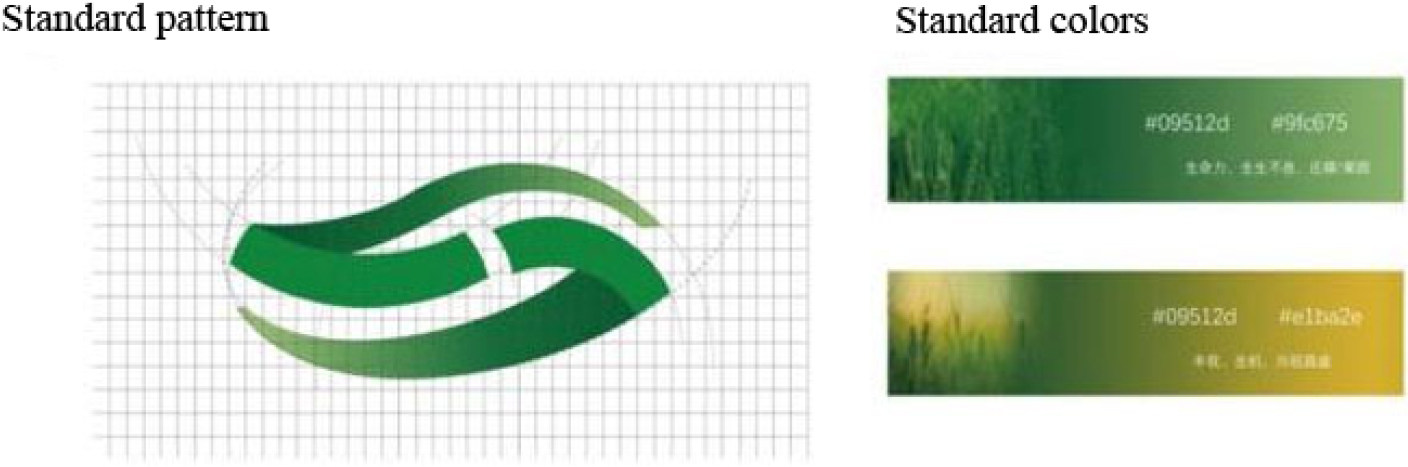
After the above tests, it was applied to the printing of tea paper packaging, and the design of the pattern on the packaging is shown in Fig. 2. The pattern elements were extracted from tea leaves, farm tools, and letters. The overall shape of the pattern is leaf, and it can be divided into two small hoes. The line direction of the pattern was a variation of “S” and “H”. Colors #09512d, #9fc675, and #e1ba2e were chosen.
3.3 Experimental results
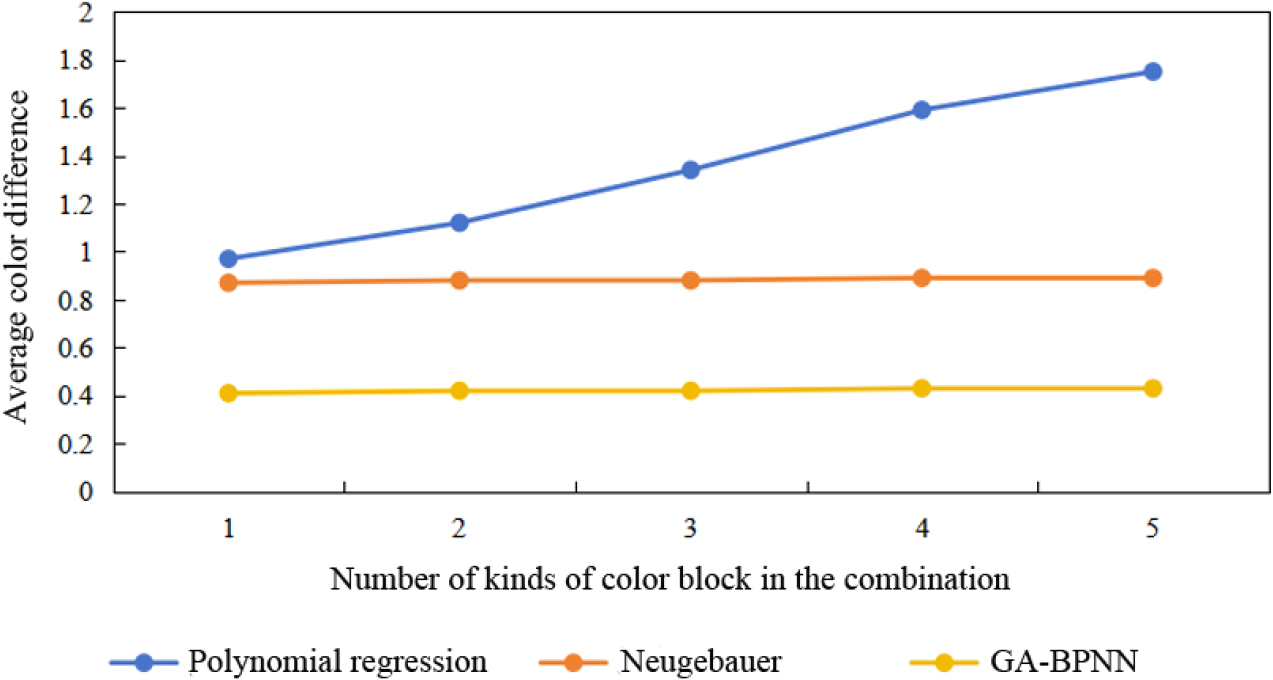
Three different color separation algorithms were used to print different combinations of color blocks, and the color difference between the printed color blocks and the original ones was used to compare the print performance among the three algorithms, as shown in Table 1 and Fig. 3. It can be seen that as the number of color block types in the combination increased, the color difference between the color blocks printed by the polynomial regression algorithm and the original color blocks increased significantly, while the Neugebauer algorithm and the GA-BPNN algorithm increased, but not significantly. For combinations with the same number of color block types, the color blocks printed under the polynomial regression algorithm had the largest color difference, followed by those printed under the Neugebauer algorithm, and the color blocks printed under the GA-BPNN algorithm had the smallest color difference.
Table 1.
Comparison of the printing performance between three color separation algorithms for different combinations of color blocks
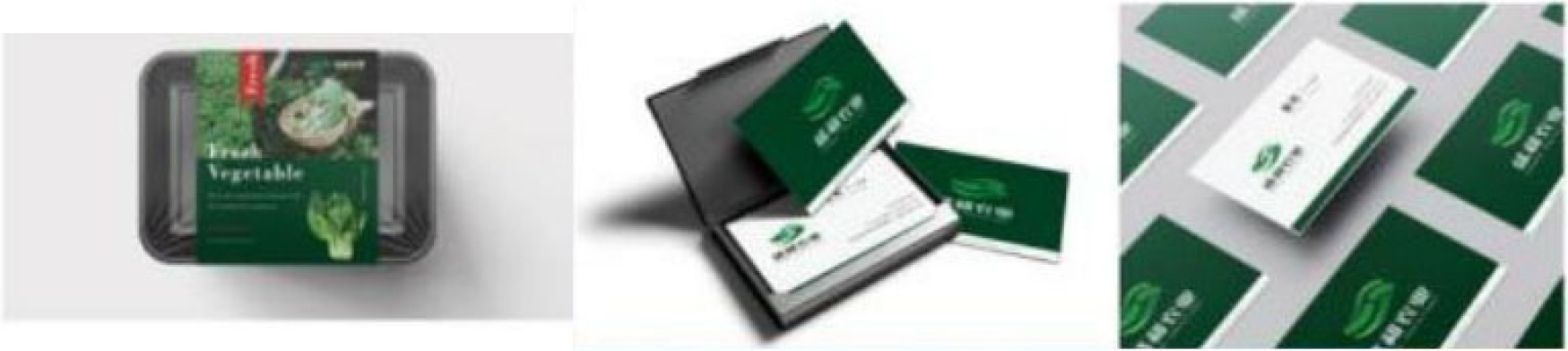
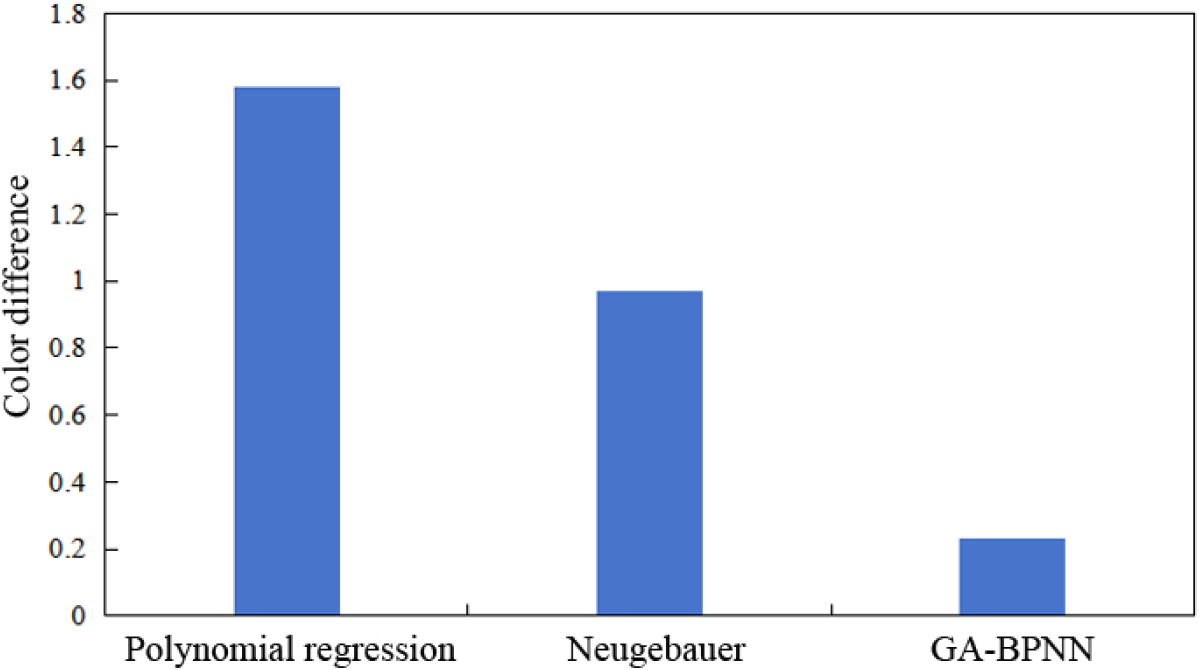
The application of the designed pattern to paper packaging is shown in Fig. 4. It was printed using the three color separation algorithms mentioned earlier respectively. For the printed product, in addition to using a colorimeter to test the color difference between the printed and design patterns, this paper also invited ten evaluators to compare the color difference between them. The evaluation was scored from 1 to 5, with higher scores indicating greater differences. The final results are shown in Table 2 and Fig. 5. As can be seen from Fig. 4, the pattern was applied to the packaging of the tea gift box, printed on the surface of the box, on the paper card inside the gift box, or on the paper tape that fixed the plastic box. It can be seen from Table 2 and Fig. 5 that the printing color difference of the GA-BPNN algorithm was the smallest, and the difference was also the smallest in manual scoring, and the comparison results were consistent with the test results in the previous text.
4. Conclusions
This paper chooses the BPNN algorithm improved by a GA to achieve the conversion of the design pattern color from the CIELAB color space to the CMYK color space for the reproduction and printing by the printing equipment, followed by simulation experiments. During the experiment, comparisons were made with the polynomial regression and Neugebauer color separation algorithms. Finally, an evaluation was made on the printed pattern designed in this paper. The printed pattern under the GA-BPNN algorithm demonstrated smaller color differences and was more stable. For the designed tea packaging pattern, the GA-BPNN algorithm showed the smallest printing color difference, and the difference was also the smallest in the manual scoring. The contribution of this paper lies in using the BPNN algorithm to convert the image color space, providing an effective reference for improving the printing color effect. The limitation of this paper is that the model of the printing equipment used when testing the color space conversion algorithm was fixed, making it difficult to verify algorithm generality. Therefore, future research will focus on expanding the types of printing equipment to improve the generality of the proposed algorithm.