


1. Introduction to Paper Sludge and Its Use
2. Ash Fractionation and Enzymatic Hydrolysis of Paper Sludge
2.1 Ash fractionation and its effect on the sugar yield
2.2 Ash effect in other biomass types
3. Dehydration of Pure Sugars into Furan Chemicals
3.1 Reaction mechanisms and pathways for pure glucose dehydration to HMF
3.2 Dehydration of pure xylose into furfural
3.3 Catalyst systems and coordination mechanisms for pure sugar dehydration
4. Conclusions and Future Perspectives
1. Introduction to Paper Sludge and Its Use
In the pulp and paper industry, various solid waste streams are generated throughout the manufacturing process, including debarking and chipping rejects, boiler and furnace ash, causticizing residuals, and wastewater treatment sludges [1]. Among these waste streams, paper sludge represents the solid fraction recovered during effluent treatment. Primary sludge, typically isolated via sedimentation or flotation, mainly consists of cellulose fibers, fines, and inorganic fillers. Considering the massive scale of paper production, with over 67 million tons of paper and paperboard generated annually in the United States, approximately 50 kg of oven-dried paper sludge is generated per ton of paper produced, equating to roughly 8 million wet tons annually with a moisture content within 50 wt% [2].
The amount of sludge generated and chemical composition of paper sludge vary significantly depending on raw materials, pulping and papermaking process, and targeted paper grades (Table 1). Evaluating key physical and chemical properties, such as moisture content, ash content, heating value, fiber length distribution, particle size distribution, and pH, is essential for establishing appropriate sludge disposal and valorization strategies [3]. Among these properties, ash content plays a decisive role; a high ash fraction markedly lowers the heating value during incineration and presents operational challenges for biochemical or chemical downstream processes [4,5]. The inorganic matrix of paper sludge predominantly consists of Ca, Si, Al, Fe, Mg, and Ti [6,7]. Among these elements, calcium is typically detected as the most abundant inorganic species because calcium carbonate (CaCO3) is extensively used as a filler and coating pigment to enhance paper brightness and opacity [5,8]. When recycled fibers are utilized as a primary raw material for papermaking, Al and Si are also detected due to the presence of kaolin clay fillers.
Table 1.
Average paper sludge amount across different paper grades and raw material sources [1]
| Paper grade | Sludge (kg/ton) | ||
| Wood only | Recycled paper | Both | |
| Unbleached | 4.3 | 4.3 | 4.3 |
| Newsprint | 57 | 164 | 69 |
| Tissue | 33 | 406 | 382 |
| Printing & writing | 62 | 187 | 165 |
| Specialty | 45 | 12 | 11 |
The conventional management of paper sludge involved disposal methods such as landfill, lagoon, land application (i.e., composting via mineralization and humification of organic matter), and incineration for energy recovery. However, heightened environmental concerns, escalating capital costs, limited landfill capacity, and stringent air pollution regulations have severely constrained these traditional management practices [9]. Consequently, substantial research efforts have shifted toward valorizing paper sludge into higher value-added products such as ethanol [10,11,12], lactic acid [13,14], activated carbon [7,15], building material [16,17], and others [18].
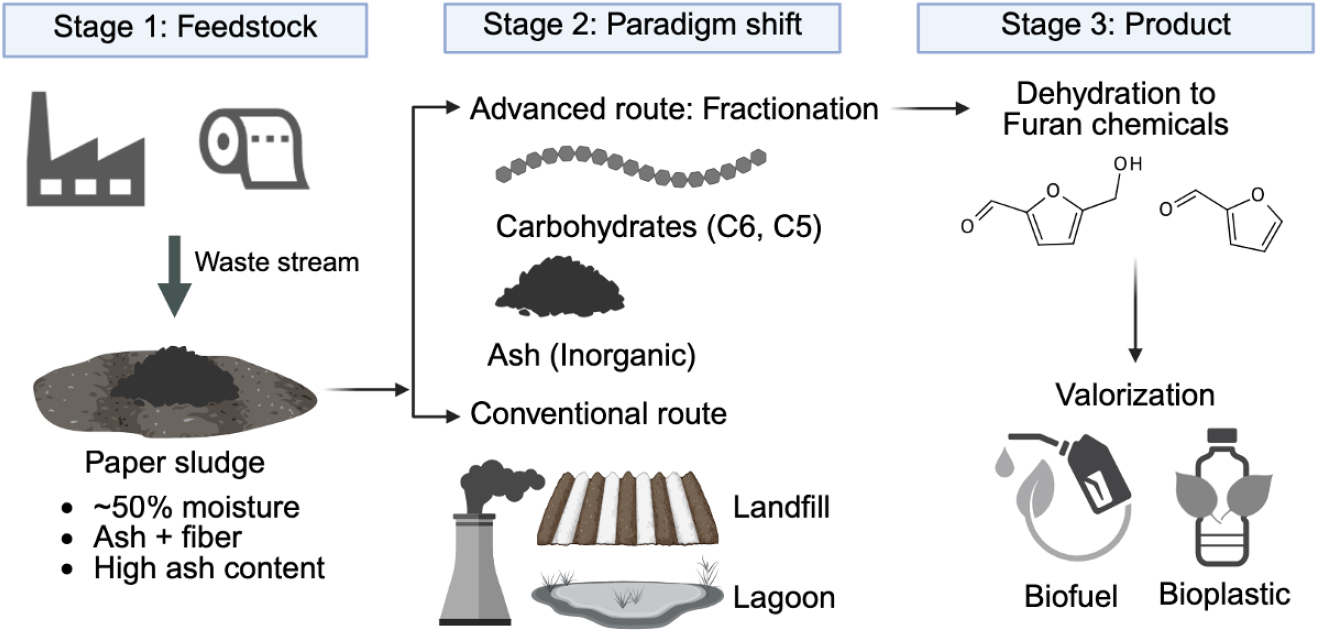
Direct studies on the catalytic dehydration of paper sludge-derived sugars into furan platform chemicals remain limited. Nevertheless, as conceptualized in Fig. 1, converting recoverable sugars from paper sludge into furan platform chemicals could provide a promising pathway toward value-added products, including biofuels and bioplastics, while expanding paper sludge valorization beyond conventional disposal and lower-value applications. Paper sludge has been extensively investigated with respect to its composition, ash removal, carbohydrate recovery, and enzymatic hydrolysis, while a much broader body of literature has established the catalytic dehydration chemistry of pure glucose and xylose. Therefore, this review integrates these two bodies of knowledge to evaluate paper sludge as a prospective feedstock for furan platform chemicals. Particular attention is given to paper sludge fractionation, enzymatic hydrolysis, and sugar recovery. Since paper sludge contains substantial moisture and variable inorganic fractions, including fillers such as CaCO3 and kaolin, residual matrix components may influence catalyst speciation, acidity, reaction selectivity, and downstream process performance. Therefore, this review critically examines the catalytic mechanisms and reaction parameters governing pure glucose and xylose into high-value furan platform chemicals, with the aim of assessing their applicability to sludge-derived sugars and identifying key research needs for future paper sludge-to-furan conversion.
2. Ash Fractionation and Enzymatic Hydrolysis of Paper Sludge
2.1 Ash fractionation and its effect on the sugar yield
CaCO3, commonly found in paper sludge ash, acts as a primary inhibitor during enzymatic hydrolysis by affecting slurry pH beyond the optimal range for celluloytic activity. Additionally, inorganic ash non-specifically adsorbs enzymes, exhibiting a higher binding affinity for enzymes than fibers. This non-specific adsorption and pH-buffering effect significantly increase both acid and enzyme requirements to achieve acceptable sugar yields. Consequently, sludge fractionation is suggested prior to enzymatic hydrolysis to mitigate ash-induced inhibition and enhance enzyme efficiency [10,19,20,21] (Fig. 2).
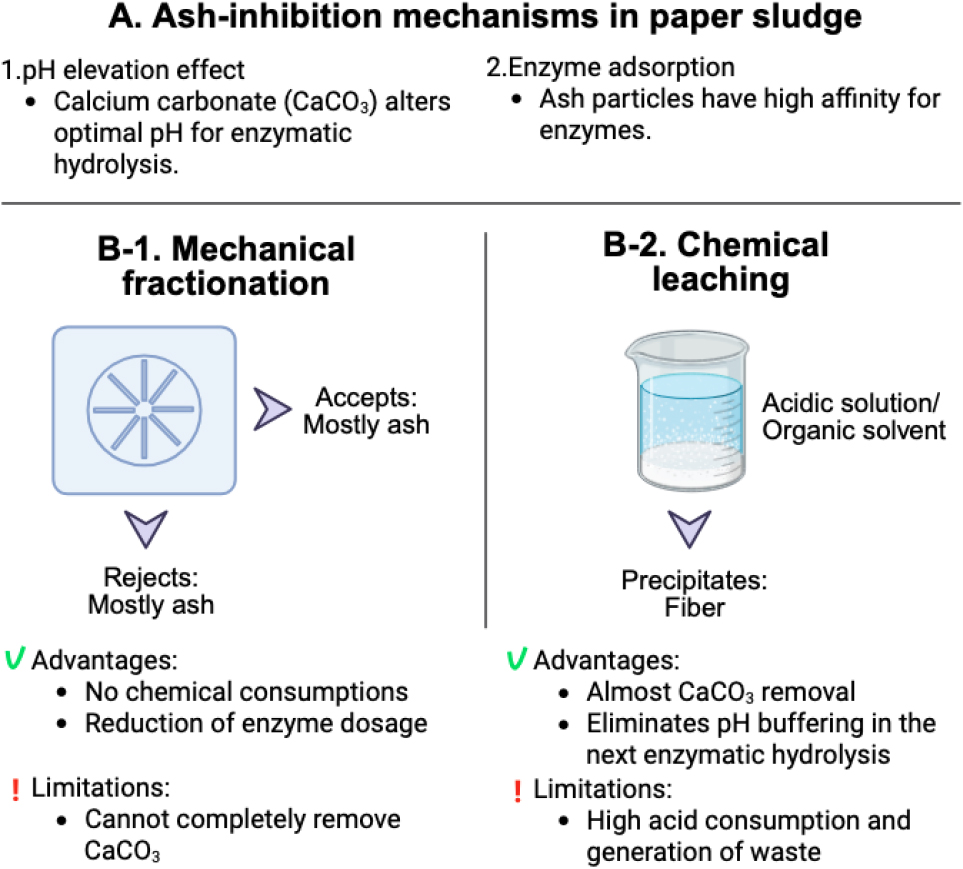
To address physical and structural interference, Chen et al. [10] demonstrated that mechanical fractionation using a screen effectively isolated cellulose-rich fibers from ash-rich fines. By reducing enzyme adsorption onto acid-insoluble ash, this screening process improved enzyme accessibility to cellulose, yielding a 1.2–1.4 times higher sugar conversion rate depending on the sludge component. Alternatively, chemical acid leaching has been explored to eliminate acid-soluble ash fractions. Mendes et al. [19] treated sludge with organic and inorganic acids to solubilize ash components, achieving an 88% sugar conversion yield when HCl-pretreated sludge was hydrolyzed at a high enzyme dosage (35 FPU/g). Similarly, Gurram et al. [20] reported that overnight acid washing with dilute HCl successfully converted insoluble CaCO3 into CaCl2, effectively removing the primary alkaline buffer from primary sludge.
However, simple water washing has shown limited effectiveness in enhancing sugar yields. Zhu et al. [21] observed that while repeated water washing reduced the acid required for pH neutralization, it did not significantly improve sugar conversion. To overcome the limitations of washing alone, the authors recommended incorporating nonionic surfactants to prevent non-specific enzyme adsorption and enhance overall cellulase activity. Park et al. [22] demonstrated that mechanical fractionation using a hole-type screen achieved up to 98% ash removal efficiency. Interestingly, their findings revealed that complete ash removal is not strictly necessary for optimal enzymatic hydrolysis. Instead, retaining a controlled amount of residual ash helps buffer the hydrolysate solution upon hydrochloric acid (HCl) addition, maintaining an optimal pH range for cellulase while simultaneously suppressing non-specific enzyme adsorption onto the ash [22]. Consequently, this introduces a practical process trade-off for bio-refinery design; process engineers can balance ash removal energy against acid dosage based on the specific sludge composition and operational economics.
2.2 Ash effect in other biomass types
The negative impact of inorganic ash on enzymatic hydrolysis is not unique to paper sludge; it is widely observed across various lignocellulosic feedstocks, including agricultural residues and recycled paper products. In agricultural biomass, ash typically consists of silica (SiO2) and alkali/alkaline earth metal cations (i.e., Ca2+, Mg2+). Yin and Chen [23] demonstrated that ash cations in rice straw generally inhibited overall cellulase activity, although Ca2+ and Mg2+ selectively β-glucosidase activity. A combined treatment of water washing and steam explosion effectively removed ash from rice straw, increasing the enzymatic sugar yield by 25.8%. Although increasing the dosage of enzyme without pretreatment achieved a comparable conversion rate, the authors emphasized that ash removal pretreatment represents a more economically viable strategy. He et al. [24] investigated ash removal from corn stover to improve enzymatic hydrolysis rate and subsequent ethanol fermentation. Soaking corn stover in water to extract soluble minerals and heavy metals followed by mechanical pressing significantly enhanced the sugar yield from 43% to 71%. In the context of recycled paper waste, Chen et al. [25] examined the reuse of newspaper for fermentable sugar production, noting that residual printing ink, alongside inorganic ash, served as a primary inhibitory barrier to enzymatic hydrolysis. Similar to the surfactant-assisted strategies applied to paper sludge, the addition of nonionic surfactants effectively mitigated non-specific enzyme adsorption and enhanced sugar conversion rate across various enzyme dosages (2, 4, and 8 FPU/g).
Importantly, while ash in agricultural biomass consists predominantly of silica and soluble alkali salts that can be substantially removed via simple water soaking, paper sludge ash is uniquely dominated by alkali CaCO3 and kaolin clay. This structural distinction underscores why paper sludge requires specialized physical screening or chemical acid leaching, rather than basic water washing, prior to catalytic dehydration into furan chemicals.
Collectively, these parts have shown that the carbohydrate fraction of paper sludge can be recovered through fractionation and enzymatic hydrolysis, yielding glucose and xylose as the major components. However, characterization of the resulting hydrolysates has largely focused on sugar recovery, while the identities and concentrations of residual inorganic species, incompletely hydrolyzed carbohydrates, enzymes, and other process-derived components remain comparatively less understood. More importantly, direct studies examining how such complex paper sludge-derived hydrolysates act during subsequent catalytic dehydration to 5-hydroxymethylfurfural (HMF) and furfural remain limited. This distinction is illustrated in Fig. 3. Accordingly, Section 3 reviews these pure sugar studies to establish the fundamental chemistry governing HMF and furfural formation and to provide a mechanistic baseline for identifying the variables that should be systematically evaluated when actual paper sludge-derived hydrolysates are used in future studies.
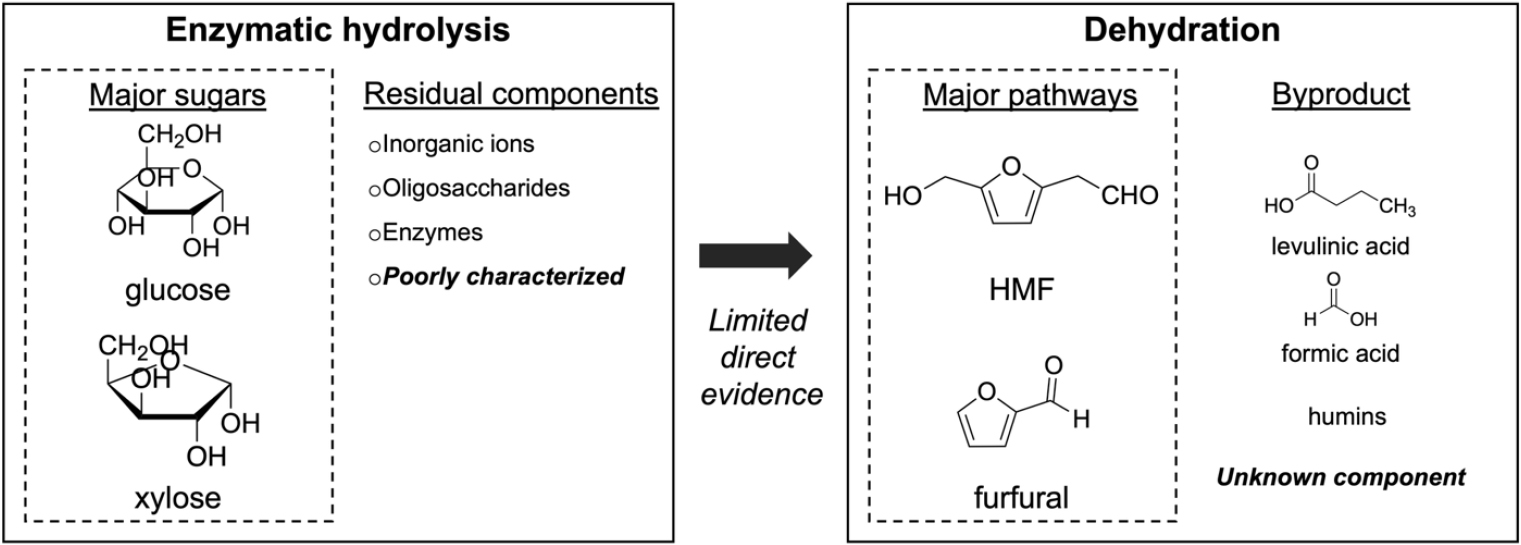
Fig. 3.
Conceptual framework bridging enzymatic hydrolysis of paper sludge and furan production. Direct paper sludge studies have established enzymatic hydrolysis of glucose and xylose. Catalytic dehydration to HMF and furfural has been investigated predominantly using model sugar systems while levulinic acid, formic acid, and humis were identified as dehydration byproducts. Residual components in sludge-derived hydrolysates and their effects on catalytic performance remain insufficiently understood, representing a key research gap for future paper sludge-to-furan conversion.
3. Dehydration of Pure Sugars into Furan Chemicals
3.1 Reaction mechanisms and pathways for pure glucose dehydration to HMF
HMF serves as a versatile bio-based platform chemical for synthesizing high-value polymers and advanced biofuels, such as 2,5-furandicarboxylic acid (FDCA) and 2,5-dimethylfuran (DMF) (Fig. 4). The catalytic dehydration of hexoses into HMF involves the net elimination of three water molecules per sugar monomer [26]. Compared to fructose, glucose exhibits significantly lower HMF selectivity and requires harsher reaction conditions due to the high thermodynamic stability of its pyranose ring, which hinders ring-opening and subsequent enediol formation. Chemically, glucose conversion proceeds via two primary routes: an acyclic pathway involving aldose-ketose isomerization, and a direct cyclic pathway (Fig. 4). To explain hexose dehydration, early landmark work by Feather and Harris [26] established that carbohydrate dehydration in both acidic and alkaline media is predominantly driven by 1,2- and 2,3-enediol intermediates, noting that acyclic enediol formation is favored during D-fructose mutarotation. Zhao et al. [27] and Pidko et al. [28] elucidated the isomerization mechanism; specifically, Pidko et al. [28] demonstrated that Lewis acid metal centers coordinate with the O1/O2 positions of open-chain glucopyranose, facilitating an intramolecular 1,2-hydride shift from C2 to C1 alongside proton transfer to O6, thereby promoting isomerization to fructose prior to rapid triple-dehydration into HMF. Building upon these fundamentals, van Putten et al. [29] categorized aqueous acid-catalyzed hexose dehydration into acyclic and cyclic routes, identifying aldose-to-ketose isomerization via a 1,2-enediol intermediate as the primary rate-limiting step in acyclic pathways.
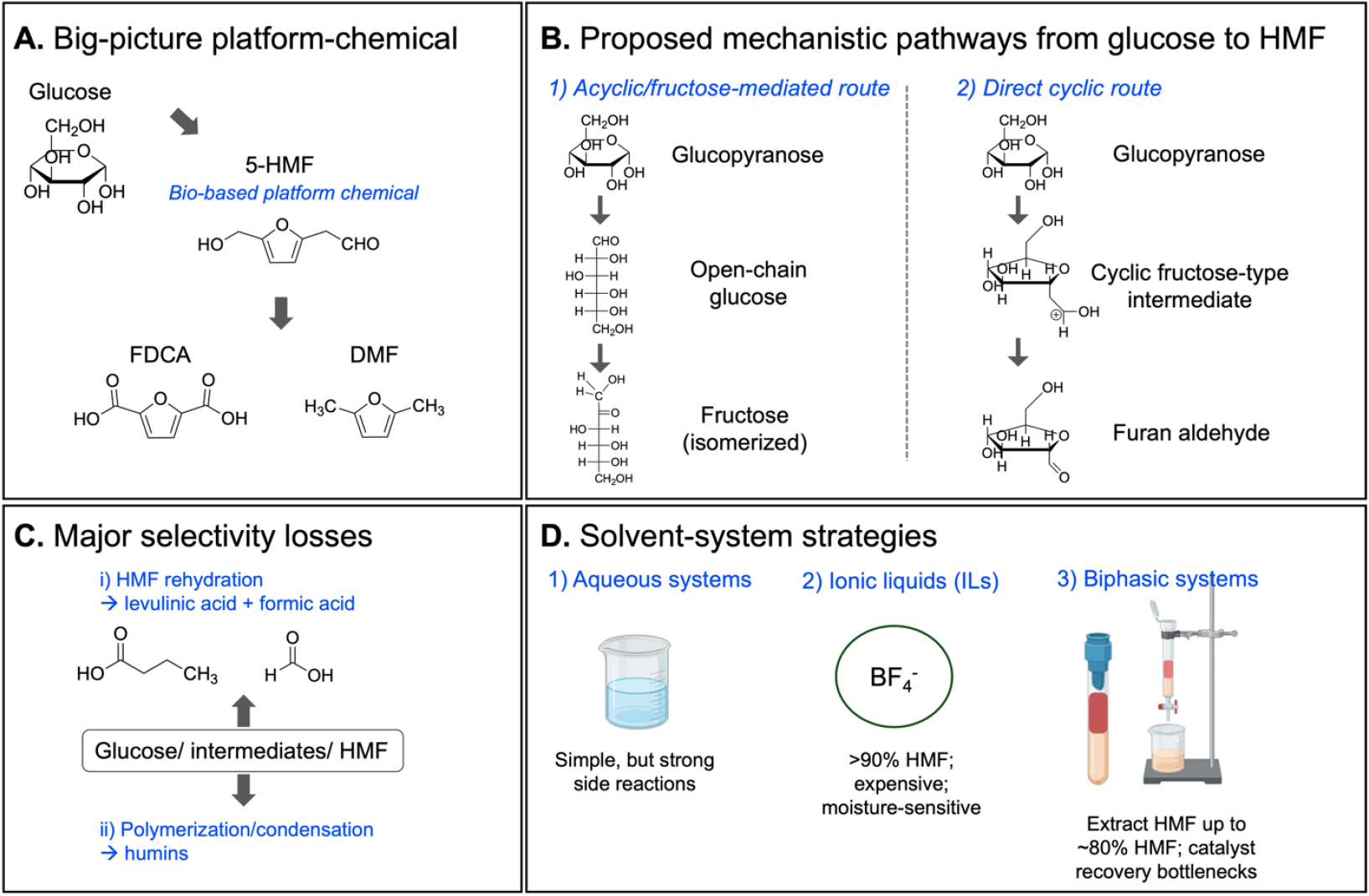
Fig. 4.
Catalytic conversion network of glucose to HMF: (A) Versatile platform chemicals, HMF, for the production of high-value added chemicals (i.e., FDCA, DMF); (B) Two main debating mechanisms of dehydration from glucose to HMF (acyclic/fructose-mediate route or direct cyclic route); (C) Byproduct formation including HMF rehydration to levulinic acid and formic acid, and humin condensation; (D) Solvent types for dehydration of glucose to obtain high HMF yield.
On the other hand, the necessity of complete ring-opening has been actively debated, with several researchers proposing a direct cyclic mechanism. Qian [30] argued for direct cyclic transformation bypassing fructose formation, providing evidence that C2-to-C1 hydride transfer can also occur within the cyclic structure (Fig. 4). According to this direct cyclic model, HMF formation is initiated by selective protonation of the C2-OH group on the glucopyranose ring, followed by C2-O2 bond cleavage and C2-O5 bond formation to directly yield a five-membered furanose intermediate [31]. Density functional theory (DFT) calculations investigated by Yang et al. [31] support this cyclic route, indicating that C2-OH protonation and C-O bond cleavage exhibit a lower activation energy barrier than ring-opening, providing theoretical rationale for direct HMF generation under specific acid- or halide-promoted conditions.
HMF is highly susceptible to rehydration, forming levulinic acid and formic acid, while cross-polymerization among unreacted sugars, reactive intermediates, and furans generates insoluble humin (Fig. 4) [32,33]. To suppress these side reactions and overcome the inherent limitations of aqueous systems, specialized solvent systems have been widely investigated in the literature. Ionic liquids (ILs) can achieve exceptional HMF yield (>90%) by disrupting hydrogen-bonding network; however, literature consistently emphasizes that ILs are prohibitively expensive and highly susceptible to catalytic deactivation even by trace moisture [34], rendering them impractical for processing wet industrial feedstocks like paper sludge. Alternatively, biphasic solvent systems (i.e., water/ methyl isobutyl ketone (MIBK)) continuously extract HMF into the organic phase upon formation to minimize self-condensation and rehydration, reaching HMF yields up to 80% [35]. Nevertheless, researchers point out key engineering bottlenecks in biphasic systems, including the challenge of recovering homogeneous catalysts and potential mass-transfer limitations when integrating heterogeneous catalysts with inorganic salts and residual sludge ash matrices.
3.2 Dehydration of pure xylose into furfural
Xylose, the predominant pentose monomer derived from the hemicellulose fraction of paper sludge, serves as the direct precursor for furfural, which is a vital platform chemical for producing value-added products. To maximize furfural production from xylose and xylan, extensive research has evaluated the coupled effects of catalyst design [36,37], solvent types [38,39], and reaction temperature and time [40].
From a mechanistic perspective, the catalytic dehydration of xylose to furfural is generally classified into two competing pathways depending on the catalyst’s functionality: an isomerization-mediated pathway (ring-opening) and a direct dehydration [37,41]. To operate under mild reaction conditions and lower temperatures, Binder et al. [42] have proposed Lewis-acid catalyzed systems, particularly chromium halide catalysts with ionic liquids. Under this condition, chromium halide promotes the ring-opening of xylose and its isomerization to a xylulose intermediate via 1,2-hydride shift. Conversely, in Brønsted acidic aqueous media containing halide salts, Marcotullio and de Jong [43] proposed an alternative direct dehydration mechanism that bypasses the preliminary isomerization to xylulose. In their proposed pathway, chloride ions (Cl−) act as specific nucleophilic catalysts that promote C1-C2 enolization and subsequent dehydration steps through proton transfer and hydrogen bonding, directly facilitating the elimination of three water molecules from pentoses to yield furfural.
To overcome product degradation and severe polymerization in aqueous systems, biphasic solvent extraction has been widely introduced to protect furfural [44]. By incorporating an organic extractant such as MIBK, furfural is continuously partitioned into the organic phase immediately upon formation, thereby isolating it from the acidic aqueous phase and preventing secondary condensation into humins. Weingarten et al. [44]’s studies using water/MIBK systems have achieved furfural yields exceeding 80%. Furthermore, Mittal et al. [45] demonstrated that combining a 0.05 M H2SO4 with an optimized MIBK biphasic system enhanced the furfural yield to over 80%. These mechanistic and process-level insights confirm that pairing halide/Lewis acid catalysts with biphasic solvent extraction offers a highly efficient route for converting the xylose fraction of paper sludge into high-purity furfural.
3.3 Catalyst systems and coordination mechanisms for pure sugar dehydration
The catalytic dehydration of pure sugars into furan platforms is governed by diverse catalyst classes, including homogeneous mineral acids, heterogeneous Lewis/Brønsted acids, metal salts, and ion-exchange resins [27,46]. In heterogeneous catalytic systems, the strength of acid sites and the Brønsted-to-Lewis acid ratio play a decisive role in directing glucose conversion and HMF selectivity. Ordomsky et al. [47] investigated the effect of metals on the glucose dehydration over various metal phosphate catalysts, demonstrating that higher total acidity enhances overall glucose conversion. Greater fructose accumulation over Al and Ti suggests that fructose dehydration is relatively slow, whereas the lower fructose accumulation over Zr and Nb is consistent with its more rapid conversion to HMF.
In Lewis acid-catalyzed systems, interactions between metal centers and sugar hydroxyl groups are widely considered important for the initial activation of glucose [27,48]. Zhao et al. [27] demonstrated that selected metal chlorides in chloride-containing ionic liquids efficiently promote glucose conversion, with CrCl2 exhibiting activity for both glucose-fructose isomerization and dehydration. Subsequent computational and spectroscopic studies showed that the coordination behavior is strongly dependent on the metal identity, oxidation state, and ionic-liquid environment. For example, Pidko et al. [28] found that substitution of a chloride ligand by a glucose hydroxyl group was energetically favorable for chromium (II) chloride complexes, whereas copper (II) chloride preferentially formed hydrogen-bonded rather than directly coordinated glucose complexes. However, no universal preference for coordination to a particular glucose hydroxyl group was identified, indicating that metal-sugar coordination should not be represented by a single structure applicable to all metal chloride systems.
Guan et al. [48] performed comprehensive density functional theory (DFT) calculations to elucidate the molecular mechanism catalyzed by metal chloride, including FeCl3, CrCl3, and WCl3, in 1-butyl-3-methylimidazolium chloride ([BMIM]Cl). They established that glucose conversion proceeds via the glucose-to-fructofuranose isomerization pathway. A five-membered metal-glucopyranose chelate was proposed as a key activated complex during the isomerization stage. Coordination of neighboring glucose hydroxyl groups to the Lewis acidic metal center facilitates sugar activation, ring opening, and rearrangement through enediol-type intermediates toward fructofuranose. This proposal is consistent with the experimental observation of Hu et al. [49], who reported evidence supporting the formation of a five-membered Sn-glucose chelate in an SnCl4/1-ethyl-3-methylimidazolium tetrafluoroborate ([EMim]BF4) catalytic system. Nevertheless, these chelated structures should be regarded as catalyst-dependent mechanistic models rather than universal intermediates for all metal-catalyzed glucose dehydration reactions.
An alternative strategy employs spatially distinct solid base and acid catalysts to sequentially promote glucose isomerization and fructose dehydration. Acid catalysts alone, particularly strongly acidic ion-exchange resins in polar aprotic solvents, can favor intramolecular glucose dehydration to anhydroglucose, including levoglucosan, rather than selective HMF formation [49]. Takagaki et al. [50] and Ohara et al. [51] therefore combined hydrotalcite, a solid base, with Amberlyst-15, a solid Brønsted acid, to establish a one-pot catalytic system. Hydrotalcite preferentially catalyzed the aldose-ketose isomerization of glucose to fructose, whereas Amberlyst-15 subsequently promoted the dehydration of fructose to HMF. The combined catalyst system consequently improved HMF selectivity by accelerating the desired isomerization-dehydration sequence while suppressing the competing formation of anhydroglucose. Rezayan et al. [52] developed bifunctional Sn/KIT-1/C catalysts in which grafted Sn species within mesoporous silica provide strong Lewis acid sites, while oxidized carbon domains supply Brønsted acidity. Their results showed that balancing the amounts and strengths of these acid sites, with maintaining accessible microporosity, enhanced HMF formation while suppressing byproduct generation.
More recent studies have expanded this mechanistic by demonstrating that glucose dehydration cannot be rationalized solely in terms of total acidity or a single catalyst. Using isotope-tracing experiments and in-situ nuclear magnetic resonance (NMR) analysis in a CrCl3/dimethyl sulfoxide (DMSO), Meier [53] distinguished the effects of water on the sequential steps of glucose conversion to HMF. Water had only a limited influence on the initial glucose isomerization pathways but substantially hindered the first dehydration step of fructose, resulting in fructose accumulation and slower HMF formation. Most recently, Xu et al. [54] showed that catalyst wettability must be optimized together with the Lewis-to-Brønsted acid balance. In their carbon-based catalyst, Al-Ti-derived Lewis acid sites and sulfonic Brønsted acid sites were most effective when the surface maintained sufficient affinity for the hydrophilic glucose substrate while limiting water accumulation near the resulting HMF, thereby suppressing its rehydration. Collectively, these studies establish that metal identity and coordination state, Lewis-Brønsted acid-site proximity, water activity, pore accessibility, and interfacial wettability jointly determine whether sugar follows productive dehydration pathways or competing routes leading to furfural rehydration and humin formation.
4. Conclusions and Future Perspectives
Paper sludge represents a promising source of recoverable sugars that could serve as feedstocks for the production of furan platform chemicals, including 5-HMF and furfural, which can be further upgraded into bio-based polymers, specialty chemicals, and hydrocarbon fuels. Compared with untreated lignocellulosic biomass, paper sludge has already undergone substantial mechanical and chemical processing during pulp and paper manufacturing. Consequently, it may require less severe pretreatment before enzymatic hydrolysis. Nevertheless, the composition of paper sludge varies considerably among mills, and high concentrations of CaCO3 and other inorganic components may interfere with pH control and enzyme activity. Effective deashing and conditioning should therefore be regarded as essential feedstock-dependent operations rather than evidence that no pretreatment is required.
The potential integration of paper sludge valorization into existing pulp and paper mills offers several practical advantages, including access to established feedstock-handling systems, utilities, process water, and waste-management infrastructure. However, this level of experimental evidence does not yet extend to the downstream catalytic conversion step. Direct studies evaluating the dehydration of actual paper sludge remain limited under process-relevant conditions. In particular, the effects of residual inorganic salts, organic acids, ash-derived ions, and hydrolysis additives on sugar dehydration remain insufficiently understood. These components may alter catalyst speciation, acidity, reaction kinetics, furan selectivity, humin formation, and solvent-recovery behavior. Future studies should therefore systematically compare pure sugar solutions, composition-matched synthetic hydrolysates, and actual sludge-derived hydrolysates under equivalent catalytic conditions to distinguish intrinsic dehydration chemistry from matrix-induced effects.
Although the downstream catalytic chemistry requires broader experimental validation, process-level analyses already provide useful insight into the economic consequences of integrating sugar dehydration within a paper sludge biorefinery. Techno-economic analysis (TEA) and life cycle assessment (LCA) of paper sludge provide complementary frameworks for evaluating whether favorable lab-scale results can be translated into economically and environmentally viable biorefineries. Cruz et al. [55] developed a process model and TEA for converting carbohydrates recovered from paper sludge into a jet-fuel-range hydrocarbon blend through ash removal, enzymatic hydrolysis, sugar dehydration, aldol condensation, hydrogenation, and hydrodeoxygenation. Although the final product was a hydrocarbon blend rather than isolated HMF or furfural, their results demonstrated that the dehydration and solvent-recovery stages strongly influenced both capital and operating costs. The base-case configuration, which employed 1,4-dioxane during sugar dehydration, resulted in minimum fuel selling price (MFSP) of USD 8.6 per gasoline gallon equivalent (GGE). Substitution of 1,4-dioxane with acetone, together with increased solids and sugar concentrations, decreased the MFSP to USD 4.5 per GGE. These results indicate that economic performance is governed not only by furan yield but also by solvent circulation, water handling, chemical recovery, and downstream processing requirements.
Lan et al. [56] evaluated the environmental implications of this pathway using an industrial-scale process simulation coupled with LCA. For a system employing acetone, the estimated carbon intensity of paper-sludge-derived sustainable aviation fuel (SAF) was 35.7–41.8 g CO2-eq MJ-1 of SAF. On a feedstock basis, the process provided a net climate benefit of -636 to -584 g CO2-eq per dry kilogram of paper sludge when avoided sludge disposal was included [56]. When the ash separated from paper sludge was recycled as a substitute for cementitious material, the estimated fuel carbon intensity decreased further 5.1- 11.1 g CO2-eq MJ-1, corresponding to -925 to -873 g CO2-eq per dry kilogram of sludge. These results highlight the potential system-level value of utilizing both the carbohydrate and ash fractions of paper sludge, although the environmental performance of the integrated pathway remains dependent son assumptions regarding conversion efficiency, energy supply, avoided disposal, and ash utilization.
Future development of paper sludge biorefineries should therefore focus on flexible, multiproduct configurations that integrate proven upstream sugar recovery with systematically validated downstream catalytic conversion. The most effective pathway will be the one that combines high carbon utilization with reduced water and solvent circulation, efficient catalyst and solvent recovery. Because current TEA and LCA studies primarily evaluate fuel-oriented pathways, dedicated assessments are still needed for the production and purification of HMF and furfural. The immediate research priority should be to validate catalytic dehydration using actual paper sludge and to determine how residual components alter catalyst activity, selectivity, and stability. Subsequent studies should address continuous processing, catalyst recyclability, solvent recovery, and process-water reuse. Although this review primarily draws upon U.S.-based paper sludge studies, the integrated framework discussed may also provide a useful basis for evaluating paper waste and other ash-rich biomass or industrial waste streams. Applying this framework to Korean feedstocks could help identify locally appropriate pathways for producing furan chemicals while maximizing the value of both the organic and inorganic fractions of paper-mill residues.