


1. Introduction
Kudzu is a group of plants in the genus Pueraria lobata (Willd.) Ohwi which is regarded as an invasive plant in several countries. On the other hand, kudzu root extract has been mostly used as a herb in traditional oriental medicine in Korea, China and Japan for more than 2,000 years. The extract has been used to treat fever, migraine, allergies, diarrhea, acute dysentery, deafness, angina, heart attack, hypertension, diabetes and alcoholism.1,2) Kudzu fibers from vines and stems were also used to make grass cloth and paper.3)
However, kudzu kills or damages other plants by smothering them under a solid blanket of leaves, encircling woody stems and tree trunks, and breaking branches or uprooting entire trees and shrubs. Therefore, kudzu removal is a widespread issue in many countries, and Korean researchers have been trying to reuse leftovers of kudzu including vines and roots composed of cellulose fibers.4-6)
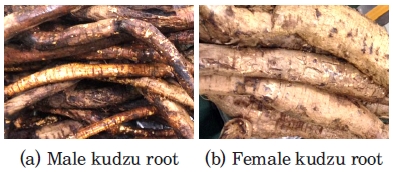
It is interesting to note that Kudzu is morphologically classified into male and female roots in Korea. A male root is straight and thin in shape, and a female root is irregular and thick in shape. However, it is not easy to distinguish their gender from unspecified root samples. If kudzu roots are chemically classified, it is easy to describe that the female roots contain more moisture and starch contents than the male ones. Instead, the male roots are composed of more fibers. However, unless they are physically chewed to extract starch and moisture for a sensory test, the starch and moisture of the kudzu roots are not readily segregated from any samples.
If the mixed root fibers of male and female kudzu are used for making paper, paper properties may be affected by their chemical and morphological differences. These roots are rich in starch and other carbohydrates, generally surpass over 10 cm in diameter, reach over 2 m in length, and weigh as much as 180 kg. Starch contents have been reported to be around 25 percent of dry mass of roots.7,8) Therefore, it will be considerably meaningful to investigate characteristics of each root fibers which can be used as useful resources for papermaking.
A few researchers tried to apply the fibers from stems and roots of kudzu for development of useful resources including papermaking and biofuels. Kim et al. (2010) reported that kudzu fibers from the stems had a similar mean fiber length to hardwood kraft pulp fibers.4) They also showed that the paper from kudzu stem fibers had bulkier structure than that from hardwood bleached kraft pulp. Jo et al. (2011) studied pulping characteristics of kudzu root fibers using mechanical and chemical treatment in addition to their anatomical properties.5,6) However, they did not show the chance of the intrinsic fiber and paper properties by different pulping treatments with different types of kudzu root fibers. They all used the fibrous leftovers after extraction of kudzu roots as a herb in traditional medicine.
Some researchers proposed the way to produce bioethanol using carbohydrates and starch from kudzu roots. Tanner et al. (1979) reported that kudzu starch appeared to be saccharified at about the same rate as the more conventional fermentation starches including corn dextrin and manioc.3) Sage et al. (2009) indicated that kudzu in naturally infested regions in North America could be a new source of carbohydrates for bioethanol production due to equal levels of carbohydrates to maize and sugar cane.9) It had been reported that kudzu roots contained a high concentration of carbohydrates up to 68 percent by dry weight, compared to a few percent in leaves and vines.9,10)
As mentioned, Kadzu is expanding its habitat in many countries including Korea with an amazing speed. Possible efforts to control kudzu are to be local but to pull out the roots. The removed roots should be used as useful raw materials for papermaking or other purposes by mixing them with wood pulps. This study investigated chemical and pulping characteristics of kudzu root fibers for contributing to endless battle to root out kudzu.
2. Materials and Methods
2.1 Raw materials
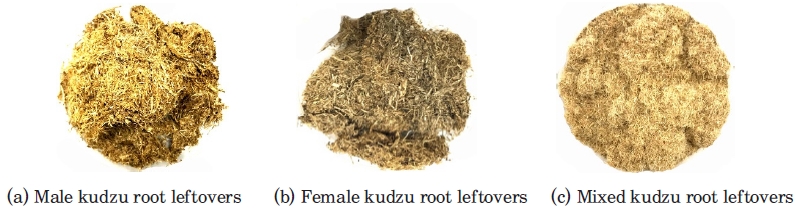
Kudzu roots were collected from the mountains of the research forest of Gyeongsang National University and Chungbuk province in Korea. The roots were morphologically distinguished from male and female, as shown in Fig. 1. Male roots are slenderer and longer than female ones. The raw materials used for the experiment were leftovers after squeezing mixed roots of male and female kudzu, as shown in Fig. 2. The leftovers from the mixed roots were thoroughly washed for removing contaminants such as tiny soil particles and then used for kraft pulping.
2.2 Chemical and ash analysis of kudzu roots fibers
The extractive contents of the collected kudzu root fibers were measured according to TAPPI Standard Method T 204, T 207, and T 222. Ash contents the root fibers were measured based on TAPPI Standard Method T 211.
Starch contained in kudzu root fibers was determined using UV/Vis spectrophotometer (U–3000, Hitachi, Japan). After reacting 10 mL of gelatinized raw starch with 0.1 mL of 0.1 N triiodide solution, the starch solution was diluted from 50 to 350 ppm respectively. Each starch solution was used to obtain a calibration curve through a maximum absorbance of UV/Vis spectroscope, based on Beer’s law.
A small piece of Kudzu roots were soaked in distilled water for 30 minutes, and the residual water after removing the kudzu roots was filtered through a No.2 filter paper. The water containing eluted starch was centrifuged at 2,100 rpm for 30 minutes for further purification, and then gelatinized at 90℃ for 30 minutes. After 10 mL of the gelatinized starch reacted with 0.1 mL of 0.1 N triiodide solution, its absorbance was measured at a wavelength range of 400 to 800 nm using UV/Vis spectrophotometer. If a maximum absorbance for a specific sample was obtained from the spectrum curve, it is used to calculate a starch content of kudzu root fibers.
2.3 Pulping and bleaching
Leftovers from extracts of male and female kudzu roots were cut into an optimal length, 1.4-4.2 mm long, using a guillotine cutter for pulping. They were cooked and bleached using a laboratory digester as shown in Table 1-3. Since individual male and female roots could not be readily separated after extraction, the mixed leftovers were practically used for kraft cooking.
Table 1.
Soda pulping condition using the leftovers from male and female kudzu root fibers
| NaOH (%)* | Cooking Temp. (℃) | Cooking time (min) | Liquor-to-roots ratio |
|---|---|---|---|
| 5 | 90 | 120 | 9:1 |
Table 2.
Kraft pulping conditions using the mixed leftovers of male and female kudzu root fibers
| Active alkali (%) | Sulfidity (%) | Cooking Temp. (℃) | Cooking time (min) | Liquor-to- roots ratio |
|---|---|---|---|---|
| 20 | 25 | 180 | 90 | 4:1 |
Table 3.
Bleaching conditions for soda pulp and kraft pulp
| Na2S2O4 | H2O2 | |
|---|---|---|
| Addition ratio (%)* | 25 | 25 |
| Bleaching temp. (℃) | 90 | |
| Bleaching time (min) | 120 | |
2.4 Handsheet preparation and property testing
Bleached kudzu root pulps were mixed with softwood bleached kraft pulp (SW-BKP), mulberry pulp and manila hemp pulp (refer to Table 4). After being mixed with a certain proportion, the fibers were beaten up to 400 mL CSF using a laboratory Valley beater. Handsheets of 20 g/m2 for physical and optical testing were formed according to TAPPI Standard Method T 205. Supplementary additives included alkyl ketene dimer (AKD, Solenis), epoxidized polyamide resin (polyamide-epichlorohydrin, PAE resin, Dongjin Industry), polyvinyl alcohol (PVA, Kemira), direct dye (yellow, Cheonil Chem, Ind) and Sodium sulfate (Na2SO4, Hanbit E&C) as shown in Table 5.
Table 4.
Mixing ratios of pulp fibers used for stock preparation
| Pulp types | Origin | Addition ratio (%) | Note* |
|---|---|---|---|
| Softwood bleached kraft pulp | Canada | 70 | 2-2.5 mm long |
| Mulberry fibers | Thailand | 10 | 6-10 mm long |
| Manila hemp fibers, Abaca | Philippine | 10 | 4-6 mm long |
| Bleached kraft male kudzu root pulp Bleached kraft female kudzu root pulp Bleached kraft kudzu mixed root pulp | Korea | 10 (separate mixing by pulp types) | 0.7-1 mm long (Fines contents 9-15%) |
Table 5.
Addition ratios of supplementary chemicals for stock preparation
| Chemicals (%)* | Dyeing | ||||||
|---|---|---|---|---|---|---|---|
| AKD | PVA | PAE | Direct dye (Yellow) (%)* | Na2SO4 (%)* | Dyeing temp. (°C) | Dyeing time (min) | pH |
| 1 | 1 | 4 | 1 | 3 | 60 | 15 | 7 |
Tensile strength and brightness of sheets were measured using tensile tester (FRANK-PTI, Austria) and Elrepho (L&W, Sweden). Fiber length and fines contents were measured by FQA-360 (OpTest, Canada).
In order to evaluate ability to resist yellowing and fading of paper upon to UV light, Fade-O-Meter (FC-2011, Korea) was used under a xenon arc lamp at 50℃ for 24 hours. Elrepho was used to measure ISO brightness, light scattering coefficient (s) and light absorption coefficient (k) before and after exposure to UV. The ratios of k (light-absorption coefficient) to s (light-scattering coefficient) before and after accelerated aging was used to assess the extent of light fastness like Eq. 1 as follows:
PC number is proportional to the concentration of chromophores formed during light-induced photo yellowing. Therefore, the smaller the PC number is, the less the paper is photo-yellowed.
3. Results and Discussion
3.1 Chemical and ash analysis of kudzu root fibers
Extractives and ash contents of bleached soda pulps made from male and female kudzu root fibers were summarized in Table 6. Extractives and ash contents of bleached kraft mixed kudzu root fibers were summarized in Table 7. In general, cold- and hot-water extractives include inorganic compounds, tannins, gums, coloring matters, and starches. On the other hand, organic extractives include low-molecular carbohydrates, salts, polyphenols, waxes, fats, resins, sterols, non-volatile hydrocarbons, and other water-soluble compounds. Male kudzu pulp fibers contained a little more extractives and holocellulose than female ones, and the amount of lignin and ash contents did not show any big difference between male and female kudzu root fibers. After two-stage bleaching sequences, representative extractives of male and female kudzu fibers were slightly reduced and their lignins were considerably reduced from about 23% to 17-18%.
Table 6.
Chemical and ash analysis of soda kudzu pulp fibers before and after bleaching
Table 7.
Chemical and ash analysis of kraft kudzu pulp fibers before and after bleaching
Extractives of the bleached kraft kudzu root fibers became around 50% less than those of the unbleached ones. It was caused by reduction of more extractives during much stronger chemical treatment during kraft pulping followed by bleaching. For lignin contents, the bleached kraft kudzu root pulp fibers were at about 50% of the unbleached ones. Ash content of the kraft kudzu fibers was rarely affected by pulping types or bleaching. It is interesting to note that strong alkali treatment such as NaOH and Na2S during kraft pulping led to the greater reduction of both lignin and extractives compared to soda pulping. For reference, holocellulose contents of kudzu root fibers were 60-65% before pulping and reduced to 25-28% after bleaching.
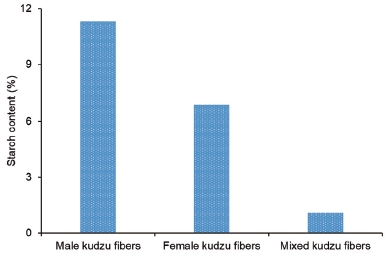
Fig. 3 displays starch contents of bleached kudzu root fibers. Starch is a helpful source in papermaking from the mechanical srength point of view but, if starch in kudzu root fibers exceeds a permissible level, there is a possibility for significant build-up in the white water. If unretained starch is built up in white water, it contributes to foam, bacterial growth and BOD increase.11-12) Representative male and female pulp fibers were produced by soda pulping, and mixed pulp fibers came from kraft pulping. Male and female kudzu root fibers contained about 11% and 7% starch respectively, and kraft mixed fibers did around 1% starch. Strong alkali treatment on kudzu roots such as kraft pulping contributed to more decrease in a starch content than mild treatment such as soda pulping. Jackson et al. (1988) showed that starch cooked with NaOH had increased water solubility.13) The higher amount of starch in bleached soda kudzu root pulps may lead to the more frequent trouble in papermaking. Therefore, kraft pulping of kudzu root leftovers will be preferable to soda pulping in order to avoid any contamination of white water during papermaking process.
3.2 Fading resistance
Paper photo-yellowing or fading has been regarded as one of the common phenomenon of the aging and deterioration. Paper yellowing often occurs due to oxidation of paper components including primary components and extra additives. Oxidation generating carbonyl groups (C=O) and carbon-carbon double bonds (C=C) is particularly affected by UV light, heat, moisture, metal cations such as Cu2+ and Fe3+, and the gaseous pollutant such as SO2 and NO2.14,15) If lignin in pulp fibers is not completely removed during pulping and bleaching process, paper will be greatly sensitive to photo-yellowing.
Fig. 4 displays the photo-yellowing degree of the papers including bleached soda kudzu pulps and bleached kraft kudzu pulp. Photo-yellowing resistance was evaluated by PC number. The paper sample made of softwood bleached kraft pulp had the greatest resistance against photo-yellowing while the paper including kudzu root pulps irrespective of pulping types were rapidly degraded by UV light. SW-BKP without lignin had the greatest fading resistance. On the other hand, all types of pulps including kudzu root fibers had a very weak resistance against photo-yellowing. It is interesting to note that the paper samples including bleached kraft mixed kudzu pulp expressed more resistance against photo-yellowing than those including bleached soda male and female kudzu pulps representatively. However, even though bleached kudzu pulps under 10 percent is used as raw materials for papermaking, it had a negative effect on photo-yellowing resistance. Therefore, Kudzu root fibers from which lignin is not completely removed must be used as a limited application under circumstances not severely exposed to light.
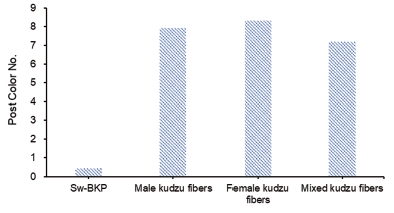
Fig. 4.
PC number of papers with and without bleached kudzu root fibers (10% of bleached kudzu root fibers were mixed with the other raw materials).
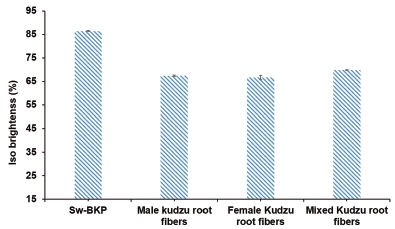
Fig. 5 shows the brightness change of different type of pulps with and without kudzu root pulps. SW-BKP had the highest brightness, and the pulps containing a little amount of kudzu root fibers irrespective of the pulping methods exhibited the lower brightness than SW-BKP. The low brightness of the papers containing kudzu root fibers is closely related to the residual lignin of each kudzu fibers, which leads to the fast discoloration.
3.3 Tensile strength
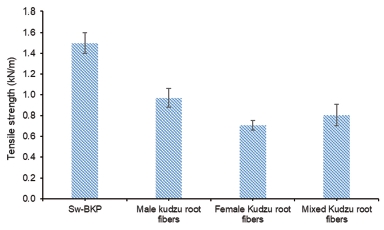
Fig. 6 shows the change of tensile strength of paper with and without kudzu root fibers. As expected, SW-BKP without kudzu root fibers had the greatest strength. Among the sheets containing kudzu root fibers, the sheet containing soda male kudzu root fibers had greater strength than soda female one and kraft mixed one. In general, soda pulping was regarded as an alternative method for producing sulfur-free pulp in spite of lower strength compared to kraft pulp. Contrary to the expectation, soda male kudzu fibers had a little greater strength than kraft mixed kudzu fibers. It is known that tensile strength is closely related to fiber strength, fiber length, and bonding. Average fiber length of male fibers was around 0.73 mm which was longer than 0.65 mm of mixed fibers. Such difference of fiber length might cause the sheet including soda male fibers to be a greater than that containing kraft mixed fibers.
4. Conclusions
Despite invasive characteristics of kudzu, the root leftovers after juice extraction can be a useful fiber resource for papermaking. Kudzu was divided into male and female in appearance. After squeezing out the juice, it was hard to distinguish each gender from male and female leftovers. Soda pulps were made from male and female root leftovers representatively, and kraft pulp was made from their mixed leftovers. Soda pulps did not show any big difference in the contents of both extractives and lignin before bleaching. However, bleaching led to the decrease in extractives and lignin of each pulp. Kraft pulping made by strong alkaline treatment contributed to the higher reduction in the contents of extractives and lignin than soda pulping irrespective of bleaching. Starch content harmful in white water in the papermaking process was higher in soda pulp than in kraft pulp. When 10% of kudzu pulp was mixed in a papermaking stock, fading resistance of the sheets containing bleached soda pulp and kraft pulp was exceedingly weaker than that of bleached SW-BKP. Even though tensile strength of the sheet containing soda kudzu pulp was lower than the sheet made of bleached SW-BKP, the sheet containing soda male pulp had a higher strength than that containing kraft mixed pulp. In conclusion, irrespective of pulp types, kudzu root leftovers could be a minor resource to produce paper with special functionality in spite of their weak fading resistance and low strength.