


1. Introduction
Due to the shortages in wood supplies, several countries in the world are expected to focus their attention on the development of alternative fiber sources such as bagasse, kenaf, ramie, empty fruit bunches, bamboo, and wheat straw.1-4) It was reported that non-wood pulp production was about 11.45 million metric tonnes in 2014 and increased to be around 14.48 million metric tonnnes in 2015.5) In Indonesia, one of the abundant sources of non-wood for pulp and papermaking is Empty Fruit Bunches (EFB). EFB is the major biomass byproduct, which is the fibrous material from stalk and spikelets of the fruit bunch after removal of fruits.6)
Oil palm cultivation in Indonesia has been going on for more than ten decades. Very suitable soil conditions in some parts of Indonesia has made palm oil as a commodity nationwide.7) Palm empty fruit bunches can be an alternative source of raw materials of non-wood fiber for pulp and paper. This is related in an effort to preserve the Indonesian forests. The use of non-wood raw material is a way that can be taken to produce pulp and paper. In addition, the increasing use of paper that will be directly proportional to the import of waste paper, while the recycling rate of used paper in Indonesia is still quite low. EFB is continuously available with the development of the palm oil industry, which grew rapidly during the past two decades, can be made into a pulp with a high enough strength as a raw material to produce paper stationery, cement bags and printed paper. Thus, the utilization of EFB as raw material for pulp and paper will provide added value for the palm oil industry. EFB can be also used for more profitable and high economic value, for example in the chemical industry, paper, composites and biofuels.8) This paper gives an overview of the chemical characteristics and properties of fibers from oil palm empty fruit bunches associated with the properties of pulp and paper making.
2. The potential and availability of EFB
Palm oil is one of the Indonesia’s main commodities which plays a vital role in Indonesia’s economy. The Indonesian government has named the palm oil industry as one of the industrial pillars published in the Industry Structure 2025. Presently, Indonesia is one of the leading crude palm oil (CPO) producers in the world. In 2015, world was producing total of about 54 million tons of palm oil, and Indonesia contributed 31.1 million tons.9) CPO in Indonesia mainly is used for food (edible oil) and only about 20% for non-food. The increasing of CPO production goes hand in hand with the area of plantations (Fig. 1) and then the waste generated from palm oil mills.
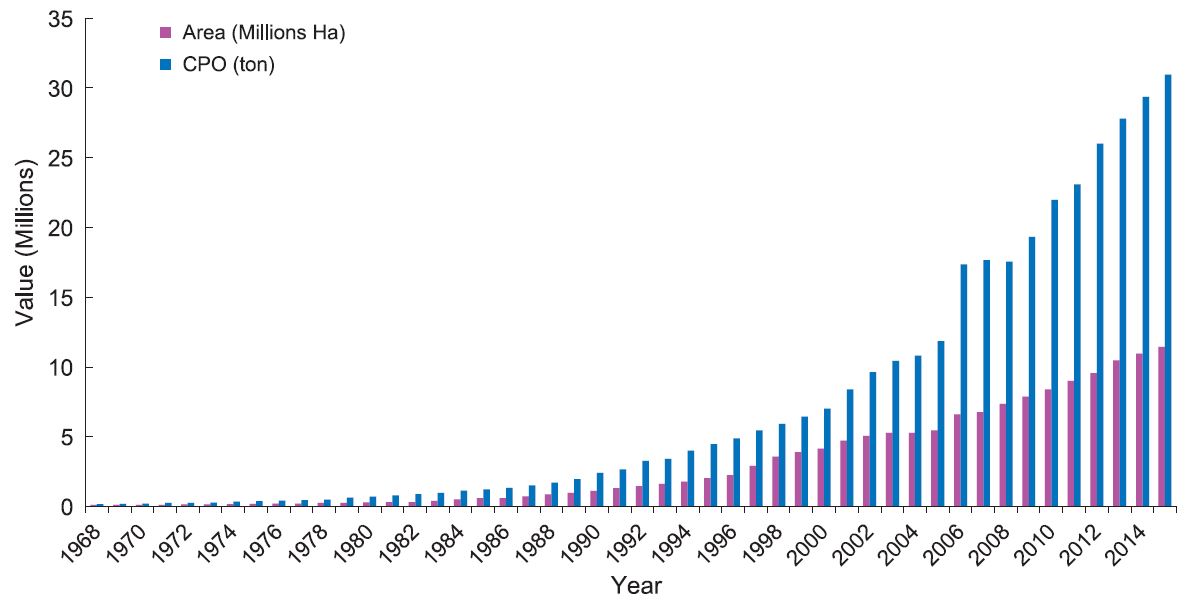
Fig. 1.
Area of palm oil and CPO production in Indonesia (Source: Directorate General of Estate Crops, 201413)).
The development of oil palm plantations has grown very rapidly, so that the addition will increase the production of palm oil, palm oil industry will also increase the production of solid waste EFB produced from palm oil mills. The development of oil palm plantation is always accompanied by a mill so that is what distinguishes from other agricultural commodities. This is due to the oil palm susceptible to chemical and physical changes during oil in bunches and processing time. Therefore, the development of oil palm is not accompanied by the development of the plant would be a futile effort. We have already recorded 713 units of palm oil mill with a capacity of 30, 45 and 60 tons fresh fruit/hour spread in Indonesia.10)
The potential of Indonesian palm oil industry has increased through the expansion of land reached an average of 250,000 hectares per year, bringing the total area of 10 million hectares.11) Every ton of CPO produced would generate about 1.1 tons of EFB. Currently, EFB are often incinerated at the plant site, which causes some air pollution.12) This pollution will need to be curbed in compliance with environmental regulations. The only beneficial current use of EFB is the fertilizer value of the ashes. At a few places, the EFB are chopped up and spread on estate grounds without incineration. To increase the added value for EFB, it has a high potential for pulp and paper products.
3. Characteristics of EFB
EFB fiber morphology is influenced by genetic properties of a plant. The average weight of about 400 g EFB fibers per fruit bunches.8) EFB fibers include short fibers to moderate, i.e., between 1-2 mm in diameter while including a group of small to medium diameter (2 to 2.5 μm).11) In general, physical and morphological properties of EFB fibers shown in Table 1.
Table 1.
Morphological properties of EFB fibers
| Parameter | The end part of the EFB stem14,17) | EFB fiber tip (malai)14,17) | EFB fibers18) | EFB fibers1) |
|---|---|---|---|---|
| Fiber length, mm | ||||
| - Minimum | 0.63 | 0.46 | 0.27 | - |
| - Maximum | 1.81 | 1.27 | 1.48 | - |
| - Average (L) | 1.20 | 0.76 | 0.53 | 0.99 |
| Fiber diameter (D), µm | 16.89 | 14.34 | 14.00 | 19.10 |
| Lumen diameter (l), µm | 8.04 | 6.99 | - | - |
| Wall thickness (w), µm | 3.49 | 3.68 | - | 3.38 |
| Runkel ratio (2w/l) | 0.87 | 1.05 | - | - |
| Felting ratio (L/D) | 79.95 | 53.00 | - | - |
| Flexibility (l/D) | 0.54 | 0.49 | - | - |
| Fibers content (%) | 72.67 | 62.47 | - | - |
| Nonfibers content (%) | 27.33 | 37.53 | - | - |
| Bulk density, kg/m3 | 177.98 | - | - | - |
The chemical compositions of EFB fibers are mostly composed of lignin, cellulose and hemicellulose. The cellulose content of EFB fiber is around of 41.1%, hemicellulose (14.6%-29.4%), lignin (22.7%-31.7%), and extractives (1.34%-3.30%).14,15) The content of cellulose almost equal to the cellulose content of wood fiber (38%-49%), bamboo (26%-43%) and bagasse (32%-44%).16) Hence, the EFB fibers have the potential to be used as raw material for pulp and paper. The chemical components of the EFB can be seen in Table 2. EFB chemical compositions when compared with other sources of raw materials can be seen in Table 3.
Table 2.
Chemical compositions of EFB
| Parameter | Value | ||
|---|---|---|---|
| Herawan and Rivani (2013)10) | Erwinsyah et al. (2012)14) | Law and Jiang (2001)1) | |
| Extractives (%) | 7.78 | 5.22 | 2.83 |
| Ash (%) | 6.23 | 2.00 | 3.81 |
| α Cellulose (%) | 37.50 | 41.09 | - |
| Hemicellulose (%) | 28.57 | - | - |
| Holocellulose (%) | - | 69.33 | 86.30 |
| Pentosan (%) | 26.69 | 29.37 | - |
| Solubility in 1% NaOH Solution (%) | 29.96 | 24.69 | 29.90 |
Table 3.
Chemical compositions of EFB and other sources of raw materials
| Sources | Value (%) | ||||
|---|---|---|---|---|---|
| α Cellulose | Lignin | Pentosan | Ash | Remarks | |
| EFB strand | 37.50 | - | 26.69 | 6.23 | Herawan and Rivani, 201310) |
| EFB strand | 41.09 | - | 29.37 | 2 | Erwinsyah et al., 201214) |
| Bamboo | 26-43 | 21-31 | 15-26 | 1.7-5 | Pahkala, 200116) |
| Bagasse | 32-44 | 19-24 | 27-32 | 1.5-5 | Pahkala, 200116) |
| Hardwood | 38-49 | 23-30 | 19-26 | 1 | Pahkala, 200116) |
| Softwood | 40-45 | 26-34 | 7-14 | 1 | Pahkala, 200116) |
4. EFB utilization as pulp raw materials
Pulp of EFB can be produced through the process of semi-chemical pulping by the process of soda or sulfate. In addition, before the pulp cooking process can also be applied lipase in pre-treatment to reduce the incidence of pitch (stain) on the paper produced. It depends on the final target to be achieved.11) The process of making pulp from EFB has been investigated by various methods, which is soda19,20), soda anthraquinone20-23), alkaline peroxide24-26), acetosolv27), prehydrolysis soda- AQ28) and chemical mechanical.11) In addition to the process of pulping, pulp bleaching process of EFB has been done by various methods including biobleaching with laccase and xylanase21), totally chlorine free.20) The results of these studies indicate that the EFB can produce good sheet properties and is very useful for papermaking.29) EFB pulp with soda process had produced an industrial scale in Malaysia and is claimed to be suitable for printing and writing paper, corrugated cartons and other paper products.29)
5. Potential of EFB for paper production
Paper of EFB had been demonstrated in a pilot machine of 500 mm width and speed of 10 m/min. In their study, EFB was mixed with OCC pulp and no chemical additive was used for paper manufacturing. 30) Gonzalo et al.30) revealed that clean EFB alone (100%) could be used for papermaking, and for the parameter of tensile breaking stress and tear index has a similar value to those obtained for the mixture with commercial OCC (75%).
A laboratory research on utilization of EFB for raw material of paper also was performed by Erwinsyah et al.14) The process of CTMP and APMP were used to make mechanical pulp from empty fruit bunches of palm oil (EFBPO). These pulps then used for kraft liner making with the EFBPO - OCC mixing ratio of 50-50 and 75-25, and corrugating medium of 100% EFBPO. The best kraft liner is obtained from CTMP - OCC with 75-25 mixing ratio, and corrugating medium from CTMP 100%. Both results meet the requirements of Indonesia National Standard for liner and medium paper of Class B.14)
A higher scale of paper from EFB had been conducted by Rushdan et al.6) A blending stock containing EFB soda pulp (6-50%) and OCC paper was investigated on some parameters for medium paper as shown in Table 4. EFB soda pulp in the furnish improved some parameters, i.e., burst, corrugated medium test, ring crush, tensile index, and folding endurance. However, the EFB has a negative effect on the thickness, bulk, and tear index. This phenomena occured due to the properties of EFB pulp fiber that more flexible than OCC, therefore the paper would decrease in thickness and bulk. The flexibility of EFB fiber enhance the properties of burst, corrugated medium test, ring crush, tensile index and folding endurance caused by the increasing of fiber bonding. From Table 4, it shows that medium paper from mixture of EFB and OCC has similar properties to pulp from commercial hardwood namely A. mangium and E. globulus.6)
Table 4.
Characteristics of medium paper from EFB soda pulp
Source: Rushdan et al. (2007)6)
Pulp from EFB is suitable for raw material of kraft liner and corrugating medium.14) A blending of EFB pulp with recycled pulp from old corrugated container (OCC) could be used for medium paper. The properties of EFB pulp is closed to the commercial hardwood pulp of Acacia mangium and Eucalyptus globulus.6) A study of commercial scale of corrugated board production has been conducted in Indonesia. It is shown that EFB pulp has high potential to produce pulp and paper, so the EFB could substitute pulpwood due to its properties similar to commercial hardwood pulp.11) A large scale paper from EFB pulp was performed by cooperation between Indonesian Oil Palm Research Institute (IOPRI) and Center for Pulp and Paper (CPP) since 2011 to produce medium paper, liner paper, corrugated carton box. In 2013, a laboratory result was up scaled to the mill scale in one of the pulp and paper mill near Bandung City. A 8.6 ton of EFB was converted into pulp and then corrugated carton box, and resulted about 1,250 pieces of corrugated carton box. The corrugated carton box would be used as oil palm seed packaging in IOPRI.11)
6. Conclusions
Indonesia has a large amount of non-wood source of EFB. The continuous availability of EFB provides opportunities as an alternative raw material manufacture of pulp and paper as well as being relevant solutions to overcome the limitations of non-wood fiber sources. EFB is expected to be commercialized into products of pulp and paper in Indonesia. The EFB could substitute the pulp from commercial hardwood. Due to the short fibers of EFB, so it should be blended with OCC to produce a suitable paper products such as medium paper, kraft liner paper, and corrugated board box.