


1. Introduction
Cigarette paper is composed of natural cellulosic fibers and inorganic fillers. The main components of cigarette papers are cellulose, hemicellulose, lignin and pectin.1,2) Cellulosic fibers are the main materials for cigarette papers, and the common fibers used for cigarette papers include flax, rice, hemp, cotton, hardwood, softwood, and many more.2)
During combusting process, cigarette papers are independently subject to thermal pyrolysis, and interact with tobacco in the combustion part of the cigarette. Considering cigarette papers alone, cigarette papers undergo various dehydration, fragmentation, elimination and condensation reactions, to give plenty of gaseous products, a complex semi-volatile liquid tar, and a residual carbonaceous char.3) The thermal pyrolysis of cigarette papers with tobacco can also chemically contribute pyrolysized components and smoke constituents. Therefore, special attention should be given to the interactions of cigarette papers and cut tobacco leaves, depending on the main cellulosic materials of cigarette papers.
This study was carried out to evaluate the effects of flax and wood fibers of cigarette papers on the pyrolytic chemicals of cigarettes by combusting process. And, the interactions of two different main cellulosic fibers of cigarette papers with cut tobacco were also investigated.
2. Materials and Methods
2.1 Materials
Cigarette papers from flax and wood pulps were used provided by SWM International Inc. (France). The burning chemicals were the mix of citrates of sodium and potassium (50%:50%), respectively.
2.1.1 Analysis of chemical composition and physical properties of cigarette papers
Hot water and acetone extracts were evaluated, in accordance with the TAPPI standard method (TAPPI T 204 om-97). The physical properties of cigarette papers from flax and wood were evaluated, in accordance with the relevant TAPPI and ISO methods. The tensile strength (TAPPI 494 om-01), filler content as CaCO3 (TAPPI om-02), and burning chemicals as citrate contents (ISO 20369) were evaluated. The air permeability unit (CU) (ISO 2965) of cigarette paper was the air permeability as the flow of air (cm3min-1) passing through a 1 cm2 surface of the test piece of cigarette paper, at a measuring pressure of 1.00 kPa. 2,3) Morphology of paper surface was evaluated by scanning electron microscope (SEM).
2.1.2 Analysis of chemical composition for cigarette papers
1H NMR spectroscopy was used to analyze the chemical components for cigarette papers.4,5) 40 mg of residues were preliminary acid hydrolyzed in 0.4 mL of 72% H2SO4 solution at 30°C for 1 hour, after being extracted by hot water and acetone, followed by the second hydrolysis in 2.0 mL of heavy water (D2O) at 121°C for 1 hour. The quantitative analysis for chemical compositions were obtained with Bruker AVANCE NMR Spectroscopy (500 MHz) by NMR Program. The detected peaks were selected ranging from 4.4 ppm to 5.4 ppm, and the relative chemical portions in cigarette papers were calculated with integrating the peaks of anomeric hydrogen. The operating conditions of 1H NMR spectroscopy are explained in Table 1.
Table 1.
Operating conditions of 1H NMR spectroscopy for the chemical composition of cigarette papers
2.1.3 Replacement of cigarette by flax and wood cigarette papers
Schematic procedures for the replacement experiments are depicted in Fig. 1. Two different circumferential cigarettes with flax cigarette papers were replaced by wood cigarette papers. The circumference and cross section areas of the cigarettes were 24.5 mm, 17.0 mm, 50.6 mm2 and 23.0 mm2, respectively. The surface areas of the combustion parts of the large and small circumferential cigarettes were 1,274 mm2 and 1,105 mm2. All the non-tobacco materials and cut tobacco leaves remained, except the cigarette papers. The selected encapsulated pressure drops (EPDs) of cigarettes ranged 135±5 mmH2O and 265±10 mmH2O, respectively. In this experiment, the pressure drop means the difference in static pressure between the two ends of a cigarette.2,3)
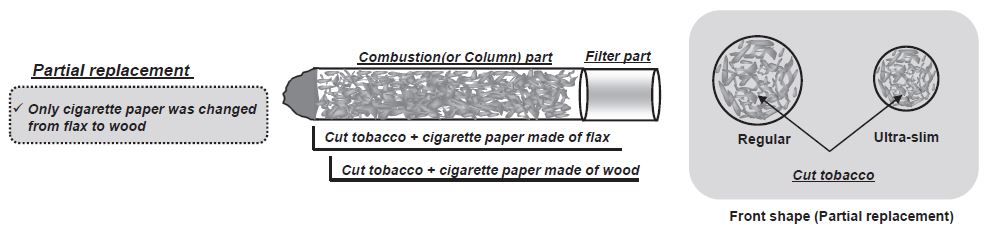
2.1.4 Analysis of the pyrolytic chemicals of cigarette in the mainstream
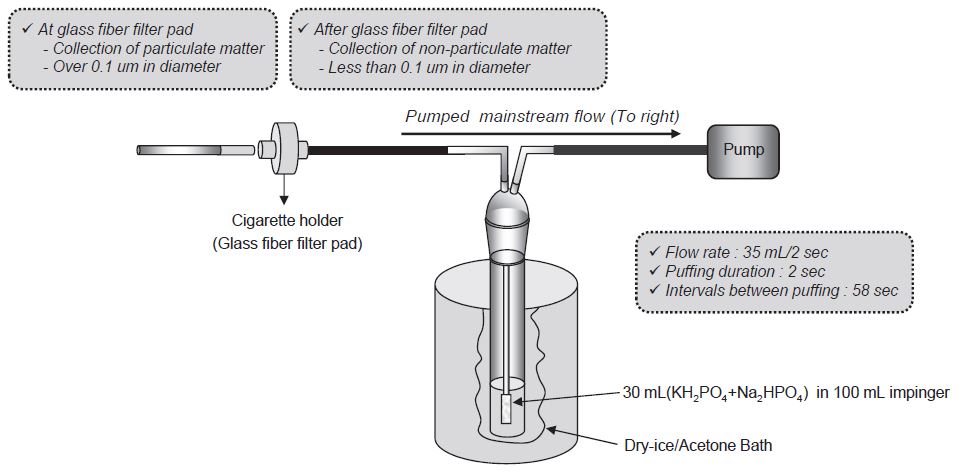
The pyrolytic chemicals of cigarettes in the mainstream smoke by combusting process, such as tar, nicotine, water and carbon monoxide (CO) amounts, were determined according to the relevant ISO standards (ISO 4387, ISO 10315, ISO 10362-1). Tar is the term applied to the smoke particulate fraction minus the water and nicotine content.2) The mainstream smoke means the smoke drawn from the mouth or butt end of cigarette, when a smoker puffs on the cigarette.2,3) As shown in Fig. 2, at the glass fiber pad (manufactured by Cambridge Filer Corporation, Syrause, New York, NY, USA), the particulate matters (over 0.1 μm in diameter) were collected, while the smoke materials (less than 0.1 μm in diameter) passing through the glass fiber filter pad were collected after the filter pad.
3. Results and Discussion
3.1 Physical properties and chemical additives of cigarette papers
As shown in Table 2, there were no significant differences in the mechanical properties and chemical additives, except for the fiber composition. The burning chemicals were the mix of citrates, sodium and potassium, and the added amounts were 0.7% and 0.8%, respectively. The mechanical properties of flax and wood cigarette papers, including basis weight, porosity, and tensile, showed similar results.
Table 2.
The physical and chemical properties of cigarette papers
3.2 Morphology of flax and wood papers
The morphologies of flax and wood paper surfaces were obtained by SEM, as shown in Fig. 3. The shape of wood fiber was comparable to that of the flax fiber. The widths of wood pulps were wider than those of flax fibers. The refining process made some strands from flax fibers that were more noticeable, compared to the wood fibers.
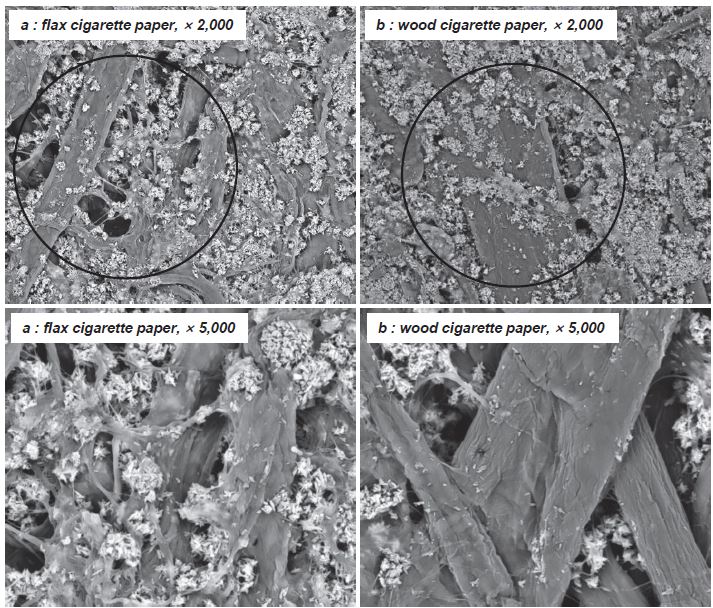
The strands and the distributed filler particles from flax made the paper structure develop more microporous than did the wood fibers. This microporosity of flax paper distributed the air flow through the paper. However, the surface morphology of wood paper showed the less distribution of filler particles and the less developed strands of wood fibers after the refining process. The porous structure of wood paper resulted in less distributed air flow through the paper than did flax paper. The degree of different mircoporosity of the flax and wood fibers affected the combustion behavior of the cigarettes. The more efficient and distributed air flow, because of the microporosity in the paper, caused more complete combustion of the cigarettes.2)
3.3 Analysis of the chemical composition of cigarette papers
The chemical components of cigarette papers from flax and wood pulp were analyzed. The amounts of cellulose, hemicellulose, and lignin are listed in Table 3. The amount of hollocelllulose was calculated from the total sum of alpha-cellulose and hemicellulose. The amounts of hollocellulose and alpha-cellulose were higher in flax cigarette paper than in the wood cigarette paper, which was in agreement with the results reported by Kim et al.1) The lower alpha-cellulose content indicated a higher proportion of noncellulosic materials.6) The extracted amounts by hot water and acetone from wood paper were 2.7% and 0.7%, respectively. Lignin contents of the flax and wood cigarette papers, known as the precursor of smoke phenolic compounds, were not detected in this research, because of the relatively small peak area. Hemicellulose and polysaccharides are found in the cell walls of all plants.2,6,10) In this research, the hemicellulose content of wood paper was 9.2%, which was lower than that of flax of 11.7%.
3.4 Analysis of the pyrolytic chemicals of cigarette in the mainstream
The large and small circumferential cigarettes with flax cigarette papers were replaced by wood cigarette papers, and the tar, nicotine and CO in mainstream smoke are shown in Figs. 4-6. All the non-tobacco materials and cut tobacco leaves remained the same, except for the cigarette papers. The ratio of flax and wood paper in the combustion part was 5% and 8% for the large and small circumferential cigarette, respectively. No significant difference was observed in the tar or nicotine. The tar deliveries of large circumferential cigarette in flax and wood paper were 5.5 mg/cig. and 5.3 mg/cig., and nicotine deliveries were 0.38 mg/cig. and 0.39 mg/cig., respectively. The similar results for tar (flax 4.5 mg/cig., wood 4.5 mg/ cig.) and nicotine deliveries (flax 0.42 mg/cig., wood 0.39 cig.) for the small circumferential cigarettes were obtained in the small circumferential cigarettes as shown in Fig. 4.
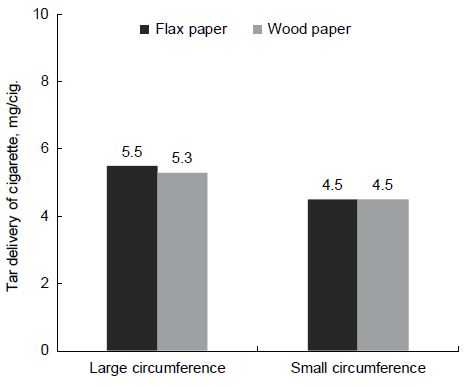
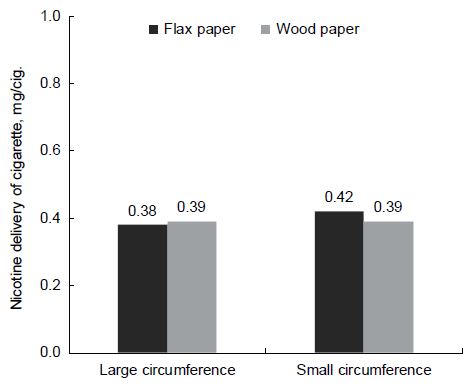
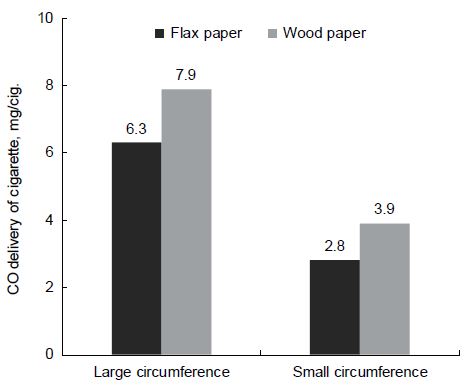
Fig. 6.
Effects of fiber composition of cigarette paper on CO (carbon monoxide) delivery by combusting process.
The use of wood paper increased CO deliveries in the mainstream smoke. The CO deliveries of large circumferential cigarette increased from 6.3 mg/ cig. to 7.9 mg/cig., when the flax paper was replaced by the wood paper. Similar results for CO deliveries were obtained in the small circumferential cigarettes, increasing from 2.8 mg/cig. to 3.9 mg/cig.
More increase of CO was observed in large circumferential cigarettes, than in small circumferential cigarettes. This was because the surface area of the large circumferential cigarettes was larger at 1,274 mm2, compared to that of small circumferential cigarettes of 1,105 mm2. The greater surface area of papers meant that the large circumferential cigarettes had more materials to combust, and to generate CO during the combustion.
It was considered that the CO increase was attributed to the less distributed air flow in the paper structure, and the difference of the degree of polymerization (DP).2,7-9) Firstly, as seen in Fig. 2, the lesser microporosity of wood papers made the air flow containing oxygen less distributed, and caused incomplete combustion. Therefore, the amounts of CO delivery increased, because of the incomplete combustion, with less oxygen and non-uniform air flow in the paper structure during combusting process. Secondly, the CO increase using the wood papers was considered to result from the higher DP of wood fibers, compared to flax fibers. Thermal pyrolysis and the degradation of cellulosic materials are affected by the degree of polymerization, molecular weight, and crystallinity, etc.7,11) The flax and wood pulps are natural cellulosic polymers, and the DP and molecular weights are different, depending on the growing conditions. The DP of flax (about 700-1,100) was lower than that found in wood (about 1,100-3,000).6,7,11) During thermal pyrolysis, the cellulose is broken down, and the breakdown products are subjected to pyrolytic changes and volatilization.8)
The use of wood paper showed the increase of CO. This was due to the larger numbers of cellulobiose unit in wood paper, because the higher cellulosic materials of wood fiber contained more sites in the cellulobiose unit to react with oxygen, and produce CO during pyrolysis.10,11)
4. Conclusions
In this study, the fiber compositions of cigarette papers were considered to evaluate the effects of flax and wood fibers of cigarette papers on the smoke chemistry of cigarettes. The replacement of flax papers by wood papers in cigarettes showed a similar level of tar and nicotine, but increased delivery of CO in the mainstream smoke by combusting process. It may be suggested that the possible reasons for different delivery of CO are: (1) microporosity, (2) DP of cellulose. And further research is needed for that.