


1. Introduction
2. Structural and Mechanistic Basis
2.1 Major derivative families and structural descriptors
2.2 From de-substitution to ultimate mineralization
3. Structure–Biodegradability Relationships
3.1 Substituent chemistry and linkage cleavability
3.2 Degree of substitution and molar substitution
3.3 Substitution topology and surface localization
3.4 Molecular weight and physicochemical accessibility
3.5 Physicochemical accessibility and material architecture
4. Environmental and Methodological Controls
4.1 Environmental conditions modify biodegradation trajectories
4.2 Inoculum characteristics and test configuration
4.3 Endpoint identity and its implications for structure–biodegradation relationships
5. Integrated Framework, Design Implications, and Outlook
5.1 An integrated structure–property– environment framework
5.2 Design implications and research priorities
1. Introduction
Cellulose is an abundant renewable polymer whose β-(1→4)-linked glucan backbone is intrinsically susceptible to enzymatic and microbial degradation. Chemical derivatization, however, is commonly required to impart solubility, thermoplasticity, barrier performance, rheological control, or compatibility with other materials. These modifications replace hydroxyl groups with ester, ether, or other functional substituents and can substantially alter the environmental fate of the resulting materials [1]. Recent standardized studies illustrate the consequence of this structural modification. In OECD 301-based aqueous screening tests, none of 14 cellulose-based pharmaceutical excipients evaluated by Bading et al. [2] satisfied the criteria for ready biodegradability, although the extent of degradation varied among derivatives. Similarly, mineralization rates of several semisynthetic cellulose derivatives were substantially lower than those of unmodified cellulose under both soil-compost and wastewater conditions [3]. Thus, the renewable origin and biodegradable backbone of cellulose do not, by themselves, determine the biodegradability of its derivatives.
The relationship between chemical modification and biodegradation is more complex than can be represented by a single structural descriptor. Degree of substitution (DS) and molar substitution (MS) are among the most frequently reported parameters and, within individual derivative families, increasing substitution generally reduces degradation rate or increases the time required for degradation [1]. Nevertheless, recent controlled studies demonstrate that average DS alone is insufficient. Functionalized cellulose nanofibrils showed degradation behavior that correlated more strongly with the degree of substitution at the material surface than with bulk-average substitution [4]. Cellulose acetates having comparable average DS but different positional distributions of acetyl groups also exhibited different marine biodegradation behavior [5]. Moreover, cellulose acetate (CA) and cellulose propionate (CP) with the same DS of 2.5 reached markedly different mineralization levels under identical marine test conditions, demonstrating that substituent chemistry exerts an effect independent of average DS [6]. Consequently, biodegradation of cellulose derivatives must be considered in terms of substituent identity and linkage chemistry, extent and distribution of substitution, and the physicochemical accessibility created by these structural features.
Environmental and methodological conditions introduce an additional level of complexity. A derivative that degrades slowly in a short screening assay may undergo substantial biodegradation when exposure is extended or when the microbial community becomes adapted. Cellulose diacetate with DS 2.5, for example, reached >90% relative biodegradation in extended freshwater and seawater simulation tests, while pre-adaptation of the freshwater microbial community shortened the observed lag phase from approximately 75 to 5 days [7]. Conversely, the apparent degradation of the same polymer class can differ strongly depending on inoculum density and test configuration. CMC with DS 0.65 showed comparatively slow mineralization in an OECD 301B screening test but >60% ultimate biodegradation within 6 h in an activated-sludge simulation test (OECD 314B) [8]. These observations also emphasize the importance of the analytical endpoint: mineralization, disappearance of the parent polymer, molecular-weight reduction, dissolution, and whole-material mass loss describe different stages or mechanisms and should not be treated as interchangeable measures of biodegradability [1,8].
Previous reviews have established that cellulose-derivative structure and degradation environment jointly influence degradation behavior [1]. Since the publication of the comprehensive review by Erdal and Hakkarainen in 2022, a substantial body of new work has emerged, including studies on additional derivative classes, functionalized celluloses, environmental degradation, and structure-dependent biodegradation. The present review therefore both updates the evidence base through 2026 and re-examines it using a descriptor-based framework organized around molecular structure, degradation endpoint, and environmental context. Particular attention is given to substituent and linkage chemistry, DS (or MS, where conventionally reported), substitution pattern, molecular weight or degree of polymerization (MW/DP), and accessibility-related physicochemical properties. Environmental and methodological variables—including degradation compartment, inoculum characteristics, adaptation, temperature, test configuration, and analytical endpoint—are evaluated in parallel to determine when apparent structural effects can be meaningfully compared across studies.
The evidence base for this narrative review was assembled through targeted searches in Scopus, iterative refinement of derivative- and degradation-related search terms, and backward reference tracing from relevant reviews and primary studies. Studies were considered when they provided experimental information relevant to the degradation or biodegradation of chemically modified cellulose, or mechanistic and physicochemical information needed to interpret such behavior. The evidence-mapping process identified 52 primary studies spanning direct environmental biodegradation, mechanistic enzymatic or structural studies, application-level degradation tests, and supporting physicochemical studies. Of these, 33 primary studies were directly cited in the narrative synthesis, while the broader set was used to map the available evidence and identify recurring or supporting findings.
For evidence synthesis, the 52 studies were further classified according to the type of evidence they provided. Core evidence (n = 20) comprised studies reporting direct degradation or biodegradation data for cellulose derivatives in controlled biological or environmental systems. Mechanistic support (n = 12) comprised studies providing enzymatic, structural, de-substitution, hydrolytic, or related evidence relevant to degradation mechanisms. Application-level support (n = 17) included studies of blends, coatings, composites, films, or other multicomponent systems in which the response of the cellulose derivative could not always be isolated from formulation effects. Background studies (n = 3) provided relevant physicochemical or structural context but no direct degradation endpoint.
Each study was evaluated using a common extraction framework covering derivative and substituent identity, substitution level and pattern, MW/DP, relevant physical properties, material form, environment, inoculum, test method, temperature, duration, endpoint, and degradation outcome. Quantitative comparisons were restricted to studies with sufficiently compatible endpoints and experimental contexts, while multicomponent application studies were interpreted separately from intrinsic derivative behavior. The available evidence was predominantly derived from aerobic biodegradation studies, although anaerobic investigations were also considered where available. Accordingly, the structure–biodegradability relationships discussed in this review are primarily supported by aerobic systems, and their applicability to anaerobic environments remains less well established. On this basis, the objectives of this review are to identify the best-supported structure–biodegradability relationships, distinguish intrinsic structural effects from environmental and methodological influences, resolve apparently conflicting findings through endpoint-specific interpretation, and identify descriptors relevant to future predictive modeling and the design of cellulose derivatives with controlled environmental lifetimes.
2. Structural and Mechanistic Basis
2.1 Major derivative families and structural descriptors
Cellulose consists of β-(1→4)-linked anhydroglucose units (AGUs), each containing three hydroxyl groups at the C2, C3, and C6 positions that can undergo chemical modification. Representative structures of cellulose and selected cellulose derivatives are shown in Fig. 1. Derivatization improves properties such as solubility, thermoplasticity, film-forming ability, rheological control, and barrier performance, but simultaneously alters molecular and physicochemical features relevant to microbial and enzymatic degradation [1].
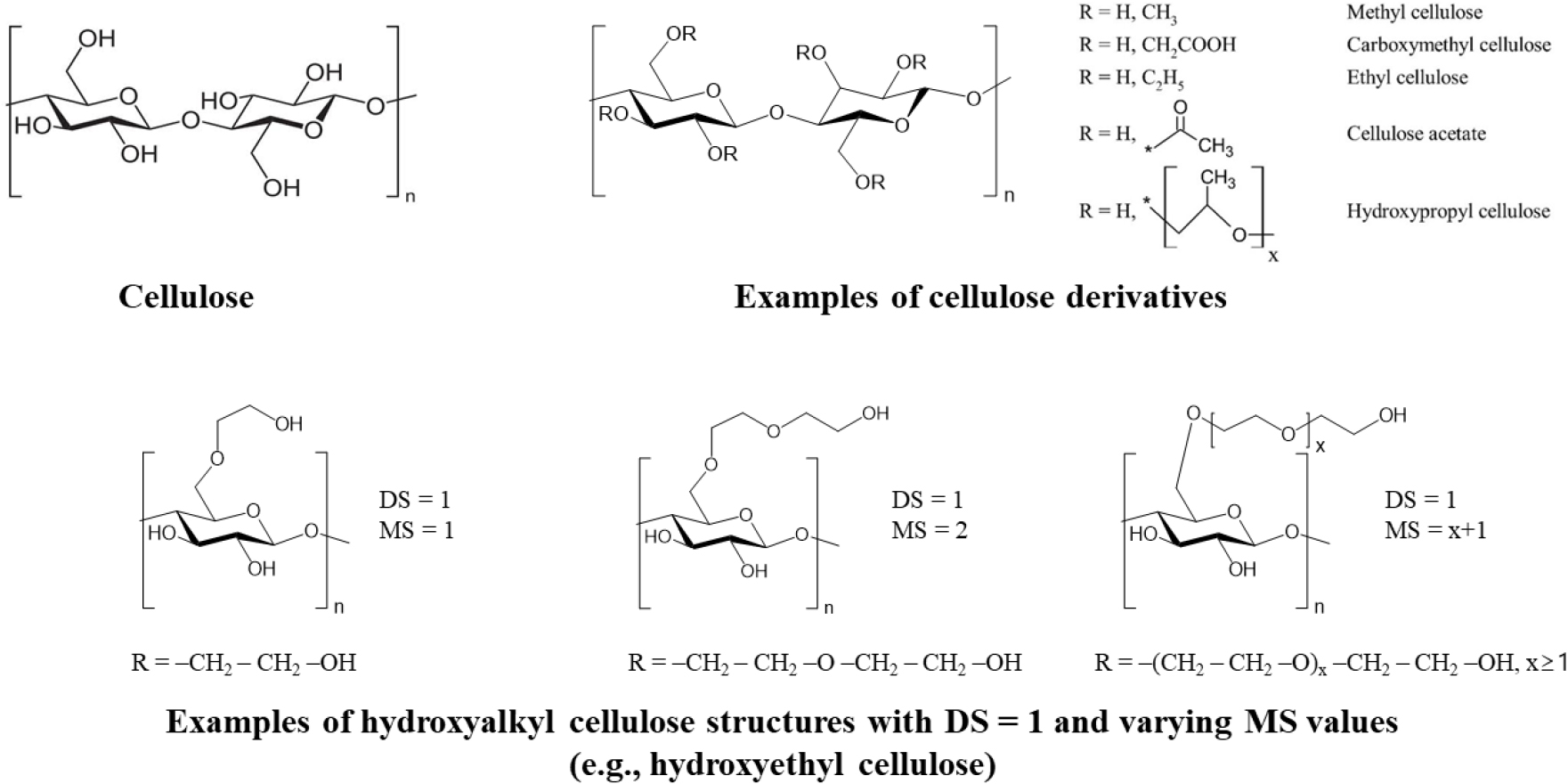
Cellulose esters include CA, cellulose propionate, cellulose butyrate, and mixed esters such as cellulose acetate propionate (CAP) and cellulose acetate butyrate (CAB). Their substituents are connected through ester linkages that can undergo hydrolytic or enzymatic cleavage. Cellulose ethers include methyl cellulose (MC), ethyl cellulose (EC), carboxymethyl cellulose (CMC), hydroxyethyl cellulose (HEC), hydroxypropyl cellulose (HPC), and mixed ethers such as hydroxypropyl methylcellulose (HPMC). Ether-linked substituents are generally more resistant to de-substitution, and degradation may therefore depend more strongly on the accessibility and distribution of unsubstituted or weakly substituted cellulose sequences [9,10].
The extent of substitution is most commonly described by the DS, defined as the average number of hydroxyl groups per AGU replaced by substituents. Because each AGU contains three hydroxyl groups, DS ranges theoretically from 0 to 3 for derivatives in which one substituent can occupy each hydroxyl position. For hydroxyalkyl derivatives such as HEC and HPC, however, the introduced side chains contain new hydroxyl groups that can undergo further reaction. Their substitution is therefore also described using MS, which represents the average number of moles of substituent introduced per AGU and is not restricted to a maximum value of three [2,11]. DS and MS consequently describe related but chemically different aspects of substitution and should not be compared as equivalent quantities across derivative families.
Importantly, average DS or MS does not uniquely define the molecular structure of a cellulose derivative. Two samples with the same average DS may differ in the relative substitution of the C2, C3, and C6 positions, the distribution of substituted and unsubstituted AGUs along the chain, the length of hydroxyalkyl side chains, or the localization of modification at the material surface. These distinctions are biologically relevant because cellulolytic enzymes recognize and interact with local structural motifs rather than an average substitution value. Early enzymatic studies already indicated that cellulose-ether degradation depended on the availability and distribution of unsubstituted glucose units [9,10], while more recent work has demonstrated that regioselective and surface-localized substitution can alter biodegradation even when average substitution is similar [4,5].
A second structural dimension is the molecular size of the cellulose backbone, typically reported as molecular weight (MW), degree of polymerization (DP), or viscosity grade. In principle, shorter chains may provide a greater number of chain ends and may differ in solubility or accessibility; however, MW frequently changes simultaneously with substitution chemistry, processing history, and morphology. Consequently, its independent contribution to cellulose-derivative biodegradability remains less clearly established than that of substituent chemistry or DS/MS.
Chemical substitution also modifies physicochemical properties that determine whether enzymes and microorganisms can access the polymer. Depending on substituent chemistry and distribution, derivatization may alter water affinity, swelling, solubility, crystallinity, chain packing, surface energy, and morphology. These properties should not be regarded as separate from molecular structure; rather, they represent the physicochemical consequences through which structure is translated into biological accessibility. Leppänen et al. [12], for example, found that enzymatic hydrolysis of chemically modified cellulose films decreased as substitution increased and also differed according to substituent chemistry, illustrating the combined influence of chemical modification and material structure on enzymatic susceptibility.
For this review, biodegradation-relevant structure is therefore organized into four principal dimensions: (i) substituent identity and linkage chemistry, (ii) extent of substitution, expressed primarily as DS and as MS where applicable, (iii) substitution pattern, and (iv) molecular size, expressed as MW or DP. These descriptors are interpreted together with accessibility-related physicochemical properties. This distinction provides the structural basis for evaluating how chemical derivatization modifies the sequential processes leading from initial polymer recognition to ultimate biodegradation. The major cellulose-derivative classes considered in this review, together with their principal structural descriptors and general biodegradation trends, are summarized in Table 1.
Table 1.
Major cellulose-derivative classes and structural features relevant to biodegradation
|
Derivative class |
Representative derivatives |
Main substituent / linkage |
Key structural descriptors | Main biodegradation trend |
Studies used in this review |
|
Cellulose acetate |
CA; cellulose diacetate; cellulose triacetate | Acetyl / ester |
DS; C2/C3/C6 substitution; substitution distribution; surface vs bulk substitution; MW/DP |
• Higher DS generally delays degradation within comparable systems. • Deacetylation, substitution pattern, morphology, and environment can strongly modify the response. | [3], [5], [7], [12,13,14,15,16,17,18,19,20,21] |
|
Other simple cellulose esters |
CP; cellulose butyrate |
Propionyl, butyryl / ester |
DS; substituent identity; acyl-chain length; MW/DP |
• Biodegradation depends strongly on acyl substituent identity as well as DS. • Propionyl/butyryl substitution can produce substantially different behavior from acetyl substitution. | [6], [14] |
|
Mixed cellulose esters | CAP; CAB |
Acetyl + propionyl or butyryl / ester |
Total DS; individual acyl contents; substituent ratio; MW/DP |
• Degradation reflects the combined effects of total substitution and acyl composition. • Composition–property–degradation relationships are often confounded by simultaneous structural changes. | [22] |
|
Carboxymethyl cellulose |
CMC; Na-CMC |
Carboxymethyl / ether |
DS; substitution sequence/distribution; MW/DP |
• Increasing DS generally reduces cellulolytic susceptibility. • Microbial adaptation and test configuration can strongly influence observed biodegradation. | [2], [3], [8], [10], [23,24,25,26,27] |
|
Alkyl cellulose ethers | MC; EC |
Methyl, ethyl / ether |
DS; substitution distribution; MW/DP |
• Increasing alkyl substitution generally reduces hydration and degradability. • Environmental evidence, particularly for EC, remains limited. | [3], [9], [10], [27], [28] |
|
Hydroxyalkyl cellulose ethers | HEC; HPC |
Hydroxyethyl, hydroxypropyl / ether |
MS; DS where relevant; side-chain architecture; substitution distribution; MW/DP |
• Greater hydroxyalkyl substitution is generally associated with lower enzymatic susceptibility. • DS and MS often covary, limiting attribution to a single descriptor. | [3], [10], [11], [25], [29] |
|
Mixed cellulose ethers | HPMC; HEMC |
Methyl/ethyl + hydroxyalkyl / ether |
Alkyl DS; hydroxyalkyl MS; MW; viscosity grade |
• Biodegradation varies with both substitution composition and molecular size. • Commercial grades often confound DS/MS, MW, and viscosity effects. | [2], [3], [29] |
|
Surface- functionalized cellulose |
Functionalized CNF/CNC |
Surface ester, ether, carboxyl, or other functional groups |
Surface DS; bulk-average DS; surface area; particle dimensions |
• Surface modification can strongly alter biodegradation. • Surface DS may be more informative than bulk-average DS for nanocellulose. | [4] |
|
Reversibly or secondarily functionalized cellulose |
Cellulose acetals; modified HEC; cellulose carbamate-type derivatives |
Cleavable/ reversible or secondary functionality |
DS of secondary functionality; linkage cleavability; residual substitution; MW/DP |
• Removal of secondary functionality can facilitate subsequent cellulose degradation. • De-functionalization itself should not be equated with ultimate biodegradation. | [30,31,32] |
|
Grafted and structurally complex cellulose derivatives |
Cellulose ester–graft–PLA; chemically modified cellulose films |
Grafted or multiple functionalities |
Parent-cellulose DS; graft composition/length; MW; morphology; crystallinity |
• Degradation depends jointly on substitution, graft structure, morphology, and phase organization. • These systems are useful for formulation effects but less suitable for isolating intrinsic structural effects. | [12], [33] |
Abbreviations: CA, cellulose acetate; CAB, cellulose acetate butyrate; CAP, cellulose acetate propionate; CMC, carboxymethyl cellulose; CNC, cellulose nanocrystal; CNF, cellulose nanofibril; CP, cellulose propionate; DS, degree of substitution; EC, ethyl cellulose; HEC, hydroxyethyl cellulose; HEMC, hydroxyethyl methylcellulose; HPC, hydroxypropyl cellulose; HPMC, hydroxypropyl methylcellulose; MC, methyl cellulose; MS, molar substitution; MW, molecular weight; DP, degree of polymerization.
Note: Studies are listed according to the derivative class and structural interpretation for which they are used in this review; some cross-derivative studies therefore appear in more than one row. Application-level studies are included where they provide relevant degradation evidence, but whole-material degradation is not interpreted as intrinsic biodegradation of the individual cellulose derivative unless derivative-specific degradation can be distinguished.
2.2 From de-substitution to ultimate mineralization
Biodegradation of cellulose derivatives generally requires restoration of sufficient accessibility to the cellulose backbone before extensive cellulolytic cleavage can proceed. The specific route depends strongly on the chemistry of the substituent linkage. For cellulose ethers, the ether bond is comparatively resistant to biological cleavage, and degradation is therefore thought to proceed preferentially through unsubstituted or weakly substituted regions of the backbone [9,10]. In contrast, cellulose esters can undergo de-esterification, which progressively regenerates hydroxyl groups and increases the resemblance of the modified polymer to native cellulose.
CA provides the clearest evidence for such a sequential mechanism. Buchanan et al. [13] observed that CA recovered after microbial exposure exhibited both a decrease in average DS and changes in molecular-weight distribution, indicating that deacetylation and backbone degradation occurred during biodegradation. Lower-substituted CA films were degraded more rapidly than more highly substituted materials, consistent with the view that acetyl groups hinder access to the cellulose backbone and that their removal facilitates subsequent hydrolysis [13].
Enzyme-based studies provide more direct evidence for the coupling between de-substitution and backbone cleavage. Haske-Cornelius et al. [18] showed that esterases could deacetylate CA with degrees of acetylation up to approximately 1.8, and that subsequent cellulase treatment released more glucose from pre-deacetylated CA than from untreated material. For CA with DS 1.8, esterase pretreatment increased glucose recovery from approximately 15% to 28%. This synergistic response supports a mechanism in which deacetylation increases the number of cellulose-like regions accessible to cellulolytic enzymes.
A similar effect was observed when the deacetylation step was initiated from within the material itself. Kalita and Hakkarainen incorporated immobilized lipase into CA films and found that enzyme-containing films underwent substantially greater deacetylation and molecular-weight reduction than neat CA during aging in the presence of lipase and cellulase [19]. After 40 days, the number-average molecular weight of the CA film containing 5% immobilized lipase decreased by 88%, compared with 48% for the CA control, while the water contact angle decreased from 59° to 16°, indicating a pronounced increase in surface hydrophilicity. The same material also showed much more extensive disintegration during simulated composting. These observations illustrate how de-substitution can simultaneously alter chemical structure and physicochemical accessibility, thereby accelerating subsequent chain cleavage.
However, deacetylation should not be interpreted as a mandatory abiotic pretreatment for all CA degradation. Serbruyns et al. [7] reported >90% relative biodegradation of cellulose diacetate with DS 2.5 in extended freshwater and seawater simulation tests and concluded that prior abiotic hydrolysis to reduce DS was not required to initiate biodegradation. This finding suggests that deacetylation may occur biologically within the microbial degradation sequence rather than necessarily preceding it as an independent environmental process. The long lag period observed in freshwater, and its substantial shortening after microbial pre-adaptation, further indicate that the onset of biodegradation depends not only on material structure but also on the prior exposure and functional capacity of the microbial community, as discussed further in Section 4.2.
The mechanistic sequence is therefore better represented as a set of coupled biological transformations than as a rigid two-step process. For cellulose esters, de-substitution may occur before or concurrently with backbone cleavage, depending on substrate structure and microbial community. For cellulose ethers, where substituent removal is more limited, cellulolytic attack may instead depend on the availability and continuity of unsubstituted regions [9,10]. In both cases, primary degradation ultimately generates lower-molecular-weight fragments that can become accessible for microbial uptake.
Importantly, primary degradation is not equivalent to ultimate biodegradation. Changes in DS, molecular weight, viscosity, or polymer identity demonstrate chemical or macromolecular transformation but do not establish complete conversion of polymer carbon to inorganic products. Wilcox et al. [8] demonstrated this distinction directly for CMC with DS 0.65 in activated sludge. The starting polymer shifted rapidly toward lower-molecular-weight oligomers, with a primary degradation rate of approximately 5.0 h-1, whereas ultimate biodegradation proceeded at lower rates of approximately 0.8–1.6 h-1. These results indicate that breakdown of the parent polymer to lower-molecular-weight products can proceed more rapidly than their subsequent mineralization.
This distinction is especially important for substituted polysaccharides because intermediate fragments may retain substituents and therefore require additional extracellular or intracellular transformations before assimilation. The complete pathway can therefore be conceptualized as a sequence involving de-substitution and/or initial chain cleavage, formation of lower-molecular-weight oligomers, further depolymerization to assimilable products, microbial uptake, and ultimate mineralization to CO2 and H2O under aerobic conditions or CO2 and CH4 under anaerobic conditions. This conceptual pathway is summarized in Fig. 2.
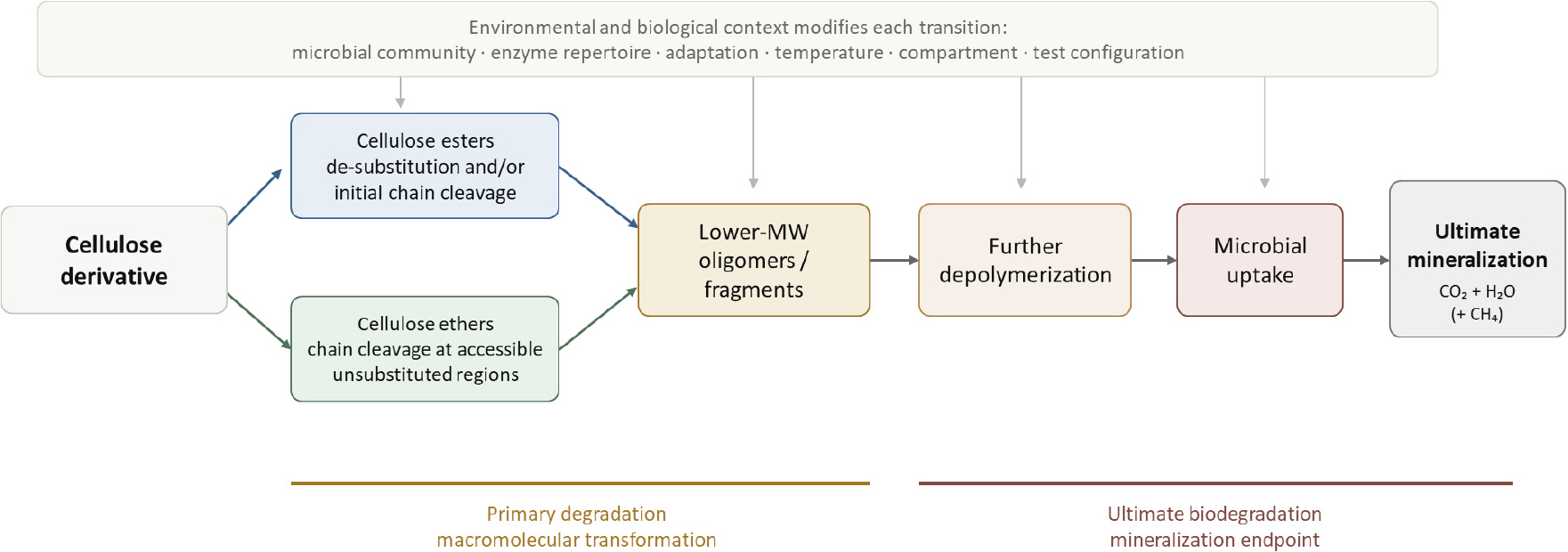
The relative importance and rate of each step depend on substituent chemistry, DS/MS, substitution pattern, physicochemical accessibility, and the microbial environment. Consequently, a slow overall mineralization rate may arise from different rate-limiting steps in different cellulose derivatives. In one material, de-substitution may be rate-limiting; in another, backbone cleavage, transport, or microbial assimilation may dominate. This mechanistic distinction provides the basis for interpreting the structure–biodegradability relationships discussed in Section 3.
3. Structure–Biodegradability Relationships
3.1 Substituent chemistry and linkage cleavability
The effect of substitution on biodegradability depends not only on its extent but also on the chemical nature of the substituent. Substituents modify hydrophobicity, steric environment, intermolecular interactions, and the susceptibility of the linkage connecting the side group to the cellulose backbone. Consequently, cellulose derivatives with similar average DS may exhibit markedly different degradation behavior when the substituent chemistry differs.
Early radiolabel experiments provide particularly strong evidence for this effect. Komarek et al. [14] compared CA and CP over overlapping DS ranges using a mixed microbial culture and 14C-labeled ester groups. CA with DS 1.85 showed >80% conversion of labeled polymeric carbon to 14CO2, while CA with DS 2.07 and 2.57 still exceeded 60% conversion. In contrast, CP samples with DS 2.11, 2.44, and 2.64 showed only 0.09–1.1% conversion over the test period. Importantly, cellulose propionate with lower DS values (1.77–1.84) still reached approximately 70 to >80% conversion within 29 days, indicating that propionyl substitution did not prevent biodegradation but required a lower substitution level for rapid mineralization.
A more recent matched-structure comparison strengthens this interpretation. Kotcharoen et al. [6] evaluated CA and CP films with the same DS of 2.5 under identical marine test conditions. After 119 days, CA reached 27.1% mineralization whereas CP reached only 2.3% (Fig. 3A). Because average DS and environmental conditions were controlled, the large divergence provides direct evidence that substituent identity influences biodegradation independently of DS. The bulkier and more hydrophobic propionyl group likely affects several interacting processes, including water access, ester cleavage, and polymer–microbe interactions, although the relative contribution of each mechanism cannot be isolated from the available data. More complex ester systems provide supporting evidence. Lee et al. [33] investigated cellulose ester–graft–polylactide copolymers containing acetyl, propionyl, or hexanoyl substituents and found that materials with lower acyl substitution exhibited measurable enzymatic weight loss after sequential proteinase K and cellulase treatment. Longer acyl groups tended to be associated with reduced enzymatic degradability, consistent with increasing hydrophobic and steric constraints. Similarly, Berget et al. [22] observed composition-dependent biodegradation among commercial CAB materials during soil testing. The most degradable CAB reached 22% after 28 days, whereas two variants with higher butyryl-to-acetyl ratios reached approximately 11% and 9%, respectively. These results are consistent with reduced susceptibility as the relative content of the longer butyryl substituent increases.
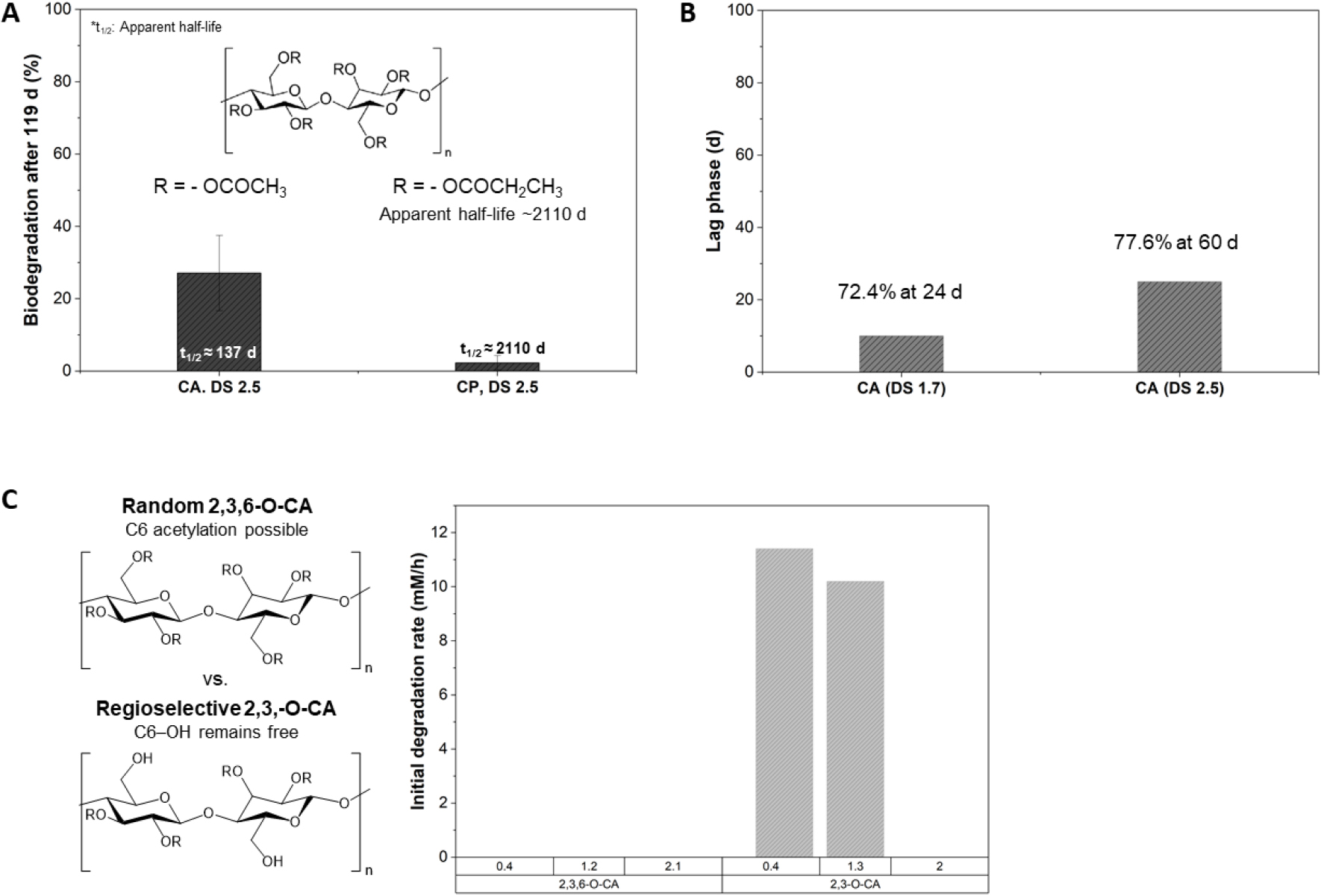
Fig. 3.
Fig. 3. Structural determinants of cellulose-derivative biodegradation beyond average substitution level. (A) Effect of substituent chemistry at matched degree of substitution. Cellulose acetate (CA) and cellulose propionate (CP) [6]; (B) Effect of substitution level on mineralization kinetics of CA under thermophilic composting conditions. [15]; (C) Effect of substitution position on enzymatic susceptibility of CA [34]. All panels were independently redrawn from numerical values reported in the cited studies rather than reproduced from the original figures.
Substituent effects are also determined by the cleavability of the bond linking the substituent to cellulose. In cellulose esters, enzymatic or hydrolytic de-esterification can regenerate hydroxyl groups and thereby facilitate subsequent cellulolytic attack. Haske-Cornelius et al. [18] demonstrated this directly for CA: esterase pretreatment increased glucose recovery during subsequent cellulase treatment, with CA of DS 1.8 increasing from approximately 15% to 28% glucose recovery. Kalita and Hakkarainen [19] similarly showed that promoting deacetylation through embedded lipase accelerated molecular-weight reduction and subsequent material deterioration. These findings indicate that substituent removal can function as a kinetic gateway to backbone degradation.
The importance of linkage chemistry becomes even clearer when deliberately reversible substituents are introduced. Peil et al. [30] prepared cellulose acetals in which the substituent linkage was designed to undergo hydrolysis under mildly acidic conditions. For cellulose cyclohexyl acetal, initial mass loss corresponded predominantly to acetal cleavage and regeneration of cellulose; once sufficient deacetalization had occurred, cellulase-driven fragmentation accelerated, and up to 100% gravimetric loss was reached after 27 days. Cellulose butyl acetal followed the same two-stage mechanism but required approximately 59 days for complete gravimetric loss under the tested conditions. Although these results represent hydrolysis and enzymatic disintegration rather than ultimate mineralization, they demonstrate that even highly substituted cellulose can remain degradable if the introduced functionality is connected through a reversible linkage. This concept is not restricted to cellulose acetate. Efiana et al. [31] attached betaine to HEC through an ester linkage and found that lipase cleaved approximately 80% of the betaine substituent within 6 h. The experiment demonstrates rapid enzymatic de-functionalization of the modified polymer, although it does not establish complete degradation or mineralization of the HEC backbone. Such studies are mechanistically valuable because they distinguish removal of the introduced functionality from subsequent degradation of the underlying polysaccharide.
Taken together, these results suggest that substituent chemistry may influence biodegradation through both physicochemical accessibility and linkage cleavability. Bulky or hydrophobic groups can limit hydration and enzyme access, whereas cleavable linkages may permit progressive de-substitution during degradation. More resistant linkages may prolong the inhibitory effect of substitution even at relatively low substitution levels. Because these effects are closely coupled with substitution level and experimental conditions, their individual contributions are difficult to isolate across unmatched studies.
Accordingly, a universal ranking of cellulose substituents by biodegradability cannot be established from cross-study comparisons in which substitution level and test conditions differ. The strongest evidence comes from controlled comparisons in which substitution level and experimental conditions are held constant [6,14]. These studies indicate that substituent identity, substitution level, and linkage cleavability should be considered jointly when interpreting biodegradation behavior. The effect of substitution level is examined separately in Section 3.2, while the influence of substitution pattern is addressed in Section 3.3.
3.2 Degree of substitution and molar substitution
Among the structural descriptors of cellulose derivatives, the DS is the most frequently used predictor of degradability. Increasing DS decreases the fraction of unsubstituted anhydroglucose units and can alter hydration, intermolecular interactions, and accessibility of the cellulose backbone. Consequently, within a given derivative family and under comparable degradation conditions, increasing substitution generally decreases degradation rate and/or increases the lag period before substantial degradation occurs [1]. However, the magnitude of this effect depends strongly on substituent chemistry and test conditions, making DS more appropriately interpreted as a kinetic constraint within a defined chemical and environmental context than as a universal biodegradability threshold.
The relationship is particularly well established for CMC. In early enzymatic experiments, Wirick examined CMC samples spanning DS 0.41–2.45 and found progressively greater resistance to cellulase attack with increasing substitution; the DS 2.45 sample was essentially refractory under the tested enzymatic conditions [10]. This behavior was related to the abundance and continuity of unsubstituted anhydroglucose units along the polymer chain, indicating that the effect of average DS is mediated in part by the local availability of cellulase-accessible sequences. Importantly, this was an enzymatic chain-cleavage experiment rather than a mineralization assay, and the observed resistance therefore reflects susceptibility to primary degradation rather than ultimate biodegradation. A subsequent study using wastewater-derived microbial cultures showed a comparable dependence on substitution level. Wirick compared CMC samples with DS 0.41 and 0.75 and found that the lower-substituted material was more readily degraded and that microbial acclimation occurred more rapidly [23]. Acclimation to the lower-DS CMC approached its maximum after approximately 6 weeks, whereas adaptation to the more highly substituted CMC proceeded considerably more slowly. These findings indicate that substitution can influence not only immediate enzymatic susceptibility but also the time required for microbial communities to develop an effective degradative response. Thus, the effect of substitution may be expressed through differences in microbial adaptation as well as degradation rate and extent.
At the same time, moderate substitution does not imply rapid degradation within the conventional duration of a screening assay. Van Ginkel and Gayton reported only 25% biodegradation of CMC with DS 0.7 after 28 days in a closed-bottle test, whereas oxygen consumption increased to 58% of theoretical oxygen demand after 110 days [24]. More recently, Wilcox et al. [8] evaluated CMC with DS 0.65 and observed 41.0–46.7% mineralization after 28 days and 55.2–63.7% after 70 days in OECD 301B screening tests. Under activated-sludge simulation conditions, however, the same CMC chemistry reached >60% ultimate biodegradation within approximately 6 h. These findings demonstrate that DS alone cannot determine whether a material will satisfy a fixed-duration biodegradability criterion; the biological opportunity provided by the test system is equally important.
Cellulose acetate provides another well-documented example of a within-family DS effect. Buchanan et al. [13] found that CA films with DS 1.7 underwent >80% degradation within 4–5 days in an enrichment culture, whereas CA with DS 2.5 required approximately 10–12 days for extensive degradation. In a wastewater-treatment assay, approximately 70% degradation of the DS 1.7 film occurred in 27 days, while the DS 2.5 material required approximately 10 weeks before significant degradation was observed. Cellulose triacetate with DS 2.95 showed no significant film weight loss during 28 days under the same enrichment-test framework. These observations provide strong evidence that increasing acetyl substitution progressively slows CA degradation, but they also show that the apparent effect depends on exposure duration and inoculum.
Thermophilic compost experiments similarly demonstrate that increasing DS can lengthen the lag phase without necessarily preventing extensive mineralization. Gu et al. [15] compared CA with DS 1.7 and 2.5 at 53 °C and 60% moisture. The lower-DS material exhibited a lag of approximately 10 days and reached 72.4% mineralization after 24 days, whereas the DS 2.5 material showed an approximately 25-day lag but ultimately reached 77.6% mineralization after 60 days (Fig. 3B). The principal effect of increased substitution in this comparison was therefore a substantial slowing of the process rather than elimination of ultimate biodegradation.
Broader comparative studies support the same overall trend, although they provide less direct evidence for an independent DS effect. Leppänen et al. [12] compared 14 cellulose-based films under a common 48-h enzymatic hydrolysis protocol and observed an overall decrease in hydrolysis with increasing DS. However, the materials differed in substituent chemistry, solubility, crosslinking, and physical structure. Notably, the only systematic within-chemistry DS series comprised butylated hemicellulose with DS values of 0.2, 0.4, and 1.0, rather than a cellulose derivative. The study therefore supports substitution level as an important descriptor of enzymatic accessibility, but does not establish a universal quantitative DS–degradability relationship across cellulose-derivative classes.
The dependence of DS effects on derivative chemistry and test configuration is particularly important when interpreting historical DS thresholds. Gardner et al. [16] reported that CA films with DS below approximately 2.20 disintegrated and lost mass in bench-scale compost at rates comparable to PHBV. This value has sometimes been interpreted more broadly as a biodegradability cutoff for CA. However, the reported criterion was based primarily on film disintegration and weight loss under a specific composting configuration, rather than a universal mineralization threshold. As discussed above, later simulation studies showed that cellulose diacetate with a DS of 2.5 could still undergo extensive biodegradation under aquatic conditions [7]. Therefore, DS values above ~2.2 cannot be categorically equated with environmental non-biodegradability. The same caution applies when DS is compared across different derivative chemistries. As discussed in Section 3.1, materials with the same DS can show markedly different biodegradation behavior when the substituent chemistry differs [6]. DS therefore quantifies the average extent of substitution, but does not capture differences in substituent size, hydrophobicity, linkage susceptibility, or substitution pattern. For cross-family comparisons, DS should be interpreted together with substituent identity rather than as an independent universal predictor.
Hydroxyalkyl cellulose derivatives require an additional descriptor because hydroxyalkylation is not limited to the three original hydroxyl positions of the AGU. Unlike DS, which represents the average number of substituted hydroxyl positions per AGU and is limited to three, MS represents the average number of hydroxyalkyl units introduced per AGU. Because newly introduced hydroxyalkyl groups contain reactive hydroxyl groups, successive hydroxyalkylation can produce oligomeric side chains, allowing MS to exceed three (Fig. 1). Importantly, the same MS value does not necessarily indicate the same substitution architecture. For example, an MS of 2 can correspond to idealized structures with a DS of 1, in which two hydroxyalkyl units extend a single substituted position, or a DS of 2, in which one hydroxyalkyl unit is attached to each of two positions. These structures differ in the number of substituted backbone positions and side-chain lengths, potentially influencing steric accessibility and enzymatic susceptibility. Thus, DS and MS cannot be directly compared as interchangeable measures of substitution.
Evidence for a substitution–degradation relationship is available for HEC. Diao et al. [11] compared four HEC samples with MS values of 2.12–3.51 and similar molecular weights and found that susceptibility to cellulase decreased as MS increased. The apparent enzymatic degradation rate constant, determined from viscosity changes, decreased from approximately 0.11 to 0.059 min-1 across the series. These results support an inhibitory effect of increasing hydroxyethyl substitution on enzymatic chain degradation. However, DS and substitution distribution also varied among the samples, so the observed trend cannot be attributed to MS alone. The endpoint was also enzymatic depolymerization rather than environmental mineralization.
Compared with CA and CMC, however, systematic environmental datasets for hydroxyalkyl and mixed cellulose ethers remain sparse. HEC, HPC, HPMC, and related derivatives are often reported as commercial grades that differ simultaneously in MS, DS, viscosity, MW, and substituent composition [2]. Consequently, the quantitative relationship between MS and ultimate biodegradation is much less resolved than the relationship between DS and degradation for CA or CMC. Direct comparison of numerical DS and MS values across derivative families should also be avoided because the two descriptors represent different substitution architectures.
Overall, the available evidence supports a consistent but qualified conclusion: increasing substitution generally increases resistance to degradation within a defined cellulose-derivative family and test system, typically by reducing backbone accessibility and increasing degradation lag and/or decreasing degradation rate. What the evidence does not support is a universal DS value above which cellulose derivatives become non-biodegradable. High substitution may substantially slow degradation, yet extended exposure, microbial adaptation, cleavable substituents, or favorable environmental conditions can still enable extensive biodegradation [7,15].
DS and MS should therefore be treated as kinetic structural descriptors rather than binary biodegradability criteria. Their predictive value is greatest within a defined derivative chemistry and environmental context. Importantly, however, average substitution does not specify where substituents are located. This limitation leads to the next structural question: whether positional and spatial differences in substitution can alter degradation even when average DS is comparable.
3.3 Substitution topology and surface localization
Average DS describes the mean number of substituents per anhydroglucose unit but does not specify where those substituents are located. Cellulose contains chemically nonequivalent hydroxyl groups at the C2, C3, and C6 positions, and derivatization can generate random, preferential, or deliberately regioselective substitution patterns. Consequently, cellulose derivatives with the same average DS may present markedly different local sequences of substituted and unsubstituted residues to enzymes and microorganisms. This distinction is particularly important when degradation depends on recognition of specific hydroxyl configurations or access to contiguous unsubstituted regions. Evidence from regioselectively acetylated cellulose and surface-functionalized nanocellulose therefore indicates that substitution topology should be treated as a structural descriptor distinct from average DS [4,5,34].
Direct evidence for positional effects was provided by Takeda et al. [34], who compared randomly substituted 2,3,6-O-cellulose acetate with regioselectively substituted 2,3-O-cellulose acetate in which the C6 position remained unsubstituted. The two series were prepared at comparable substitution levels: random 2,3,6-O-CA had DS values of 0.4, 1.2, and 2.1, whereas 2,3-O-CA had DS values of 0.4, 1.3, and 2.0. When exposed to Trichoderma reesei cellulase, the regioselectively substituted 2,3-O-CA samples with DS 0.4 and 1.3 were more susceptible to hydrolysis than the corresponding randomly substituted materials. At a relatively low cellulase concentration, the initial reducing-sugar production rates for 2,3-O-CA with DS 0.4 and 1.3 were 11.4 and 10.2 mM h-1, respectively, whereas the random 2,3,6-O-CA samples showed essentially no detectable hydrolysis under the same short-term conditions (Fig. 3C). At DS values of approximately 2 or higher, both substitution patterns became highly resistant to cellulase. These results demonstrate that average DS alone does not uniquely determine enzymatic accessibility.
The enhanced hydrolysis of 2,3-O-CA indicates that preservation of the primary C6 hydroxyl group can facilitate cellulase-mediated degradation. Several explanations are possible, including differences in hydrogen bonding, hydration, steric accessibility, and recognition of the glucan chain by cellulolytic enzymes. Importantly, however, the Takeda study evaluated enzymatic primary degradation rather than environmental mineralization. It therefore establishes a clear positional effect on cellulase susceptibility but does not by itself prove that C6-unsubstituted CA will always mineralize more rapidly in soil, compost, or aquatic environments. This distinction becomes important when extending regioselectivity effects from isolated enzyme systems to natural microbial communities.
More recent marine biodegradation experiments provide environmental support for the same structural principle. Li et al. [5] prepared cellulose acetate by direct esterification or partial de-esterification, producing materials with similar average DS but different positional distributions of acetyl groups; the de-esterified samples had lower C6 and higher C2 substitution. In biochemical oxygen demand tests using seawater and marine sediment inocula, the de-esterified cellulose acetates consistently exhibited greater biodegradability than directly esterified materials at comparable DS. The difference became more apparent as average DS increased, supporting the interpretation that positional distribution can become increasingly important when the overall fraction of free hydroxyl groups becomes limited. Together with the enzyme-specific findings of Takeda et al. [34], these observations provide evidence across two different endpoint levels—enzymatic hydrolysis and microbial oxygen consumption—that C6 substitution can disproportionately influence CA degradation at a given average DS.
Nevertheless, the available evidence does not yet justify a universal positional hierarchy such as C6 > C2 > C3 for all cellulose derivatives. Both Takeda et al. [34] and Li et al. [5] focused primarily on acetate substitution, and positional effects may differ for larger, charged, or hydroxyalkyl substituents. Moreover, substitution position can alter several physicochemical properties simultaneously, including hydration, intermolecular association, and chain packing. Thus, the present evidence supports the narrower conclusion that substitution at C6 is particularly relevant to CA degradation, rather than a universal rule governing every cellulose derivative.
A second level of substitution heterogeneity becomes important when chemical modification is concentrated near the surface of a material. Conventional DS measurements based on NMR or elemental analysis generally provide an average value for the entire sample. For high-surface-area materials such as cellulose nanofibrils (CNFs), however, microbial and enzymatic attack is initiated at the material–water interface, making the density of substituents at the accessible surface potentially more relevant than bulk-average substitution.
Frank et al. [4] explicitly distinguished the overall degree of substitution, DSoverall, from surface-specific substitution, DSsurface, in functionalized CNFs. CNFs bearing ester, ether, or carboxyl functionalities showed lower rates and/or extents of aerobic and anaerobic degradation than unmodified CNFs, with ether-functionalized materials exhibiting particularly strong recalcitrance. More importantly, biodegradation behavior correlated more closely with DSsurface than with DSoverall. This relationship was attributed to the requirement for microorganisms and extracellular enzymes to first interact with and colonize the cellulose surface before degradation can proceed. These results further indicate that surface coverage can be more informative than bulk-average substitution for predicting biodegradation kinetics.
This observation is conceptually important because it demonstrates that a low bulk DS does not necessarily imply high biological accessibility. In a nanostructured material, a relatively thin but densely functionalized surface layer can shield a large fraction of otherwise unmodified cellulose from direct biological attack. Conversely, a comparatively high bulk-average DS may have a smaller effect if surface coverage remains sufficiently low or if the substituent linkage is readily cleaved. Thus, the spatial location of substitution at the particle or fibril scale can be as important as its position on the AGU itself. The effect was especially pronounced for etherified CNFs. Dodecyl- and hexyl-ether CNFs became highly resistant to biodegradation at relatively low overall substitution, with surface DS values of approximately 0.16 and 0.25, respectively, sufficient to strongly inhibit mineralization [4]. Because ether bonds are substantially less susceptible to hydrolytic removal than ester bonds, these results also illustrate an interaction between surface coverage and linkage chemistry. Surface substitution therefore should not be considered independently from the chemical arguments discussed in Section 3.1.
Taken together, the available studies reveal at least three distinct levels at which substitution must be considered: average substitution level, positional distribution on the AGU, and spatial distribution between surface and bulk regions. Each provides different structural information. Average DS describes how extensively a material is derivatized; regioselective analysis identifies which hydroxyl positions remain accessible; and surface-specific measurements describe the chemical environment that microorganisms and enzymes encounter first. This distinction helps explain why materials with nominally similar DS can display different biodegradation behavior. A random CA with substantial C6 acetylation and a de-esterified CA with the same average DS but lower C6 substitution are not structurally equivalent from the perspective of cellulase accessibility [5,34]. Likewise, two functionalized CNFs with similar DSoverall can exhibit substantially different mineralization kinetics if their surface coverage differs [4]. The biodegradation-relevant structural descriptor is therefore not simply the total number of substituents, but their biologically accessible distribution.
At present, however, detailed substitution-pattern data remain available for only a small fraction of cellulose derivatives. The strongest evidence concerns cellulose acetate and functionalized nanocellulose, whereas comparable C2/C3/C6-resolved information is scarce for industrially important cellulose ethers such as CMC, HEC, HPC, HPMC, and EC. This represents an important limitation for predictive structure–biodegradability relationships. Future studies should therefore report, where analytically feasible, not only average DS or MS but also regioselective substitution and surface-specific functionalization. Incorporating these descriptors may explain part of the variability that currently appears as unexplained scatter in DS–biodegradability relationships.
3.4 Molecular weight and physicochemical accessibility
MW and DP are plausible structural descriptors of biodegradation because chain length may influence chain mobility, the abundance of chain ends, and the formation of smaller degradation products. However, in cellulose-derivative studies, MW has more often been monitored as an outcome of degradation than systematically varied as an independent property of the starting material. For example, Diao et al. [11] compared HEC samples with different MS but similar initial MW, whereas Bhaumik et al. [29] observed substantial MW decreases during degradation of several cellulose-based rheology modifiers. In both cases, MW primarily served as an indicator of polymer-chain degradation rather than as an independently varied predictor of biodegradability.
Some evidence for an effect of initial MW is provided by Bading et al. [2]. Among five HPMC viscosity grades tested under standardized aqueous biodegradation conditions, lower-viscosity grades within the Methocel K series tended to show greater biodegradation than the highest-viscosity grade. In the activated-sludge manometric respirometry test, K3 and K100 LV reached 21.4 ± 6.6% and 15.8 ± 8.0% biodegradation, respectively, compared with 11.2 ± 2.7% for K100 M. Because viscosity grade was associated with molecular weight within this series, these results are consistent with a possible decrease in biodegradability with increasing MW. However, the comparison does not isolate MW as the sole structural variable.
Taken together, the studies reviewed here suggest that initial MW/DP may influence cellulose-derivative biodegradation, but its independent contribution is less clearly established than that of substitution-related parameters.
3.5 Physicochemical accessibility and material architecture
Chemical substitution can affect biodegradation by altering the interaction of the polymer with water. Hydration can facilitate enzyme transport, microbial interaction, hydrolytic reactions, and diffusion of degradation products. Consequently, changes in contact angle, water uptake, swelling, and solubility can substantially influence degradation behavior. These properties are best viewed as physicochemical mediators between molecular structure and biological attack rather than as biodegradation endpoints themselves.
The coupled effects of de-substitution and hydration are evident in cellulose acetate. As discussed above, Kalita and Hakkarainen observed that enzyme-assisted deacetylation of CA was accompanied by a pronounced increase in surface hydrophilicity [19]. For CA containing 5% immobilized lipase, the water contact angle decreased from approximately 59° initially to 16° after 40 days of enzymatic treatment, while the molecular weight simultaneously decreased substantially. These observations are consistent with a mechanism in which removal of acetyl groups restores hydroxyl-rich regions, promotes water interaction, and may facilitate subsequent chain cleavage. Berget et al. [22] showed that CAB and CAP films differed substantially in their interactions with water and in soil biodegradation behavior. More highly hydrophobic mixed-ester compositions tended to exhibit lower biodegradation over the 28-day soil test. Nevertheless, the commercial ester grades also differed in acyl composition, substitution level, MW, and film structure, making it difficult to isolate the effect of water accessibility alone.
An important counterpoint is that increased water affinity can also lead to physical dissolution, which is not itself evidence of biodegradation. Hosseini et al. [35] prepared PLA/EC blend films in which increasing EC content reduced the water contact angle from 83.2° for neat PLA to 28.3° for the blend containing 75% EC and increased water solubility from 1.02% to 46.69%. Films containing EC lost mass when incubated in cellulase-containing buffer; however, essentially the same behavior was observed in an enzyme-free buffer control. The authors therefore concluded that the observed loss was caused predominantly by dissolution of EC in the aqueous medium rather than cellulase-mediated degradation. This example shows that increased hydrophilicity or water solubility cannot by itself be interpreted as increased biodegradability.
A related limitation arises when mass loss results from the release of formulation components rather than degradation of the cellulose derivative itself. Teixeira et al. [20] evaluated CA (DS 2.45) containing glycerol or triethyl citrate (TEC) during 180 days of soil burial. At 36 days, the formulations with the highest TEC and glycerol contents showed mass losses of 39.1% and 20.7%, respectively, compared with only 1.2% for unplasticized CA. SEM, FTIR, and TGA analyses indicated that these early mass losses largely reflected plasticizer exudation from the film matrix rather than degradation of the CA backbone, and the authors found no evidence of CA-film biodegradation over the 180-day test period.
Taken together, these studies show that increased water accessibility can facilitate biodegradation by improving hydration, enzyme penetration, microbial interaction, and transport of degradation products. However, physical dissolution or leaching can also produce substantial mass loss without biological conversion of the polymer backbone. Conversely, limited water uptake may restrict biological attack even when chemically cleavable bonds are present. Distinguishing these physical changes from ultimate biodegradation therefore requires endpoints that assess biological conversion and, particularly, mineralization, as discussed further in Section 4.
Beyond chemical structure and water affinity, material architecture can further influence biodegradation by controlling the physical accessibility of the polymer to microorganisms and enzymes. Films, coatings, blends, multilayers, composites, fibers, and particles can differ substantially in porosity, exposed surface area, water transport, and interfacial contact with the degrading environment. Compact coatings or multilayer structures may restrict contact with microorganisms, whereas porous, fibrous, or highly exposed morphologies can increase the accessible interface for biological attack. Accordingly, comparisons among cellulose-derivative biodegradation studies should consider material form and geometry, including film thickness, particle or fiber dimensions, porosity, surface characteristics, and formulation composition, where such information is available. Differences in these properties can contribute to variations in apparent biodegradation even for chemically similar polymers.
Overall, physicochemical properties and material architecture should be regarded as accessibility-related modifiers rather than biodegradation endpoints themselves. Their effects should therefore be interpreted separately from direct measures of polymer conversion and ultimate mineralization, as discussed further in Section 4.
4. Environmental and Methodological Controls
Previous reviews have established that the degradation of cellulose derivatives depends on both polymer structure and the surrounding environment [1]. Rather than re-cataloguing degradation behavior by environmental compartment, the present section focuses on how environmental conditions, inoculum characteristics, test configuration, and endpoint selection modify the interpretation of structure–biodegradation relationships. These factors are particularly important because the same derivative can exhibit different lag times, degradation rates, and final extents depending on the biological capacity and physicochemical conditions of the test system.
4.1 Environmental conditions modify biodegradation trajectories
Environmental conditions do not change the chemical identity of a cellulose derivative, but they strongly influence how its structural susceptibility is expressed. Temperature, water availability, oxygen availability, nutrient status, microbial activity, and physical contact with the material can affect the onset, rate, and extent of biodegradation. Consequently, biodegradation values obtained in different environments should not be treated as directly comparable material constants.
Recent studies illustrate this clearly. Hart-Cooper et al. [3] compared cellulose derivatives under thermophilic soil-compost and wastewater conditions and observed substantially faster mineralization rates in the former system (Fig. 4A). For example, CMC with DS 0.7 showed an apparent first-order rate constant of 0.0082 d-1 in the soil-compost system and 0.0012 d-1 in wastewater. However, the two systems differed simultaneously in temperature, inoculum, matrix, and reactor configuration. The comparison therefore demonstrates the importance of the complete test environment rather than an isolated effect of soil versus wastewater.
The same principle is evident in recent aquatic studies. Serbruyns et al. [7] reported substantial ultimate biodegradation of cellulose diacetate with DS 2.5 in freshwater, seawater, and seawater–sediment systems, but the time required differed markedly among the environments. More than 90% relative biodegradation was reached after approximately 100 days in freshwater and 142 days in seawater, whereas the sediment-associated test required much longer exposure. A pronounced lag phase was also observed in the freshwater system. These results show that a high final extent of biodegradation can coexist with slow initial kinetics and that the duration of the test strongly influences the apparent persistence of a material.
At the same time, favorable environmental conditions do not eliminate structural effects. Kotcharoen et al. [6] compared CA and cellulose propionate with the same DS of 2.5 under identical marine test conditions and observed much greater mineralization of CA than of cellulose propionate. Because the environment was held constant, the difference could be attributed primarily to substituent chemistry rather than to the test system.
Together, these studies show that polymer structure and environment should not be interpreted independently. Structure defines the potential barriers and pathways to biodegradation, whereas the test environment determines how readily those pathways are expressed over a given time scale.
4.2 Inoculum characteristics and test configuration
The biological capacity of the inoculum can be as important as the bulk environmental conditions. Cellulose derivatives may require de-substitution, extracellular depolymerization, and subsequent assimilation of lower-molecular-weight products. The organisms capable of performing these processes may initially be present at low abundance, and their enrichment or adaptation can strongly influence the observed lag phase and degradation rate.
Early studies already demonstrated this effect. Wirick [23] showed that repeated exposure of wastewater-derived microbial cultures to CMC increased their degradation capacity, with the higher-DS material requiring a longer adaptation period than the lower-DS sample. Buchanan et al. [13] similarly observed substantially faster degradation of CA in an enrichment culture than in an open wastewater-treatment system. These results indicate that microbial adaptation can accelerate biodegradation but does not remove the underlying structural constraints imposed by substitution.
More recent work provides direct evidence for the importance of prior exposure. Serbruyns et al. [7] observed an approximately 75-day lag phase for cellulose diacetate in a freshwater simulation test, whereas the lag was reduced to approximately 5 days when previously exposed microorganisms were used (Fig. 4B). Such adaptation may involve two complementary mechanisms: selective enrichment of microorganisms capable of degrading the derivative and changes in the activity of enzymes involved in polymer transformation. Evidence supporting the former was provided by Sun et al. [36], who observed significant shifts in microbial community composition during cellulose diacetate degradation in a seawater mesocosm and identified bacterial taxa potentially associated with deacetylation. In the same experimental system, Mazzotta et al. [37] reported increasing esterase and cellulase activities in microbial biofilms, with esterase activity appearing earlier than cellulase activity. These observations suggest that microbial community selection and changes in extracellular hydrolytic activity may jointly influence the initiation of cellulose-derivative biodegradation. Complementary evidence from cellulose ethers was provided by Pulyala et al. [25,38], who demonstrated derivative-dependent cellulase responses and, in CMC-exposed Cellulomonas flavigena, a transient increase in extracellular cellulase activity associated with partial backbone depolymerization. However, the relative contributions of microbial population shifts and enzyme-level responses to the shortened lag phase observed by Serbruyns et al. [7] remain unresolved because neither microbial community composition nor enzyme activity was directly characterized in that study.
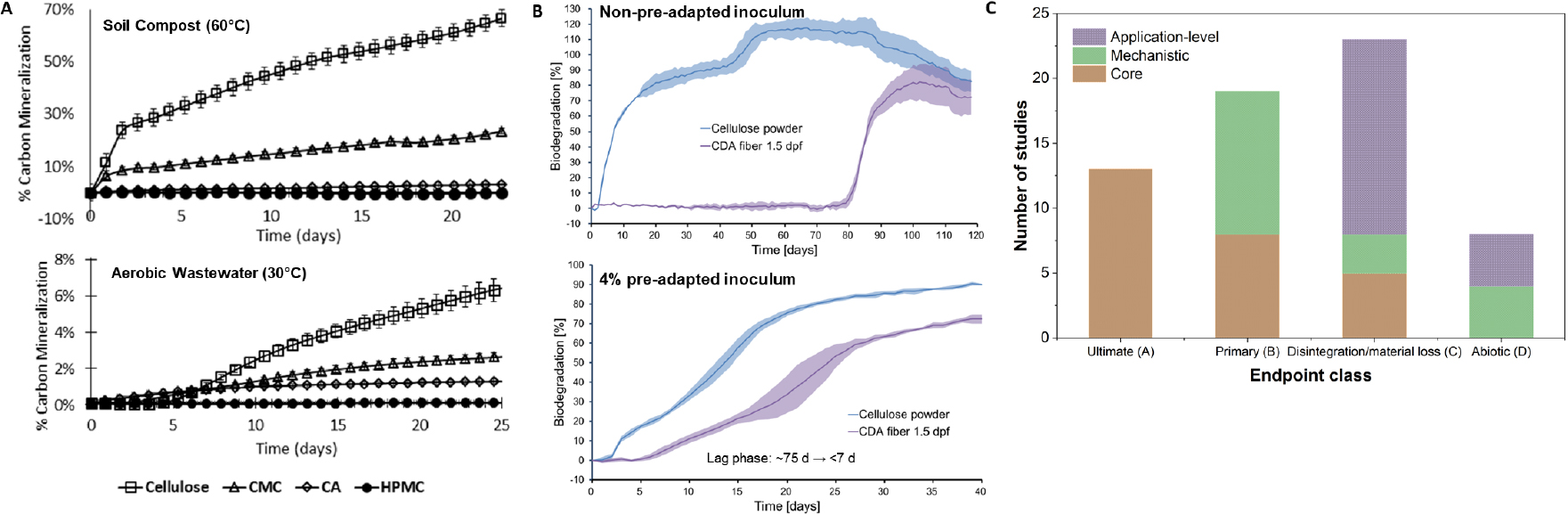
Fig. 4.
Fig. 4. Environmental, biological, and methodological controls on observed cellulose-derivative biodegradation. (A) Mineralization trajectories of cellulose and selected cellulose derivatives in soil compost (60°C) and aerobic wastewater (30°C). Reproduced from Hart-Cooper et al. [3] under the Creative Commons Attribution License (CC BY). (B) Effect of microbial pre-exposure on cellulose diacetate (CDA, DS 2.5) biodegradation in freshwater under ISO 14851 conditions. Addition of 4% pre-exposed test medium shortened the lag phase from approximately 75 d to <7 d. Adapted from Serbruyns et al. [7] under the Creative Commons Attribution 4.0 International License; original panels were cropped and combined. (C) Distribution of degradation endpoint classes across evidence tiers in the reviewed literature. Ultimate biodegradation/mineralization (A), primary degradation (B), disintegration or whole-material mass loss (C), and abiotic degradation (D) are shown as study counts stratified by evidence tier. Individual studies could contribute to more than one endpoint class, whereas evidence-tier assignment was mutually exclusive. Background studies (n = 3), which did not provide direct degradation endpoints, are not shown.
Inoculum density and test design also affect whether biodegradation becomes detectable within the experimental period. Bading et al. [2] compared several OECD 301-based configurations for pharmaceutical cellulose derivatives and found generally low biodegradation in closed-bottle tests, with somewhat greater responses when activated sludge was used. None of the tested derivatives met the formal ready-biodegradability criterion, but the variation among test configurations showed that the measured outcome depended strongly on microbial density and diversity. This distinction is particularly important when comparing screening and simulation tests. Wilcox et al. [8] observed relatively slow mineralization of CMC with DS 0.65 in OECD 301B ready-biodegradability screening tests, whereas the same material mineralized rapidly under OECD 314B activated-sludge simulation conditions. The simulation test used substantially greater microbial biomass and a much higher inoculum-to-substrate ratio, more closely representing activated-sludge treatment conditions. These assays therefore address different questions: ready-biodegradability tests provide stringent standardized screening, whereas simulation tests estimate biodegradation under a defined environmental or treatment compartment. Accordingly, failure to meet a ready-biodegradability criterion should not by itself be interpreted as evidence of long-term environmental persistence.
4.3 Endpoint identity and its implications for structure–biodegradation relationships
A persistent challenge in the cellulose-derivative literature is that the term biodegradation has been applied to measurements representing different stages or modes of material transformation. Previous reviews have already emphasized that mass loss, fragmentation, and changes in polymer properties should not be equated with complete biological conversion (e.g., [1]). The evidence mapping performed in the present review shows that this issue remains prominent and, importantly, that endpoint selection is closely associated with the type of structural information provided by a study.
For evidence synthesis, the reported outcomes were grouped into three operational endpoint levels:
1. Ultimate biodegradation/mineralization: biological conversion of polymer-derived carbon, typically quantified through CO2 evolution, CH4/CO2 production under anaerobic conditions, oxygen demand, or appropriately designed radiolabel measurements.
2. Primary degradation: transformation of the parent polymer without requiring complete carbon conversion and includes de-substitution, molecular-weight reduction, viscosity loss, chain cleavage, and formation of oligomers or sugars.
3. Disintegration or whole-material mass loss: gravimetric mass loss, fragmentation, erosion, loss of film integrity, and visual disappearance.
* Abiotic degradation: chemical hydrolysis, non-biological de-esterification, photochemical transformation, and related processes occurring without direct microbial conversion.
Abiotic degradation was flagged separately because it can alter polymer structure without demonstrating microbial utilization.
Among the 52 primary studies included in the evidence map, 13 reported an ultimate biodegradation endpoint, 19 included primary-degradation measurements, and 23 assessed disintegration or material loss; eight additionally contained evidence of abiotic degradation (Fig. 4C). Because several studies followed more than one stage of the degradation process, these categories are not mutually exclusive.
The distribution of endpoints differed markedly across the evidence classes defined above. All 13 studies containing ultimate biodegradation endpoints belonged to the core-evidence group. In contrast, 11 of the 12 mechanistic-support studies included primary-degradation measurements, whereas 15 of the 17 application-level studies relied on disintegration, mass loss, or related whole-material endpoints. None of the application-level studies directly quantified ultimate mineralization of the cellulose derivative. Endpoint identity was therefore not merely a methodological detail; it was closely associated with the type of structure–biodegradation relationship that could be inferred from a study.
Ultimate biodegradation endpoints provide the most direct evidence linking cellulose-derivative structure to biological conversion under a defined environmental condition. Several of the strongest structure–biodegradation relationships identified in Section 3 were supported by this class of studies. Radiolabeled mineralization experiments by Komarek et al. [14] demonstrated effects of both DS and ester substituent chemistry in cellulose acetate and cellulose propionate, while the matched-DS marine comparison of Kotcharoen et al. [6] demonstrated a pronounced difference between acetate and propionate substitution under the same test conditions. Frank et al. [4] further showed that surface functionalization of nanocellulose could substantially alter mineralization behavior. Together, these studies provide direct evidence that substitution level, substituent chemistry, and the spatial localization of substitution can influence ultimate biodegradation. At the same time, studies such as those of Hart-Cooper et al. [3] and Serbruyns et al. [7] demonstrate that the observed rate and extent remain dependent on environmental and experimental conditions. Ultimate biodegradation is therefore the most direct measure of biological conversion, but it should not be regarded as an environment-independent material constant.
Primary-degradation endpoints address a different level of the structure–biodegradation relationship. Their predominance among mechanistic studies reflects their usefulness for identifying structural transformations that precede or accompany mineralization. Within this operational category, de-functionalization and macromolecular depolymerization represent mechanistically distinct transformations. De-functionalization involves the removal of substituents, such as esterase-mediated deacetylation, whereas depolymerization involves cleavage of the cellulose backbone by cellulolytic enzymes. Although these reactions differ in their enzymatic requirements and kinetics, they may occur sequentially or concurrently as coupled processes, as discussed in Section 2.2. Their classification within the same primary-degradation category therefore reflects their common role in transforming the parent polymer rather than equivalence in their underlying mechanisms. Abiotic de-functionalization is classified separately. Among studies examining backbone depolymerization, Wirick [10] showed that increasing substitution of CMC reduced susceptibility to cellulolytic degradation and that the distribution of unsubstituted anhydroglucose units influenced enzymatic attack. Takeda et al. [34] subsequently demonstrated that cellulose acetates with similar average DS could exhibit markedly different enzymatic hydrolysis depending on the positional distribution of acetyl groups. Likewise, Diao et al. [11] observed decreasing susceptibility of HEC to chain scission with increasing hydroxyethyl substitution, although MS, DS, and substitution distribution varied simultaneously. These studies do not establish ultimate environmental biodegradability by themselves, but they reveal how substitution level and pattern can regulate access to, and cleavage of, the cellulose backbone.
The distinction between primary and ultimate biodegradation is particularly well illustrated by Wilcox et al. [8]. For CMC with a DS of 0.65 in the same Sycamore activated-sludge system, conversion of the parent polymer to lower-molecular-weight products proceeded with an apparent primary degradation rate of approximately 5.0 h-1, whereas the corresponding ultimate biodegradation rate was approximately 0.9 h-1. Thus, disappearance of the parent macromolecular population occurred substantially faster than mineralization of its carbon. This result demonstrates why MW reduction or oligomer formation should not be equated with ultimate biodegradation, while also illustrating the mechanistic information that would be lost if only final mineralization were considered.
A markedly different endpoint pattern was observed in application-level studies. Fifteen of the 17 studies in this category relied on mass loss, fragmentation, disappearance, or related whole-material measurements, and none directly quantified ultimate mineralization of the cellulose derivative. In blends, coatings, composites, and active films, however, the measured response can reflect not only cellulose-derivative chemistry but also formulation composition and material architecture. As discussed in Section 3.5, Hosseini et al. [35] showed that apparent loss of EC-containing films in aqueous media could largely result from physical dissolution, whereas Teixeira et al. [20] demonstrated that substantial early mass loss from plasticized CA films was dominated by plasticizer exudation rather than degradation of the CA backbone. Similar interpretive limitations apply to water-soluble CMC composites, extract-containing cellulose-ester films, and derivative-based coatings, in which loss of soluble components, degradation of another polymer phase, or deterioration of the substrate can contribute to the measured response.
This distinction has direct implications for the interpretation of structural effects. A large whole-material mass-loss value does not necessarily provide stronger evidence of intrinsic cellulose-derivative biodegradability than a smaller but polymer-specific mineralization value. Mineralization addresses conversion of polymer-derived carbon, whereas whole-material mass loss may be strongly affected by solubility, water uptake, phase morphology, porosity, coating architecture, and the behavior of other formulation components. Application-level studies are therefore particularly informative for understanding how molecular structure is translated through physicochemical accessibility and material architecture into practical environmental persistence, but they should not be used interchangeably with polymer-specific mineralization data when evaluating the effects of DS, substituent chemistry, or substitution pattern.
This does not make disintegration or loss of material integrity environmentally irrelevant. For packaging, coatings, agricultural materials, and related applications, disappearance of the physical article may itself be an important end-of-life characteristic. The distinction is instead between material-level persistence and polymer-specific biological conversion. Rapid loss of a composite film can demonstrate limited persistence of that formulation as a physical object, but it does not establish the mineralization behavior of the cellulose derivative contained within it. Application-level studies were therefore retained in the present review to evaluate formulation effects, accessibility, and practical degradation behavior, while being interpreted separately from evidence used to derive intrinsic structure–biodegradation relationships.
Abiotic transformations occupy a separate but mechanistically important position. Eight studies included hydrolysis, de-substitution, photochemical transformation, or related non-biological processes. Such transformations do not themselves demonstrate microbial conversion, but they can modify the same structural descriptors that subsequently influence biological attack. Deacetylation of cellulose acetate, for example, lowers substitution and can increase water interaction and accessibility of the cellulose backbone, whereas cleavage of environmentally labile substituent linkages may shift a highly modified derivative toward a more cellulose-like structure. Abiotic degradation can therefore act as structural preconditioning for subsequent biological degradation, but it should remain analytically distinct from ultimate biodegradation.
The endpoint-resolved analysis also helps reconcile apparently contradictory structure–biodegradation relationships across the literature. The same structural descriptor can influence different stages of material transformation. Increasing DS may reduce cellulase-mediated chain cleavage in a primary-degradation assay, alter lag time or mineralization in a respirometric test, and affect water uptake or specimen integrity in a soil-burial experiment. These responses may be mechanistically related, but they do not represent the same endpoint. Relationships involving DS, substituent chemistry, substitution pattern, MW, or physicochemical accessibility should therefore always be interpreted together with the endpoint through which they were observed.
For this reason, quantitative comparisons in the present review were restricted to studies with compatible endpoints and sufficiently comparable environmental or test contexts. Ultimate biodegradation data were not pooled with primary degradation or whole-material mass loss, and abiotic transformations were interpreted separately. A 50% reduction in specimen mass, a 50% reduction in polymer MW, and 50% carbon mineralization describe fundamentally different states of the degradation process despite being expressed by the same numerical percentage. Representative comparative evidence illustrating how structural, environmental, and methodological factors shape the observed degradation of cellulose derivatives is summarized in Table 2.
Table 2.
Selected experimental evidence linking structural, environmental, and methodological factors to cellulose-derivative degradation
|
Factor examined |
Derivative / structural comparison |
Environment / test condition |
Endpoint class* | Key finding and interpretation | Study |
|
Substituent chemistry |
CA vs cellulose propionate across overlapping DS ranges |
Aerobic microbial degradation; 14C-labeled acetyl or propionyl substituents | A† |
• CA: extensive conversion of labeled acetyl carbon to 14CO2; highly substituted CP: very limited conversion; lower-DS CP: greater conversion • Acyl substituent identity strongly affects degradation; radiolabel reflects acyl-carbon conversion, not total backbone mineralization | [14] |
|
Substituent chemistry at identical DS |
CA, DS 2.5 vs cellulose propionate, DS 2.5 |
Marine biodegradation; 119 d | A |
• DS 2.5 CA: 27.1 ± 10.4%; DS 2.5 CP: 2.3 ± 2.0% • Identical DS does not imply similar biodegradation, demonstrating an independent effect of substituent chemistry | [6] |
|
Degree of substitution |
CMC with different DS |
Cellulase-mediated degradation | B |
• Enzymatic susceptibility progressively decreased with increasing CMC DS • Higher DS reduces cellulase-susceptible cellulose-like regions | [10] |
|
DS × microbial adaptation |
CMC, DS 0.41 and 0.75 |
Aerobic microbial degradation with acclimated cultures | B |
• Degradation differed with both DS and culture acclimation • Structural resistance imposed by DS can be modified by microbial adaptation | [23] |
|
DS and degradation kinetics | CA, DS 1.7 vs 2.5 |
Thermophilic compost, 53°C | A |
• DS 1.7: lag ~10 d; 72.4% at 24 d. DS 2.5: lag ~25 d; 77.6% at 60 d • Higher DS mainly delayed degradation rather than preventing high final conversion under favorable conditions | [15] |
|
Hydroxyalkyl substitution |
HEC; MS 2.12–3.51, DS 0.98–1.34 |
Enzymatic degradation | B |
• Apparent degradation rate decreased from ~0.11 to 0.059 min-1 as substitution increased • Greater hydroxyethyl substitution was associated with lower enzymatic susceptibility; MS and DS covaried | [11] |
|
Positional substitution |
Random 2,3,6-O-CA vs regioselective 2,3-O-CA at comparable DS |
Enzymatic degradation | B |
• C6-unsubstituted 2,3-O-CA showed greater susceptibility at low/intermediate DS; near DS ≈ 2, both structures were relatively resistant • Substitution position affects enzymatic accessibility beyond average DS | [34] |
|
Substitution distribution |
CA samples with comparable average DS but different C2/C3/C6 distributions |
Marine biodegradation | A |
• Comparable-DS CA samples showed different marine biodegradation; lower C6 and greater C2 substitution were associated with greater degradation • Average DS alone is insufficient; positional distribution provides additional structural information | [5] |
|
Surface localization of substitution |
Functionalized CNF with different surface modifications |
Aerobic and anaerobic biodegradation tests | A |
• Functionalization generally reduced mineralization; biodegradation correlated more strongly with surface DS than bulk-average DS • Surface substitution can dominate biodegradation in high-surface-area cellulose | [4] |
|
MW / viscosity grade |
HPMC commercial grades |
OECD aqueous biodegradation test | A‡ |
• K3 LV: 21.4%; K100 LV: 15.8%; K100 M: 11.2% • Higher MW/viscosity was associated with lower biodegradation, but commercial-grade covariation prevents isolation of an independent MW effect | [2] |
|
Environmental moisture | CA, DS 1.7 |
Laboratory thermophilic compost, 53°C; 60, 50, or 40% moisture | C |
• Complete film disappearance occurred after ~6, 16, and 30 d at 60, 50, and 40% moisture, respectively • Moisture strongly altered apparent degradation kinetics; the endpoint represents disintegration rather than mineralization | [17] |
|
Microbial adaptation |
Cellulose diacetate, DS 2.5 |
Freshwater biodegradation test using naïve vs adapted microorganisms | A |
• Adaptation shortened the lag phase from ~75 d to ~5 d • Microbial history can strongly alter degradation kinetics without changing polymer structure | [7] |
|
Test configuration and endpoint | CMC, DS 0.65 |
OECD 301B screening vs OECD 314B activated-sludge simulation | A / B§ |
• OECD 301B: 41.0–46.7% at 28 d and 55.2–63.7% at 70 d; OECD 314B showed much faster transformation and primary degradation • Test configuration and inoculum strongly affect apparent kinetics; primary degradation and mineralization must remain distinct | [8] |
|
Formulation / endpoint confounding | Plasticized CA films | Soil exposure | C |
• Large initial film mass loss with a substantial contribution from plasticizer loss • Whole-film mass loss can overestimate degradation of the CA matrix | [20] |
*Endpoint classes: A, ultimate biodegradation; B, primary degradation; C, disintegration/material loss; D, abiotic transformation. These classes identify different processes, not levels of evidence quality.
†In [14], 14C was located in the carbonyl carbon of the acetyl or propionyl substituent. 14CO2 therefore directly represents conversion of the labeled acyl carbon, not total cellulose-backbone carbon mineralization.
‡The HPMC values from [2] were obtained from oxygen-demand-based testing of commercial grades. MW and viscosity covaried; the comparison therefore supports an association rather than an isolated causal MW effect.
§In [8], 3H labeling was predominantly associated with the carboxymethyl moiety. Conversion to 3H2O therefore should not be interpreted as direct mineralization of total cellulose-backbone carbon.
Overall, endpoint identity should be regarded as a core methodological dimension of structure–biodegradation analysis, together with molecular structure, physicochemical accessibility, environment, and inoculum characteristics. The evidence reviewed here therefore supports describing cellulose-derivative biodegradation in terms of endpoint-specific trajectories—including lag time, transformation rate, and ultimate extent—rather than by a single pooled degradation percentage or binary biodegradable/non-biodegradable classification.
5. Integrated Framework, Design Implications, and Outlook
5.1 An integrated structure–property–environment framework
The evidence reviewed in Sections 3 and 4 indicates that cellulose-derivative biodegradation cannot be explained adequately by a single molecular descriptor. Substituent chemistry, substitution level and pattern, MW/DP, physicochemical accessibility, material architecture, environmental conditions, and biological capacity jointly determine the observed degradation behavior. Their effects are therefore better understood within an integrated structure–property–environment framework rather than as independent predictors.
At the molecular level, chemical modification determines both the susceptibility of the cellulose backbone to degradation and its interaction with the surrounding medium. These structural effects are expressed partly through physicochemical properties such as hydration, swelling, solubility, surface accessibility, and morphology, which regulate contact between susceptible polymer regions and water, enzymes, or microorganisms. Once degradation is initiated, de-substitution and chain cleavage can alter DS, MW, and accessibility further, thereby changing the susceptibility of the remaining material as degradation proceeds. Environmental and biological conditions act across these processes by influencing chemical transformation, enzyme activity, microbial growth, transport, and utilization of degradation products.
The resulting relationships are summarized schematically in Fig. 5. The framework should not be interpreted as a rigid universal degradation sequence, but rather as a conceptual representation of the principal levels at which structural and environmental factors influence the degradation trajectory. Similar final biodegradation outcomes may arise through different limitations: restricted hydration, poor enzyme recognition, resistant substituent chemistry, slow chain cleavage, or limited microbial utilization can each constrain overall conversion.
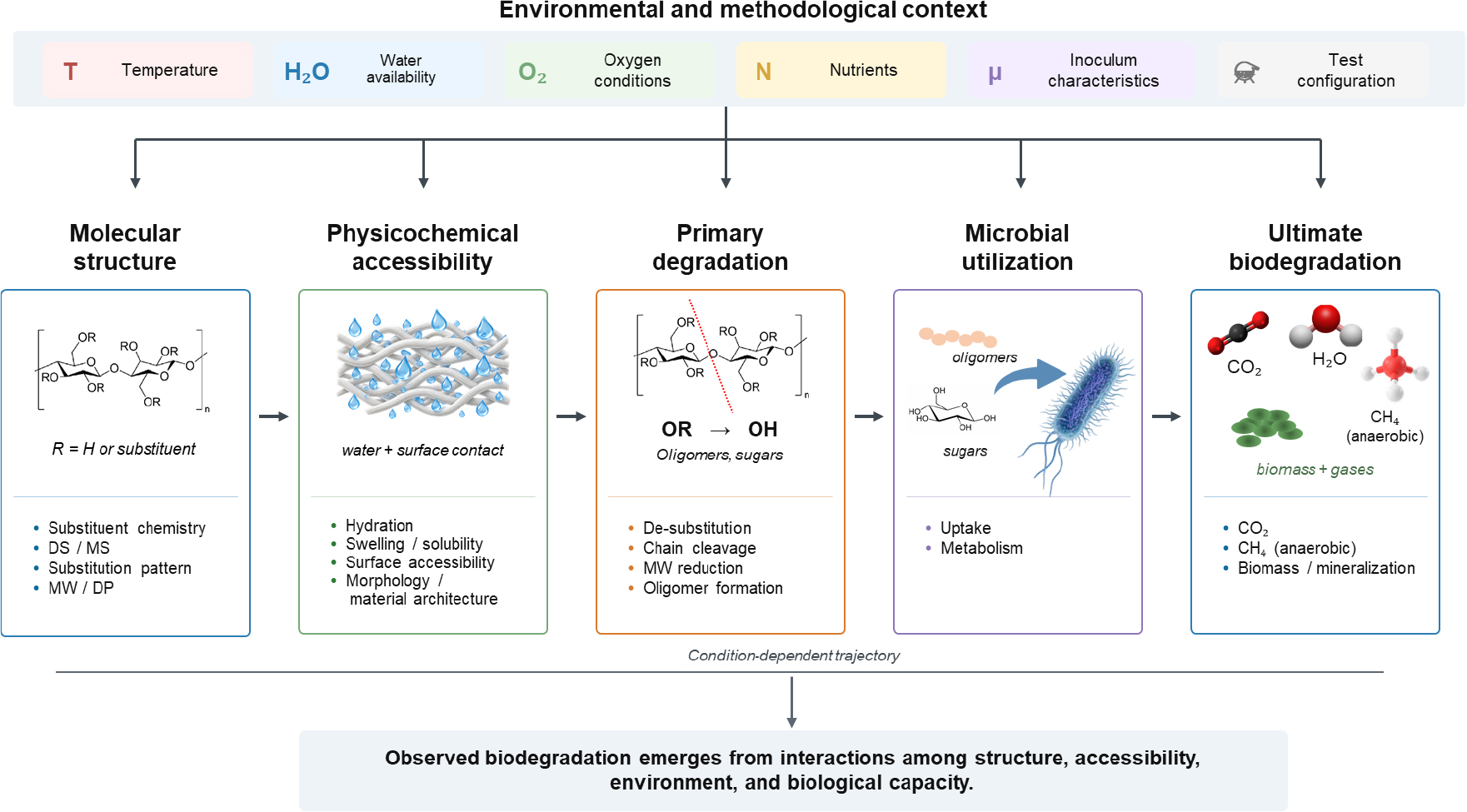
Within this framework, the inconsistent relationships often reported between DS and biodegradation become easier to interpret. DS or MS remains an important descriptor within a defined derivative chemistry, but its effect depends on the identity and location of the substituent, the accessibility of the modified polymer, and the biological and physicochemical conditions of the surrounding environment. A given substitution level therefore cannot be assigned a universal biodegradation potential across chemically different cellulose derivatives. More generally, cellulose-derivative biodegradability is best regarded as a condition-dependent outcome of the structure–property–environment system, rather than as a fixed intrinsic property represented by a single structural parameter.
5.2 Design implications and research priorities
This framework shifts the material-design objective from maximizing degradation rate to controlling environmental lifetime. Cellulose derivatives must retain sufficient stability and functionality during manufacture, storage, and use, while avoiding unnecessary persistence after disposal. The relevant design problem is therefore to coordinate molecular modification and material architecture so that functional performance during service is followed by an appropriate degradation trajectory under the intended end-of-life conditions.
Substitution should consequently be optimized rather than maximized. The substitution level required for a desired function should be considered together with substituent and linkage chemistry, because derivatives with similar DS can differ substantially in hydration, steric accessibility, de-substitution susceptibility, and subsequent backbone degradation. Substitution pattern and surface localization provide additional design variables that may allow functional modification to be introduced while preserving regions susceptible to biological attack. Similarly, physicochemical accessibility should be sufficient to permit post-use degradation without causing premature dissolution, leaching, or loss of performance during service.
Material architecture provides another level of control. Film thickness, porosity, phase morphology, coating structure, and interactions with other polymers can alter transport and degradation independently of the intrinsic chemistry of the derivative. This is particularly important for blends, coatings, and composites, in which rapid loss of structural integrity does not necessarily imply biological conversion of the cellulose-derivative fraction. Design for controlled environmental lifetime should therefore consider both molecular susceptibility and the ability of the final material architecture to permit subsequent degradation of the polymer itself.
These design principles must also be matched to a defined end-of-life environment. Compost, soil, freshwater, marine systems, and wastewater treatment differ substantially in temperature, water availability, oxygen conditions, microbial capacity, and contact between microorganisms and the material. A structural modification that is compatible with rapid degradation in one compartment may remain limiting in another. Consequently, there is little value in defining a universally “biodegradable” cellulose derivative without specifying the environment and endpoint to which that designation refers. In particular, systematic studies under anaerobic conditions remain limited compared with those conducted in aerobic environments. Further investigations are needed to determine whether the effects of substituent chemistry, DS/MS, and substitution pattern observed under aerobic conditions also apply to anaerobic biodegradation.
Translating these principles into predictive design, however, requires a more consistent evidence base. Many existing studies vary several structural parameters simultaneously, while information on substitution pattern, MW/DP, material form, physicochemical accessibility, inoculum characteristics, or environmental conditions is frequently incomplete. Future studies would benefit from systematically controlled structural series in which substitution level, substituent chemistry, substitution pattern, and molecular size can be evaluated independently wherever possible. Separate reporting of DS and MS is particularly important for hydroxyalkyl derivatives, for which the two quantities represent different structural features.
Endpoint standardization is equally important. Ultimate biodegradation, primary degradation, disintegration, mass loss, dissolution, and abiotic transformation should remain analytically distinct rather than being collapsed into a common “biodegradation percentage.” The endpoint-resolved analysis in Section 4.3 demonstrates that these measurements answer different questions and are distributed differently across mechanistic, environmental, and application-oriented studies. Preserving endpoint identity is therefore essential both for meaningful cross-study comparison and for development of predictive datasets.
Future datasets should also place greater emphasis on time-resolved degradation behavior. A terminal percentage alone cannot distinguish a material with a long lag followed by rapid conversion from one undergoing slow but continuous degradation, nor can it distinguish rapid primary degradation from slower mineralization. Lag time, degradation rate, and ultimate extent therefore provide more informative response variables than a binary biodegradable/non-biodegradable classification or a single pooled percentage.
Predictive modeling should consequently integrate molecular descriptors with physicochemical, environmental, and methodological information rather than relying primarily on derivative identity or DS. The immediate priority is not greater algorithmic complexity, but higher-quality and more mechanistically resolved data. Controlled structural series, explicit environmental and inoculum descriptors, consistent endpoint definitions, and time-resolved measurements would provide the basis for models capable of distinguishing structural limitations from environmental constraints and predicting degradation within defined domains.
Overall, cellulose-derivative biodegradation is best understood as an environment-specific trajectory emerging from the interaction of molecular structure, physicochemical accessibility, material architecture, and biological conditions. Structural descriptors such as DS or MS remain valuable, but only when interpreted together with substituent chemistry, substitution pattern, material form, environmental context, and endpoint identity. Moving from universal biodegradability labels toward endpoint- and environment-specific predictions of lag time, degradation rate, and ultimate extent should provide a stronger basis for both the rational design of cellulose derivatives with controlled environmental lifetimes and the development of reliable structure–biodegradation prediction strategies.