


1. Introduction
2. Advanced 3D Printing Strategies with Cellulose Nanomaterials
2.1 CNF inks for 3D printing: Processing, rheology, and structural precision
2.2 DIW of CNF inks
2.3 Embedded 3D printing in CNF support matrices for functional structures
2.4 Stereolithographic 3D printing of CNC-reinforced photocurable resin
2.5 Future directions in 3D printing enabled by CNF
3. Conclusions
1. Introduction
Cellulose is one of the most abundant renewable biopolymers found in nature.1,2) It has been utilized for centuries in applications such as paper production, packaging, textiles, pharmaceuticals, food additives. As the primary structural component of the plant cell wall, cellulose offers high crystallinity, mechanical strength, biodegradability, and biocompatibility.3,4) In recent years, nanoscale derivatives of cellulose, particularly cellulose nanofiber (CNF) and cellulose nanocrystal (CNC), have attracted growing interest as functional ingredients in composite materials and printable inks.5,6,7) Their high surface area, stable dispersion in aqueous systems, and chemically modifiable interfaces allow for precise tuning of material behavior.8,9) These characteristics enable nanocellulose materials to serve not only as sustainable alternatives to conventional polymers, but also as active components that contribute to performance in advanced applications.
Three-dimensional (3D) printing is a digital manufacturing method that creates complex and customized structures through the layer-by-layer deposition of material.10,11) This technique offers high resolution, geometric freedom, and adaptability across a wide range of applications. Among the diverse materials explored for additive manufacturing, bio-based polymers are gaining attention for their environmental benefits. Especially, CNF inks demonstrate several rheological features that are critical to printability, including shear thinning, yield stress, viscoelasticity, and thixotropic recovery.3) These properties allow the ink to flow through fine nozzles under pressure while maintaining its shape after deposition.12,13,14) The printability and performance of CNF inks are strongly influenced by factors such as nanofiber length, surface chemistry, concentration, and the presence of secondary polymers or additives.15,16,17) A well-designed ink must balance flow during extrusion with shape retention after printing, ensuring that printed structures remain accurate and self-supporting. CNF inks also allow for post-processing steps, such as drying or crosslinking, to yield permanent and complex geometries that are applicable in soft electronics, biomedical scaffolds, and environmental devices.18)
This review examines the design principles and performance characteristics of CNF inks for advanced 3D printing applications. The relationship between CNF ink rheology and printability across major printing platforms, including direct ink writing (DIW), embedded printing, and stereolithography (SLA), is focused on. The discussion includes how CNF preparation methods, surface modifications, and composite ink formulations affect flow behavior, printing precision, and structural integrity. This review discusses how precise modulation of ink rheology governs structural fidelity and functional outcomes in printed constructs. By analyzing both the scientific and engineering aspects of CNF-based 3D printing, future strategies that will establish CNF as a key material for sustainable and high-performance additive manufacturing are aimed to be outlined.
2. Advanced 3D Printing Strategies with Cellulose Nanomaterials
2.1 CNF inks for 3D printing: Processing, rheology, and structural precision
The preparation of CNF begins with the pretreatment of lignocellulosic biomass, typically wood-derived pulp, through chemical, enzymatic, or mechanical processes (Fig. 1, step 1). These pretreatments are crucial for disrupting the complex plant cell wall structure composed of cellulose microfibrils embedded in a matrix of hemicellulose and lignin.1,2,19) Among chemical methods, TEMPO-mediated oxidation and carboxymethylation are widely used to introduce carboxylate or carboxymethyl groups on the cellulose surface, respectively.20,21) These modifications impart strong negative surface charges that facilitate individual fibril separation during mechanical disintegration by minimizing interfibrillar hydrogen bonding and aggregation. TEMPO oxidation typically proceeds under alkaline conditions (pH ~10), while carboxymethylation occurs under neutral to mildly alkaline conditions, each influencing the resulting degree of substitution and surface charge density.20,22,23)
Enzymatic pretreatments, such as cellulase-assisted hydrolysis, provide an energy-efficient alternative by selectively degrading amorphous regions of cellulose while preserving the crystalline core, thereby enhancing accessibility for fibrillation.24,25,26) Mechanical disintegration methods such as high-pressure homogenization, microfluidization, and disk grinding are subsequently applied to break down the pretreated fibers into individualized nanofibers.27,28,29) The resulting CNF morphology, including fibril diameter, aspect ratio, and degree of crystallinity, is highly dependent on the pretreatment route. For instance, TEMPO-oxidized CNF commonly exhibits diameters of 3–5 nm and high surface charge densities, yielding colloidally stable dispersions with excellent aqueous compatibility. In contrast, mechanically isolated CNF often retains larger diameters and displays increased entanglement, leading to a gel-like rheological profile with limited printability.
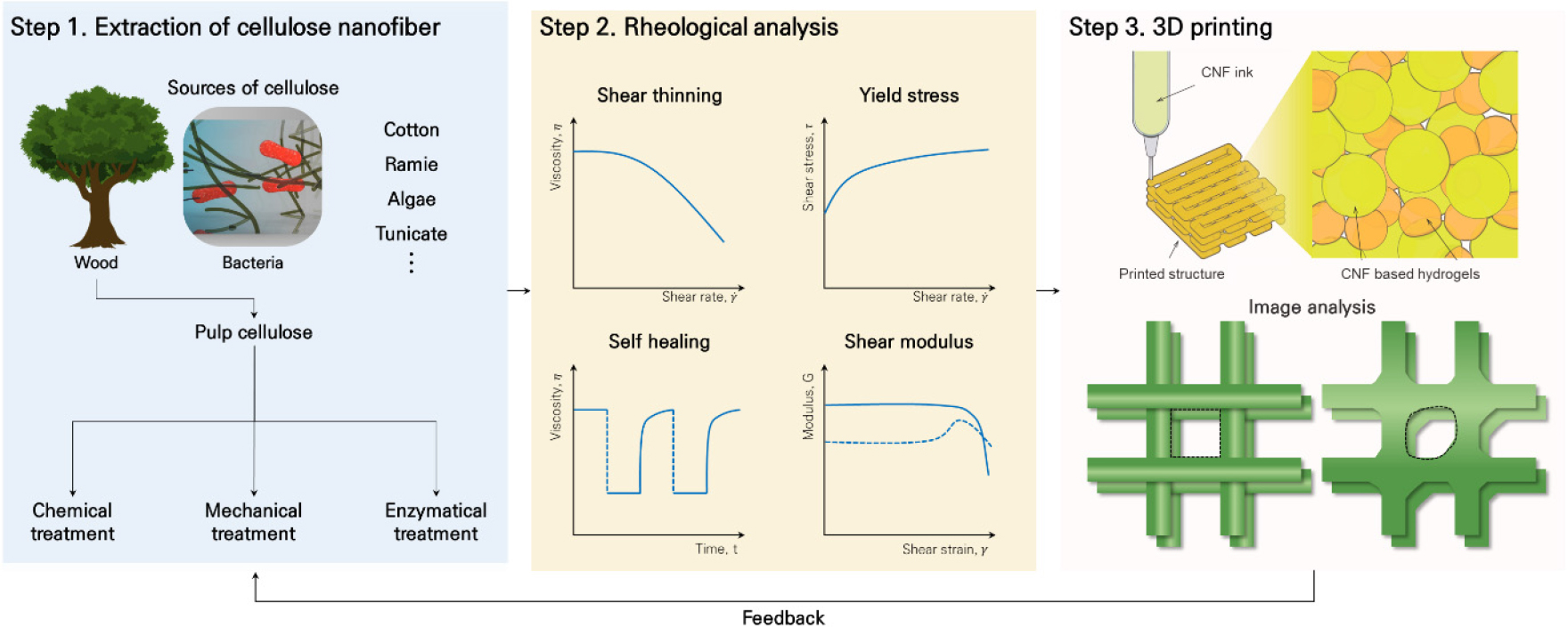
Fig. 1.
Schematic overview of the design process for CNF inks for 3D printing. Step 1: CNF is typically extracted from pulp, a processed form of lignocellulosic biomass, through chemical (e.g., TEMPO oxidation, carboxymethylation), mechanical (e.g., grinding, high-pressure homogenization), or enzymatic treatments to produce individualized nanofibers. Step 2: Rheological properties of the resulting CNF dispersions are characterized to ensure suitability for extrusion-based printing, including shear thinning behavior, yield stress, self-healing (thixotropic recovery), and shear modulus. Step 3: 3D printing is performed using DIW, and the print fidelity is evaluated by image analysis of printed structures, assessing parameters such as dimensional accuracy, pore preservation, and deformation.
Following extraction, CNF dispersions exhibit rheological behaviors that are critical for extrusion-based 3D printing applications (Fig. 1, step 2).3,30,31,32) These behaviors include shear thinning, yield stress, viscoelasticity, and self-healing. Shear thinning enables reduced viscosity under high shear conditions, allowing smooth extrusion through fine nozzles.12,32) Upon cessation of shear, rapid viscosity recovery ensures shape retention of the printed filament. Yield stress plays a vital role in maintaining structural stability by resisting deformation under gravitational forces.15) Additionally, CNF inks exhibit thixotropic recovery, wherein the disrupted fibrillar network gradually reforms over time, and this characteristic is particularly valuable for multi-layer stacking in 3D printing.33,34) These rheological properties are quantitatively assessed using tools such as steady shear flow tests, oscillatory strain sweeps, and three-interval thixotropy tests. Key parameters including the storage modulus (G′), loss modulus (G″), and yield point define the operational window of the ink. A dominant G′ over G″ indicates elastic, solid-like behavior, which is essential for printed structures to remain self-supporting after extrusion. Thixotropic and self-healing behaviors, while related, should be distinguished: self-healing refers to instantaneous viscosity recovery, whereas thixotropy involves time-dependent structural regeneration.
The printability of CNF inks is further evaluated through image analysis of printed test patterns, often in grid or lattice configurations (Fig. 1, step 3).35,36) High-resolution imaging techniques, such as optical microscopy or digital imaging systems, are used to measure features such as filament width, pore size, and corner sharpness. For example, pore closure, filament spreading, or distorted intersections may indicate inadequate yield stress, delayed viscosity recovery, or poor interlayer adhesion. Quantitative metrics such as the coefficient of variation in filament width (<10%) or the pore aspect ratio deviation (<5%) are frequently used to assess geometric fidelity.
Ultimately, a closed-loop workflow integrating CNF extraction, rheological tuning, and printability assessment enables the rational design of 3D printable inks.35) Deviations observed in printed structures can inform iterative adjustments to CNF surface chemistry, concentration, and additive formulations. This feedback loop is essential for advancing wood-derived CNF inks as sustainable, high-performance materials for additive manufacturing in domains such as biomedicine, soft robotics, and environmental sensing.
2.2 DIW of CNF inks
CNF-based hydrogels suitable for DIW must exhibit well-defined rheological properties. These inks typically possess zero shear viscosity in the range of 102 to 103 Pa·s and demonstrate strong shear-thinning behavior, with viscosity decreasing by up to three orders of magnitude under applied shear, allowing smooth extrusion through nozzles (Fig. 2a).32,37) The storage modulus (G′) must exceed the loss modulus (G″), typically by a factor of two or more, ensuring that the extruded CNF inks retain their shape without collapsing. In addition, CNF inks exhibit thixotropic recovery of G′ and G″ observed within 30 to 60 s once shear is no longer applied. This self-healing behavior helps maintain solid-like properties after deposition and contributes to the ink’s ability to support its own weight during multi-layer stacking. Together, these properties allow printed filaments to maintain their geometry and support subsequent layers before further crosslinking or solidification takes place.
The printability of CNF inks is evaluated by their ability to form continuous, uniform filaments, maintain structural features in printed lattices, and support precise layer stacking. Filaments should exhibit minimal spreading or sagging, enabling accurate formation of pore geometries and well-defined lines. For example, CNF-alginate composite inks printed at ~40 kPa using a 300 µm nozzle maintained average line widths of approximately 0.6 mm, while lower-viscosity formulations exhibited increased spreading and irregular pore definition (Fig. 2b).32,37) Image analysis is commonly used to assess print fidelity by comparing features such as filament width and pore size with the intended design. CNF inks with high storage modulus and shape retention can maintain sharp corners and stable multi-layered structures, minimizing pore closure during stacking. For instance, printed lattices composed of CNF and collagen demonstrated high structural accuracy and dimensional consistency with their CAD models, even after five-layer stacking. Successful printing outcomes depend on both appropriate ink rheology and optimized printing conditions including nozzle diameter, extrusion pressure, and print speed.
CNF inks have been applied across a wide range of 3D printing applications. In tissue engineering, CNF composites such as CNF blended with alginate or gelatin have been used to fabricate scaffolds mimicking auricular cartilage and other complex anatomical structures. These printed constructs offer excellent shape fidelity, soft tissue-like mechanical response, and resolution below 1 mm (Fig. 2c).37) In addition to scaffolds, CNF inks enable the fabrication of porous lattice structures that can be dried to form lightweight foams or aerogels with interconnected porosity suitable for cell infiltration or fluid transport. Structures such as hollow tubes, rings, and vascular-like networks with wall thicknesses of 0.5 to 1.0 mm have been successfully printed and handled without collapse, demonstrating their mechanical robustness and potential utility in fluidic and tissue scaffold applications (Fig. 2d).38) CNF inks can also be used to print freestanding custom shapes, including logos, typography, and symbols. Foam-type CNF inks, for example, support vertical structures and maintain geometry without the need for sacrificial supports, showcasing printability for creative and structural applications (Fig. 2e).30)
Beyond geometric complexity, CNF inks offer control over microstructural orientation. During extrusion, shear stress induces partial alignment of nanofibers along the printing direction, leading to anisotropic architectures with directionally dependent mechanical and functional properties (Fig. 2f).5,39) This feature enables deliberate tuning of stiffness, permeability, or cell alignment within the construct.
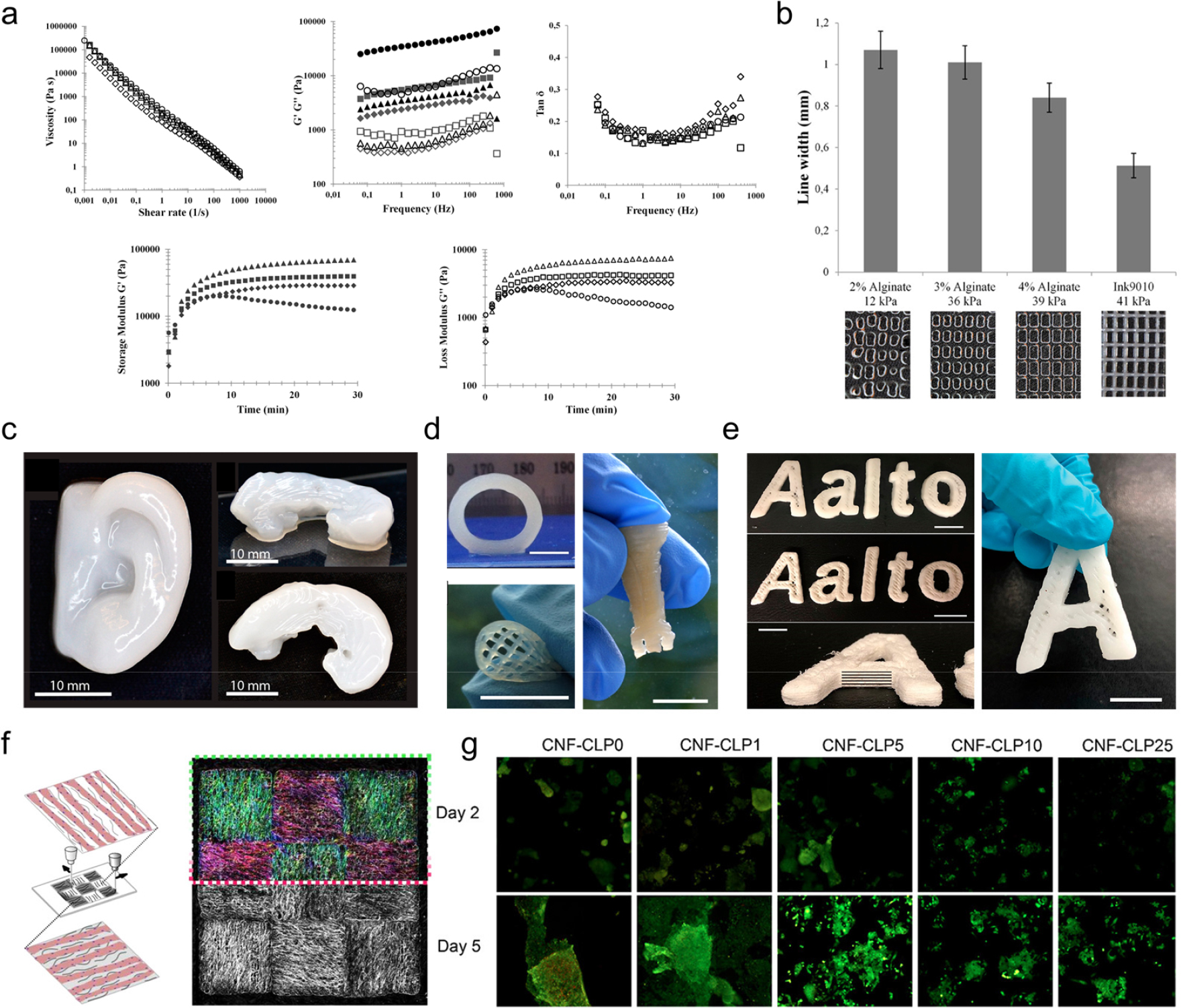
Fig. 2.
Direct ink writing of cellulose nanofiber (CNF) inks. a. Rheological properties of CNF inks demonstrate pronounced shear-thinning behavior, measurable yield stress, and solid-like viscoelasticity suitable for extrusion-based 3D printing. Reproduced with permission from Ref 37). Copyright 2015 American Chemical Society. b. Printed line width varies with alginate concentration and extrusion pressure, reflecting how rheological tuning influences print resolution and fidelity. Reproduced with permission from ref 37). Copyright 2015 American Chemical Society. c. Anatomically inspired tissue models such as ears and cartilage structures fabricated using CNF inks demonstrate the capacity for high-resolution bioprinting. Reproduced with permission from ref 37). Copyright 2015 American Chemical Society. d. Tubular and porous constructs exhibit structural integrity, illustrating their applicability in soft robotics, fluidics, and tissue scaffold engineering. Reproduced with permission from ref 38). Copyright 2017 American Chemical Society. e. CNF foam inks enable the fabrication of freestanding, customized structures with lightweight and stable architecture. Reproduced with permission from ref 30). Copyright 2019 American Chemical Society. f. CNF filaments show shear-induced nanofiber alignment during extrusion, allowing directional control over microstructure and potentially anisotropic properties. Reproduced with permission from ref 5). Copyright 2023 American Chemical Society. g. CNF-collagen bioinks support high cell viability and proliferation over 5 days, confirming their suitability for cell-laden bioprinting. Reproduced with permission from ref 5). Copyright 2023 American Chemical Society.
CNF-based materials are inherently biocompatible and well suited for supporting living cells in 3D environments. Studies have shown that CNF-containing bioinks enable high cell viability, adhesion, and proliferation. For example, in a CNF-collagen composite system, human chondrocytes printed and cultured in 3D hydrogels exhibited cell viabilities of over 70% at day 2 and over 85% at day 5, with clear signs of proliferation and spreading throughout the scaffold (Fig. 2g).5) Live/dead fluorescence imaging revealed homogeneous cell distribution and minimal cytotoxicity. In addition to chondrocytes, CNF hydrogels have demonstrated compatibility with fibroblasts and mesenchymal stem cells, supporting extracellular matrix secretion and lineage-specific differentiation. The nanoscale fibrous architecture of CNF resembles natural extracellular matrix morphology, promoting cellular attachment and biofunctionality. These features make CNF bioinks highly attractive for applications in tissue engineering, regenerative medicine, and bioprinting.
Despite these advantages, DIW of CNF inks presents several challenges. Fibril entanglement can cause nozzle clogging, particularly at high concentrations or with narrow nozzles. Environmental sensitivity, such as moisture content and drying rate, can also influence printing resolution and filament fusion between layers. Furthermore, the inherently low yield stress of some formulations may limit vertical print fidelity or overhang stability. To overcome these limitations, strategies such as co-blending with secondary polymers, ionic crosslinking, or the addition of viscosity modifiers have been explored. Careful tuning of ink composition and processing parameters is therefore essential to achieve reliable, high-performance CNF-based printing systems. Together, these findings confirm that CNF inks provide a biologically favorable and structurally stable platform for DIW applications. Their tunable rheology, formability, and cytocompatibility make them promising candidates for a broad range of biofabrication and materials engineering applications.
2.3 Embedded 3D printing in CNF support matrices for functional structures
Embedded 3D printing enables the precise patterning of inks within a yield-stress support matrix, allowing freeform fabrication of structures that would otherwise collapse under gravity (Fig. 3a).15,40) While this technique has opened new frontiers for printing low-viscosity hydrogels, soft elastomers, and even living cells, its effectiveness depends critically on the properties of the supporting medium. CNF hydrogels have emerged as ideal candidates due to their highly tunable viscoelasticity, environmental sustainability, and compatibility with a wide range of ink materials.15,41,42) CNF form dense, entangled fiber networks through hydrogen bonding, exhibiting characteristic shear-thinning behavior, yield stress, and rapid self-healing, all of which are essential for supporting extruded filaments during and after printing (Fig. 3b). Such shear-thinning behavior indicates that the viscosity of the matrix is highly sensitive to external stress, which is advantageous for minimizing resistance against moving printing nozzles or inks within the matrix.15) In particular, the ability to maintain high viscosity at low shear rates while flowing like a fluid under high shear conditions plays a critical role in ensuring both structural stability and printing accuracy during the fabrication process. Moreover, CNF gels are physically and chemically tunable. Adjusting CNF concentration, carboxyl content, and fiber morphology allows precise control over the yield stress and structural recovery time of the matrix, which directly affects print resolution, shape fidelity, and overhang stability.15) Adjusting the rheological properties of CNF matrices has been shown to enhance the stability of printed filaments across different printing speeds, ink densities, and filament geometries.
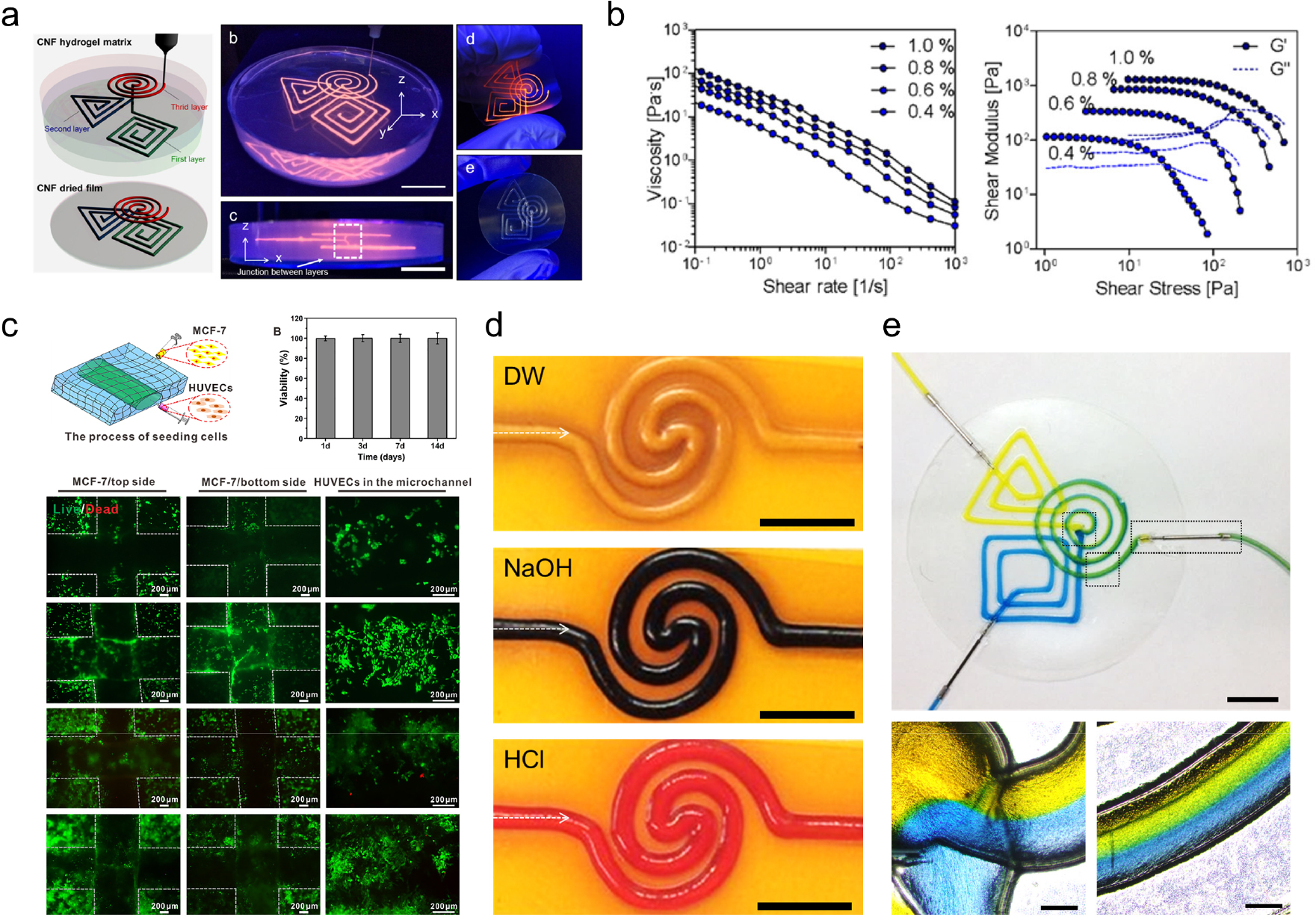
Fig. 3.
Embedded printing using cellulose nanofiber (CNF) support matrices for functional structure fabrication. a. Schematic illustration of the use of wood-derived CNF as a support medium for embedded printing and subsequent structure formation after drying. Reproduced with permission from ref 41). Copyright 2017 American Chemical Society. b. Rheological behavior of CNF matrices with varying concentrations (0.4–1.0 wt%), showing shear-thinning viscosity and yield-stress-dependent storage (G′) and loss (G″) moduli, which enable tunable support properties. Reproduced with permission from ref 41). Copyright 2017 American Chemical Society. c. Embedded printing of cell-laden constructs within CNF baths demonstrates high structural fidelity and supports spatially controlled cell seeding and long-term viability. Reproduced with permission from ref 42). Copyright 2019 American Chemical Society. d. Spiral pH sensors are fabricated through multichannel embedded printing of pH-responsive inks, demonstrating colorimetric functionality. Reproduced with permission from ref 41). Copyright 2017 American Chemical Society. e. A multi-inlet microfluidic chip is printed in a single step, highlighting the versatility of CNF-supported embedded printing for fluidic applications. Reproduced with permission from ref 41). Copyright 2017 American Chemical Society.
In the context of embedded printing, CNF support matrices offer not only printing precision but also a unique platform for multifunctional integration. In tissue engineering, spiral constructs containing embedded live cells demonstrate the ability of 3D printing matrix to preserve geometry while maintaining cellular viability and spatial distribution (Fig. 3c).15,18) The compatibility of CNF matrices with cell-laden bioinks enables the fabrication of vascularized tissue models and perfusable microenvironments. For soft electronics, silicone-based actuators were printed within CNF matrices and retained complex geometries after curing, demonstrating feasibility for constructing deformable, freestanding devices.15) The technique also supports multi-material functional printing, as shown by the fabrication of a pH-responsive spiral sensor that visually responds to environmental pH changes (Fig. 3d).41) Furthermore, microfluidic chips with precisely defined multi-inlet channels were printed into CNF matrices, and fluorescence imaging confirmed successful cell seeding, attachment, and proliferation within the embedded structures (Fig. 3e).18,41,42) These demonstrations highlight the ability of CNF to integrate mechanical, chemical, and biological functionality within a single manufacturing platform, opening opportunities for developing bioelectronic interfaces, diagnostic devices, and engineered tissue systems with structural and functional complexity.
2.4 Stereolithographic 3D printing of CNC-reinforced photocurable resin
SLA is a vat photopolymerization-based 3D printing technique that fabricates complex 3D structures by selectively curing photocurable resins using ultraviolet or visible light (Fig. 4a).44) Owing to its high resolution, smooth surface finish, and geometric precision, SLA is widely used in biomedical devices, microfluidics, optics, and advanced prototyping.44,45) However, conventional photocurable resins often suffer from limited mechanical strength, shrinkage, and poor thermal resistance. To address these issues, functional nanofillers have been introduced into resin formulations. Among them, CNC has gained increasing attention due to their high crystallinity, stiffness, excellent dispersibility in polar matrices, biodegradability, and minimal impact on optical clarity, making them highly suitable for SLA-based nanocomposite systems. In contrast to CNF, which, due to their high aspect ratio and entangled fibrous network, markedly increase the viscosity of resin formulations, often leading to printing instability in photocuring-based 3D printing systems, CNC possess high crystallinity and excellent dispersion stability.46) These physicochemical differences explain why CNC are generally preferred over CNF in stereolithographic 3D printing systems. CNC can enhance both the rheological and mechanical properties of SLA resins, even at low concentrations.31,43) Their nanoscale dimensions and strong hydrogen bonding ability allow them to interact effectively with polymer chains, improving the storage modulus, dimensional stability, and scratch resistance of the cured material. Additionally, CNC impart shear-thinning behavior to the resin, which is beneficial for printing resolution and layer-to-layer adhesion (Fig. 4b).43) These characteristics are especially critical in SLA, where precise flow control, consistent layer curing, and structural integrity are essential. Recent research has demonstrated the incorporation of CNC into various photocurable matrices such as poly (ethylene glycol) diacrylate (PEGDA), polyurethane acrylate (PUA), and bisphenol A-glycidyl methacrylate (BisGMA) enabling improved printability and mechanical robustness.
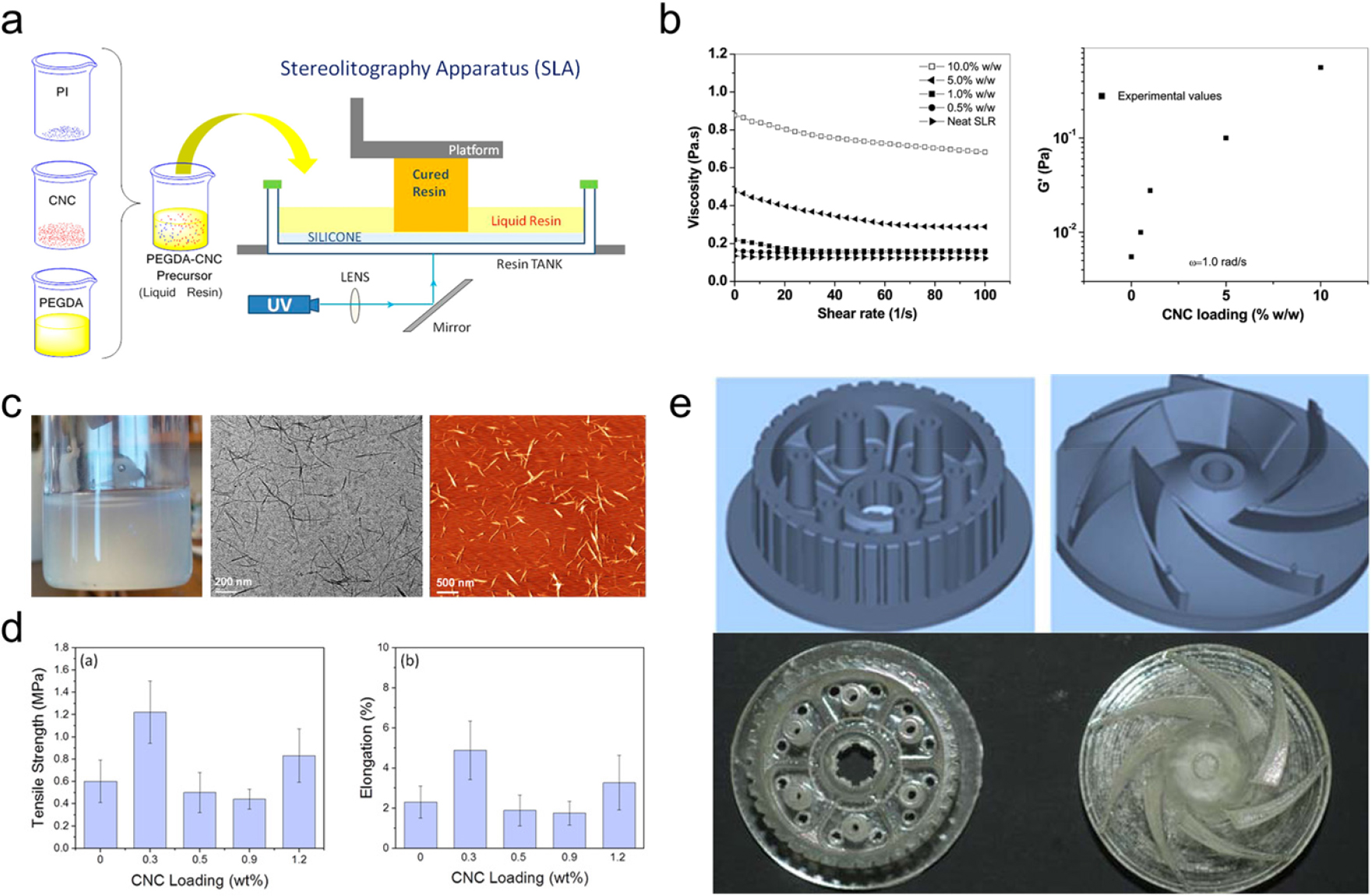
Fig. 4.
Stereolithographic 3D printing of PEGDA-CNC nanocomposite resins and their rheological, mechanical, and structural performance. a. Schematic of SLA printing using a photocurable PEGDA-CNC resin composed of polyethylene glycol diacrylate (PEGDA), cellulose nanocrystal (CNC), and photoinitiator (PI). Reproduced with permission from ref 31). Copyright 2017 American Chemical Society. b. Rheological measurements show shear-thinning behavior and increased storage modulus (G′) with higher CNC loading, indicating enhanced structural integrity. Reproduced with permission from ref 43). Copyright 2012 American Chemical Society. c. Photographs and microscopy images (TEM, AFM) confirm nanoscale dispersion of CNC within the resin. Reproduced with permission from ref 31). Copyright 2017 American Chemical Society. d. Mechanical tests demonstrate that optimal CNC content (~0.3 wt%) improves tensile strength while higher loadings reduce elongation at break. Reproduced with permission from ref 31). Copyright 2017 American Chemical Society. e. CAD designs and photographs of complex parts (gear and impeller) used for SLA printing validation. Reproduced with permission from ref 43). Copyright 2012 American Chemical Society.
In terms of dispersion, CNC form transparent and homogenous suspensions in PEGDA, as confirmed by transmission and AFM imaging (Fig. 4c).31) This uniformity is key to avoiding light scattering and print defects. Previous studies have specifically explored CNC-reinforced PEGDA resins in SLA systems, validating CNC as multifunctional reinforcing agents. CNC were incorporated into a PEGDA-based photocurable resin to develop a transparent nanocomposite ink suitable for SLA printing. The addition of 1 wt% CNC resulted in a sharp increase in storage modulus and shear viscosity, leading to significant improvements in the rubber-state mechanical performance of the printed parts—up to sixfold enhancement in G′ was reported. However, at CNC concentrations above 5 wt%, agglomeration reduced both print fidelity and mechanical strength.31) In parallel, abaca-derived CNC-reinforced PEGDA hydrogels were developed for biocompatible SLA applications. With just 0.3 wt% CNC, the printed structures showed a twofold increase in tensile strength and a 110% increase in elongation at break, along with a 300% improvement in toughness (Fig. 4d). Importantly, the printed parts retained high transparency and structural fidelity, even with complex geometries such as impeller or turbine-like components (Fig. 4e).43) Together, these studies demonstrate that CNC can function not only as mechanical reinforcements but also as rheological modifiers and optical stabilizers in SLA nanocomposite systems, offering a promising strategy for fabricating high-performance resins and functional microdevices.
2.5 Future directions in 3D printing enabled by CNF
CNF has traditionally been used in 3D printing as rheological modifiers, particularly in extrusion-based and photopolymerization systems such as DIW and SLA. Their ability to adjust viscosity, promote shear-thinning behavior, and support structural integrity has made them effective additives for improving ink printability. However, CNF possesses intrinsic properties such as biodegradability, mechanical strength, biocompatibility, and tunable surface chemistry, which suggest that their role can extend far beyond rheological control. CNF can evolve from nanoscale fibrous architectures into rheology modifiers for printable inks, functional materials for advanced applications, and enabling components for next-generation 3D printing platforms (Fig. 5). By leveraging these properties, CNF can function not only as supporting agents but also as central components in high-performance, multifunctional systems with applications in sensors, soft electronics, and tissue engineering scaffolds.
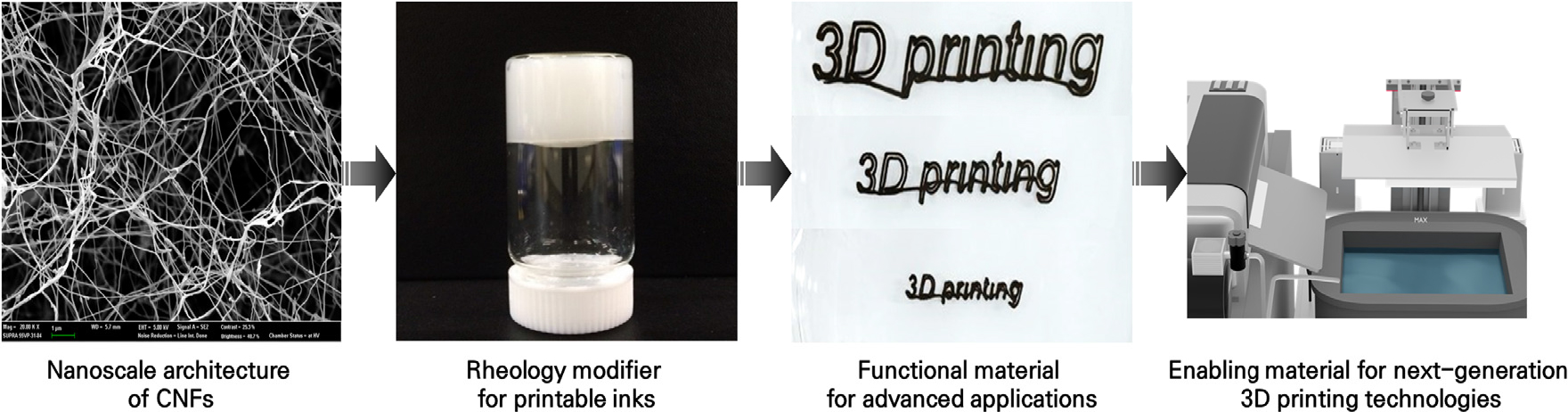
Alongside this shift in application, there is also a need to explore new 3D printing strategies specifically suited to the characteristics of CNF. This progression underscores the importance of developing novel printing approaches that exploit their nanofibrous architecture, dispersibility, and surface functionality (Fig. 5). Rather than adapting CNF to existing platforms like SLA and DIW, future efforts should focus on creating printing technologies tailored to these unique features. CNF can be formulated for use in inkjet printing, binder jetting, sheet lamination, and embedded printing, where they may serve as structural matrices, sacrificial layers, binders, or primary building materials. This versatility allows for the design of multi-material systems, hybrid fabrication workflows, and high-resolution structures. Establishing CNF-specific approaches to printing will help unlock new opportunities across materials science, biomedicine, and sustainable manufacturing.
3. Conclusions
This review has provided a comprehensive overview of CNF as both functional ink components and support matrices in advanced 3D printing systems. CNF exhibits complex rheological behaviors such as shear thinning, yield stress, viscoelasticity, and thixotropic recovery, which support the formation of high-resolution, self-supporting structures in extrusion-based techniques including DIW and SLA. In addition to their use in printable inks, CNF have also demonstrated effectiveness as support matrices for embedded printing, allowing precise deposition of soft or low-viscosity materials while maintaining structural integrity. The morphology, surface chemistry, and concentration of CNF critically influence flow behavior, print fidelity, and post-printing stability. These characteristics have enabled CNF to be applied in diverse areas such as tissue engineering, soft robotics, microfluidics, and environmental sensing. Future work should focus on developing printing strategies that leverage the unique properties of CNF, establishing standardized preparation methods, and validating long-term performance in real-world applications. Together, these insights position CNF as not only sustainable material alternatives but also as integral components of next-generation additive manufacturing platforms where material functionality, structural precision, and environmental responsibility are aligned.