


1. Introduction
2. Materials and Methods
2.1 Chemical
2.2 Bamboo material
2.3 Sample preparation
2.4 Chelating process
2.5 Alkaline activation
2.6 Hydrogen peroxide bleaching process
2.7 Lignin content determination
2.8 Fourier transform infrared (FTIR) analysis
2.9 Scanning electron microscopy (SEM) analysis
2.10 Statistical analysis
3. Results and Discussion
3.1 Chemical modification of bamboo through chelating and alkali activation
3.2 Hydrogen peroxide bleaching and optimization (Box-Behnken design)
3.3 Effect of hydrogen peroxide bleaching on bamboo chemical structure
3.4 Microstructural characteristics observed by SEM
3.5 Mechanistic summary of lignin removal and structural evolution
4. Conclusions
1. Introduction
The building and construction sector accounts for approximately 39% of global carbon emissions, underscoring the urgent need for innovative building materials that contribute to energy efficiency and carbon reduction. Beyond structural performance, contemporary material development has increasingly emphasized passive design strategies to enhance indoor environmental quality. Among these strategies, daylighting plays a central role in reducing electricity consumption while improving visual comfort, particularly in tropical climates [1,2,3,4,5]. To support daylight-oriented building design, materials capable of transmitting and diffusing natural light are required, provided that the issues related to glare control, privacy, and thermal insulation can be addressed. Conventional solutions, such as glass, polycarbonate, and polymethyl methacrylate (PMMA), are widely used. However, glass is heavy, brittle, and associated with high embodied carbon, whereas polymer-based alternatives are derived from petrochemical sources and are not biodegradable, raising long-term environmental concerns [6,7]. These limitations have motivated the exploration of bio-based, light-transmitting materials that favor diffuse illumination rather than full transparency.
In this context, transparent wood has emerged as a promising alternative through delignification and resin impregnation, enabling light transmission within a cellulose-based framework [8,9]. Nevertheless, extensive studies have demonstrated that the degree of lignin removal is a critical parameter governing both optical behavior and structural integrity. Aggressive delignification can enhance transparency but often leads to mechanical degradation, revealing a fundamental trade-off between transparency and strength [10,11]. Translucent materials that diffuse light and mitigate glare are often more desirable than fully transparent systems for building applications, particularly in tropical environments.
Chemical bleaching plays a key role in regulating the lignin content in lignocellulosic materials. Recent studies have applied the response surface methodology (RSM) to optimize delignification and chemical treatment parameters in bamboo and related biomass resources, demonstrating its effectiveness in handling multivariable process interactions [12,13,14]. However, existing RSM-based studies on bamboo have largely focused on different species and processing objectives, such as cellulose extraction or mechanical enhancement. Importantly, optimal processing conditions are highly species-dependent and are influenced by variations in bamboo anatomy, lignin distribution, and chemical reactivity [15,16,17]. Studies have shown that bleaching parameters such as temperature, chemical concentration, and treatment duration strongly influence lignin removal efficiency and microstructural changes in bamboo [11,12]. However, bleaching parameters optimized for one bamboo species cannot be directly transferred to another without compromising process efficiency or material outcomes.
Indonesia has an abundance of bamboo resources. However, bamboo remains underutilized in high-value technological applications, with most uses limited to traditional or low-value products [18]. Mayan bamboo (Gigantochloa robusta) is widely distributed in Banten and its surrounding regions and has long been used in traditional and low-value applications [19]. Importantly, bamboo exhibits substantial species-dependent variability in anatomical structure, lignin content, and chemical reactivity, which significantly influences its response to chemical treatments [12,16]. This variability necessitates species-specific investigations to develop chemically modified bamboo-based materials. Despite its availability, favorable growth characteristics, and economic accessibility, systematic studies of the process-level optimization of chemical bleaching parameters for Mayan bamboo remain scarce. In particular, the combined effects of bleaching temperature, hydrogen peroxide concentration, and treatment duration on lignin reduction in this species have not been comprehensively established.
The present study focused on the species-specific optimization of bleaching parameters for Mayan bamboo using RSM. By employing lignin content as the primary response variable and integrating Klason lignin analysis, Fourier transform infrared (FTIR) spectroscopy characterization, and scanning electron microscopy (SEM) observations, this study aims to establish a process-oriented foundation for translucent bamboo development. The results are expected to provide insights into the optimal bleaching window for controlled lignin reduction in Bambu Mayan, supporting the development of sustainable, bio-based materials for daylight-oriented building applications. Accordingly, this study was designed as a response-specific optimization in which residual lignin content was the quantitative endpoint, while FTIR and SEM were used to assess chemical and microstructural substrate evolution. A complete process mass-balance assessment, including bleaching yield, was reserved for subsequent scale-up and validation studies.
2. Materials and Methods
2.1 Chemical
This section describes the materials, experimental design, and characterization methods employed to optimize the bleaching process of Mayan bamboo (Gigantochloa robusta) using RSM. The methodology was structured to ensure consistency among the research objectives, experimental workflow, and data analysis approach. The chemicals used were EDTA (Merck, Germany), NaOH (Merck, Germany), H2O2, epoxy resin, ferroin indicator (Merck, Germany), sodium silicate (Merck, Germany), and H2SO4 (Merck, Germany), which were obtained from commercial suppliers.
2.2 Bamboo material
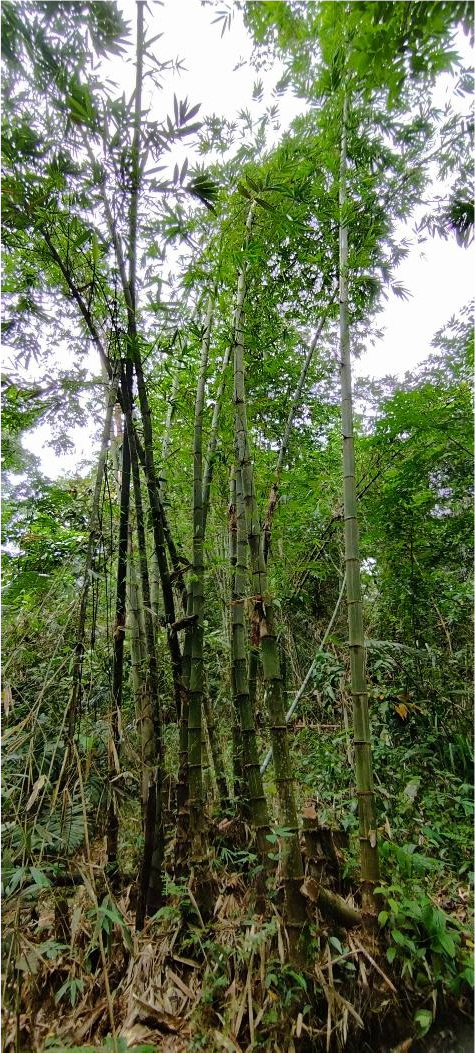
Mayan bamboo (Gigantochloa robusta) culms were obtained from Sindang Ratu Village, Naga Jaya area, Lebak Regency, Banten, Indonesia. The bamboo used in this study was harvested at an estimated age of 2–3 years, which corresponds to a growth stage characterized by well-developed culms and a relatively stable lignocellulosic composition. This species was selected because of its local abundance, economic accessibility, and limited prior investigations of engineered translucent material applications. Bamboo grows in clusters within a secondary forest–agroforestry environment, as shown in Fig. 1, indicating its high availability and natural regeneration capacity.
2.3 Sample preparation
The harvested bamboo culms were cut into rectangular specimens with dimensions of 40 mm × 20 mm × 5 mm. Before chemical treatment, the samples underwent a pretreatment process consisting of surface cleaning and air drying to stabilize their initial moisture content and dimensions. All the samples were visually inspected to exclude sections with visible defects, cracks, or biological degradation.
2.4 Chelating process
The chelating stage was conducted to remove inorganic impurities and metal ions that could interfere with the subsequent chemical treatments. The bamboo samples were immersed in an aqueous EDTA solution and treated in a water bath at 80°C for 3 h. After chelation, the samples were rapidly cooled, filtered, and repeatedly washed with deionized water until a neutral pH was achieved.
2.5 Alkaline activation
Alkaline activation was performed using a 1.5 M NaOH solution with a material-to-solution ratio of 1:5 (m/v). The mixture was homogenized using a magnetic stirrer and subsequently autoclaved at 121°C under a pressure of 3 bar for 5 min. Following activation, the samples were thoroughly rinsed with deionized water to remove residual alkali and then dried in an oven at 105°C for 4 h. This step aimed to partially remove hemicellulose and lignin while increasing cell wall porosity.
2.6 Hydrogen peroxide bleaching process
Bleaching was conducted using hydrogen peroxide (H2O2) as an oxidizing agent to further reduce lignin content and improve optical clarity [20,21,22]. The experiments were designed using the RSM approach to evaluate the influence of three independent variables: H2O2 concentration, bleaching temperature, and reaction time. After bleaching, the samples were washed to neutral pH and dried at 60 ± 2°C. Tables 1 and 2 show the limits of the variables and the design matrix, respectively.
Table 1.
Lower and higher limits of the variables
| Factors | Variables | Unit | Level | Response | ||
| -1 | 0 | +1 | ||||
| A | Bleaching temperature | °C | 70 | 85 | 100 | Lignin content (%) |
| B | H2O2 concentration | % | 5 | 10 | 15 | |
| C | Reaction time | min | 60 | 90 | 120 | |
Table 2.
Design matrix for bleaching process
2.7 Lignin content determination
The lignin content of the samples was determined according to the TAPPI standard method T 222 om-02 for Klason Lignin (Acid-insoluble lignin in wood and pulp) with minor modifications. The samples were oven-dried at 105°C to constant weight and ground to pass through a 40–60 mesh sieve. Approximately 0.3 g of the oven-dried sample was accurately weighed and placed in a glass reaction flask. Subsequently, 3 mL of 72% (w/w) sulfuric acid was added, and the mixture was gently stirred to ensure complete impregnation of the sample. The hydrolysis was conducted at 30°C for 2 h with occasional stirring. Following the initial hydrolysis, the sulfuric acid concentration was diluted to approximately 3% (w/w) by adding distilled water. The suspension was then transferred to an autoclave and heated at 121°C for 1 h to complete the hydrolysis. After cooling to room temperature, the hydrolysate was filtered through a pre-weighed glass fiber filter. The residue was washed thoroughly with hot distilled water until a neutral pH was achieved and subsequently dried in an oven at 105°C to constant weight. The acid-insoluble lignin content was calculated from the mass of the dried residue and expressed as a percentage of the oven-dry sample weight.
2.8 Fourier transform infrared (FTIR) analysis
FTIR spectroscopy was used to characterize the chemical structure of bamboo samples before and after the bleaching process. Before analysis, the samples were oven-dried at 60°C to constant weight and ground into fine powders. FTIR measurements were performed using an ATR-FTIR spectrometer (Bruker ALPHA II, Bruker Optics, Germany). Spectra were recorded in the wavenumber range of 4,000–400 cm-1 with a spectral resolution of 4 cm-1, and 32 scans were accumulated for each sample. A background spectrum was collected before each measurement and automatically subtracted. The obtained spectra were baseline-corrected and normalized prior to analysis. The characteristic absorption bands corresponding to lignin, cellulose, and hemicellulose were compared to evaluate the chemical changes in bamboo induced by the bleaching process.
2.9 Scanning electron microscopy (SEM) analysis
The surface morphology of bamboo samples before and after the bleaching process was examined using SEM. Before observation, the samples were oven-dried at 60°C to constant weight and cut into small pieces. The dried samples were mounted on aluminum stubs using conductive carbon tape and subsequently coated with a thin layer of gold to improve surface conductivity. SEM observations were carried out using a Scanning Electron Microscope (JEOL JSM-6510LA, JEOL Ltd., Japan), micrographs were obtained at various magnifications under an accelerating voltage of 10–15 kV. The resulting images were analyzed to evaluate morphological changes on the bamboo surface caused by the bleaching process.
2.10 Statistical analysis
Statistical analysis was performed using Minitab software. To optimize the bamboo bleaching process for minimizing lignin content, three key process parameters were selected as independent variables: bleaching temperature (Factor A, °C), hydrogen peroxide (H2O2) concentration (Factor B, %), and reaction time (Factor C, min). These variables were chosen based on their significant influence on lignin degradation during oxidative bleaching. A Box–Behnken design (BBD) under RSM was employed to evaluate the individual and interactive effects of the selected factors on lignin content. Each factor was investigated at three coded levels: low (−1), center (0), and high (+1). The coded and uncoded values of the variables, along with the experimental design matrix consisting of 15 experimental runs, including three replicates at the center point to estimate experimental error and assess model adequacy, are presented in Table 2. The BBD approach was selected due to its efficiency in fitting quadratic models while requiring a reduced number of experimental runs.
A second-order polynomial regression model (full quadratic model) was fitted to the response variable, namely lignin content (Y), as expressed in Eq. (1):
where Y represents the lignin content; β0 is the intercept; β1, β2, and β3 are the coefficients of the linear terms; β11, β22, and β33 are the coefficients of the quadratic terms; β12, β13, and β23 represent the interaction effects between the variables; and ε denotes the random error. Model reduction was conducted by removing non-significant terms (p > 0.05). The adequacy of the final model was evaluated using analysis of variance (ANOVA), lack-of-fit tests, and the coefficient of determination (R2). Consistent with the study objective, residual lignin content was used as the sole response variable in the RSM model. The experimental design was not constructed as a process mass-balance study; consequently, overall material recovery and bleaching yield were not used as optimization responses.
3. Results and Discussion
3.1 Chemical modification of bamboo through chelating and alkali activation
Chelating treatment using EDTA successfully removed inorganic impurities and metal ions from the bamboo surface, as indicated by the stabilization of the solution pH after repeated washing. This step is essential to ensure the effectiveness and reproducibility of the subsequent chemical treatments. Alkali activation using NaOH under pressurized conditions resulted in noticeable mass changes and surface modification of the bamboo samples, indicating the partial removal of hemicellulose and disruption of the lignocellulosic matrix. The treated samples retained their structural integrity, suggesting that alkali treatment conditions were sufficient to open the cellular structure without causing severe degradation. Table 3 shows the lignin content of the raw and activated bamboo.
Table 3.
Lignin content of unbleached/raw and activated bamboo
| Samples | Lignin content (%) |
| Raw bamboo | 11.5 |
| Activated bamboo | 4 |
3.2 Hydrogen peroxide bleaching and optimization (Box-Behnken design)
Table 4 presents the lignin content of Mayan bamboo samples determined using the Klason lignin method under various bleaching conditions defined by the RSM design matrix. The results showed that lignin content varies substantially across different combinations of bleaching temperature, H2O2 concentration, and reaction time, indicating that lignin removal in Mayan bamboo is strongly influenced by processing conditions. At a fixed reaction time of 90 min, increasing the bleaching temperature from 70°C to 100°C at low H2O2 concentrations (5%) resulted in a reduction in lignin content from 5.50% to 3.39%. This suggests that temperature plays a crucial role in enhancing the oxidative reactions involved in lignin degradation. However, when the H2O2 concentration was increased to 15%, the lignin content increased rather than decreased at both temperatures, indicating that an excessive oxidant concentration may lead to non-selective reactions that limit effective lignin removal.
Table 4.
Lignin content under various RSM conditions
A notable reduction in the lignin content was observed at intermediate temperature (85°C). The lowest measured lignin content (1.50%) was achieved at 85°C, 15% H2O2, with a reaction time of 60 min. This result highlights the presence of an optimal bleaching window, where lignin degradation is maximized without excessive reaction time or thermal exposure. Similar non-linear effects of bleaching parameters have been reported in lignocellulosic bleaching studies, where moderate temperatures and controlled oxidant concentrations promote selective lignin removal [23,24,25] and excessive oxidant levels may promote secondary reactions that reduce bleaching efficiency or lead to partial re-condensation of lignin fragments [23,24,26]. The non-monotonic response observed at 15% H2O2 indicates that increasing oxidant concentration did not consistently improve lignin removal. Hydrogen peroxide bleaching involves reactive oxygen species, including hydroxyl radicals, which can oxidize and disrupt lignin structures [23]. However, under elevated oxidant concentrations, competing reactions—including non-selective oxidation, peroxide decomposition, and reactions involving soluble lignin fragments—may reduce the effective selectivity of the bleaching process. The heterogeneous anatomical structure of bamboo may additionally produce local differences in reagent penetration and reaction severity. Consequently, the observed behavior is interpreted as evidence of competing oxidative and mass-transfer phenomena rather than being attributed exclusively to lignin re-condensation. Partial condensation or redeposition of lignin-derived fragments may contribute, but this mechanism was not directly measured in the present study and is therefore proposed only as a possible explanation.
The present optimization is therefore response-specific. It evaluates how the selected bleaching variables regulate residual lignin content within the investigated design space, rather than overall material recovery or production yield. Accordingly, the model-derived condition should be interpreted as a candidate region for controlled lignin reduction and substrate preparation, not as a complete optimum for process efficiency.
The statistical adequacy of the fitted quadratic model was evaluated using ANOVA, as presented in Table 5. The model p-value was close to, but did not reach, the predefined significance threshold of 0.05, indicating limited overall statistical support within the investigated experimental range. The response surface plots indicate descriptive curvature in the fitted response; however, graphical curvature does not independently establish predictive model adequacy. RSM generally requires evaluation of model fit and experimental confirmation of predicted conditions, while model refinement or response transformation may be necessary when model performance is unsatisfactory [27]. Moreover, the predictive capability of a quadratic RSM model can be limited when the underlying system exhibits complex non-linear behavior that cannot be adequately represented by a low-order polynomial [28]. Accordingly, the predicted condition is interpreted as a model-derived candidate operating region requiring experimental confirmation rather than as a conclusively validated global optimum.
Table 5.
Finding from the ANOVA-based quadratic model
The statistical validity and veracity of the fitted model were evaluated using ANOVA, with the results derived from the quadratic model illustrated in Table 5. The model indicated that, within the investigated experimental range, none of the individual factors or interaction terms exhibited statistical significance at the 95% confidence level. Nevertheless, the response surface plots (Fig. 2) revealed clear curvature trends, suggesting the presence of an optimum region rather than a linear relationship between the bleaching parameters and lignin content. The significant lack of fit observed in the ANOVA analysis implies that lignin degradation behavior in Mayan bamboo may involve complex mechanisms that are not fully captured by the quadratic model, a phenomenon also reported in other bleaching optimization studies involving heterogeneous biomass materials [17,21].
DF denotes degrees of freedom. The F-value is the ratio of the variance explained by a model term to the residual variance. The p-value indicates the statistical significance of the corresponding term, with p < 0.05 used as the significance criterion. Lack of fit compares the unexplained model variation with pure experimental error. Model adequacy should be evaluated before predicted conditions are subjected to experimental.
Surface response plots were constructed to visually illustrate the interaction effects among the process variables and to facilitate the identification of optimum bleaching conditions for lignin removal. Fig. 2 presents the three-dimensional response surface plots showing the interaction effects of (a) H2O2 concentration and bleaching temperature, (b) reaction time and bleaching temperature, and (c) H2O2 concentration and reaction time on lignin content. As shown in Fig. 2a, lignin content decreases with increasing bleaching temperature and H2O2 concentration up to an intermediate level, beyond which further increases lead to a slight rise in lignin content, indicating a quadratic effect of both variables. Fig. 2b demonstrates that increasing bleaching temperature in combination with an appropriate reaction time effectively enhances lignin degradation, resulting in lower lignin content, while excessively long reaction times diminish the bleaching efficiency. Similarly, Fig. 2c reveals a pronounced interaction between H2O2 concentration and reaction time, where moderate levels of both factors contribute to minimum lignin content. The curvature observed in all surface plots confirms the significance of interaction and quadratic effects among the variables, which is consistent with the ANOVA results. Overall, these graphical analyses support the adequacy of the RSM model and clearly identify an optimal region for minimizing lignin content during the bamboo bleaching process.
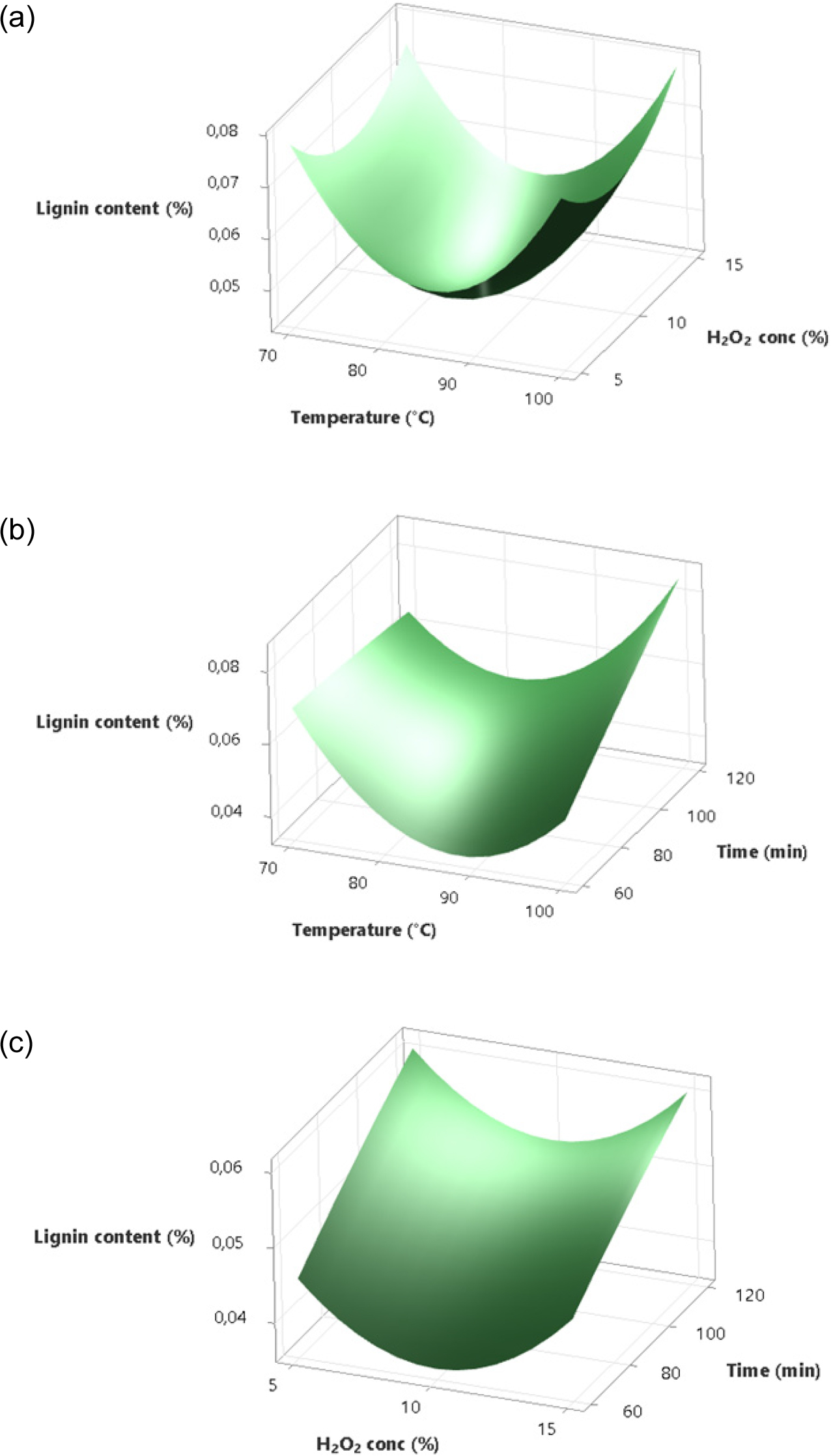
Despite this limitation, the optimization results (Table 6) predict an optimal bleaching condition at approximately 88°C, 9.85% H2O2, and 60 min, yielding a fitted lignin content of 3.5% with a composite desirability of 0.806. These optimal conditions fall within the intermediate processing range, reinforcing the importance of controlled bleaching rather than aggressive delignification. Therefore, the Klason lignin results provide quantitative evidence that controlled lignin reduction in Mayan bamboo can be achieved through careful parameter selection. This result is particularly relevant for translucent bamboo development, where partial lignin removal is desirable for modifying light interaction while preserving the structural framework.
Table 6.
Solution for optimum condition of bleaching treatment
|
Bleaching temperature (°C) |
Concentration (%) |
Time (min) |
Fitted lignin content (%) | Composite desirability |
| 88.18 | 9.848 | 60 | 3.5 | 0.806 |
The lowest experimentally measured lignin content and the RSM-derived condition represent two distinct outcomes. The value of 1.50% is the minimum response directly observed among the experimental runs, obtained at 85°C, 15% H2O2, and 60 min. In contrast, the fitted lignin content of approximately 3.5% at 88°C, 9.85% H2O2, and 60 min is an estimate generated from the smoothed quadratic response surface. The difference reflects the distinction between an individual experimental observation and a model-derived prediction. Because polynomial RSM models may not completely capture complex non-linear material responses, predicted conditions normally require confirmation experiments before being regarded as validated optima [28,29]. Therefore, the former is referred to as the experimentally observed minimum, whereas the latter is described as the model-predicted candidate condition.
3.3 Effect of hydrogen peroxide bleaching on bamboo chemical structure
Following the quantitative evaluation of lignin content using the Klason method, FTIR spectroscopy was employed to provide complementary chemical insights into the bleaching-induced modifications in Mayan bamboo. Fig. 3 presents the FTIR spectra of raw bamboo, activated bamboo, and selected bleached samples representing different bleaching conditions. The FTIR spectrum of raw Mayan bamboo exhibited characteristic absorption bands typical of lignocellulosic materials. A broad band in the region of 3,300–3,400 cm-1 corresponds to O–H stretching vibrations associated with hydroxyl groups in cellulose, hemicellulose, and lignin, while the absorption near 2,900 cm-1 is attributed to C–H stretching of aliphatic structures. These spectral features are consistent with those reported for untreated bamboo and other plant-based biomass [23,25,29].
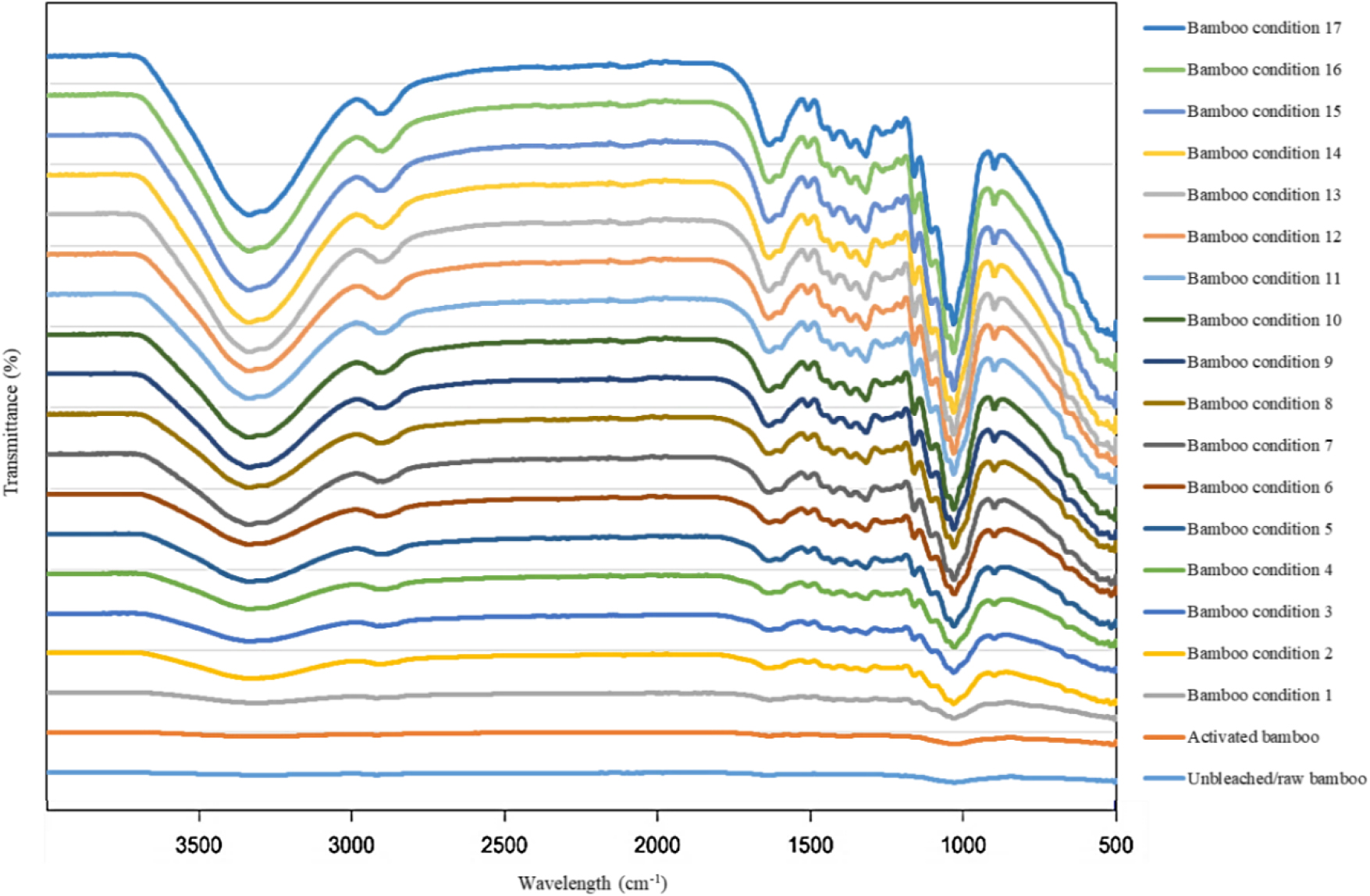
The activated bamboo sample showed only minor changes in band intensity compared to the raw bamboo, indicating that the activation treatment did not significantly alter the chemical functional groups. Instead, this step primarily improves the chemical accessibility, facilitating subsequent bleaching reactions. Similar behaviour has been observed in lignocellulosic systems where pre-treatment enhances reagent penetration without inducing extensive chemical degradation [26]. More pronounced spectral changes were observed in the bleached samples, particularly in the region of 1,510–1,600 cm-1, which is commonly associated with the aromatic skeletal vibrations of lignin. A relative decrease in absorption intensity in this region was observed for samples with lower lignin content as quantified by Klason analysis. This spectroscopic trend provides chemical-level support for lignin reduction under optimized bleaching conditions. Comparable attenuation of lignin-related bands following hydrogen peroxide bleaching has been widely reported in studies on biomass delignification and bleaching optimization [23,24,25]. In contrast, absorption bands in the 1,000–1,100 cm-1 region, which correspond to C–O stretching vibrations in polysaccharide structures, remained evident across the bleached samples. The persistence of these bands suggests that the cellulose-rich framework of bamboo was largely preserved despite lignin reduction. Such selective modification is a key objective in controlled bleaching processes and has been reported in optimized peroxide-based systems where lignin removal is favoured over polysaccharide degradation [24,26,29].
When interpreted alongside the RSM results and Klason lignin data, the FTIR spectra indicate that the optimized bleaching conditions promote controlled lignin modification rather than extensive delignification. This behaviour is consistent with the non-linear response trends observed in the RSM analysis, where intermediate processing conditions resulted in lower lignin content compared to more aggressive bleaching scenarios. Therefore, FTIR spectroscopy is an effective complementary tool for validating the chemical selectivity of the bleaching process in Mayan bamboo.
3.4 Microstructural characteristics observed by SEM
The microstructural evolution of bamboo fibres before and after bleaching was examined using SEM to elucidate the morphological consequences of lignin removal and to corroborate the chemical evidence obtained from Klason lignin analysis and FTIR spectroscopy. Representative SEM micrographs of raw bamboo, activated bamboo, and selected bleached samples (Conditions 3, 6, 11, 16, and 17) are presented in Fig. 4. The SEM image of the raw (unbleached) bamboo (Fig. 4a) shows a dense and compact structure characterized by tightly bonded fiber bundles embedded in a continuous lignin-rich matrix. The cell walls appeared relatively smooth with limited inter-fiber voids, indicating strong lignin-mediated adhesion between cellulose microfibrils. This morphology is consistent with the relatively high lignin content measured by the Klason method before treatment, and is typical of untreated bamboo, where lignin acts as a rigid binding phase within the lignocellulosic framework [23,30].
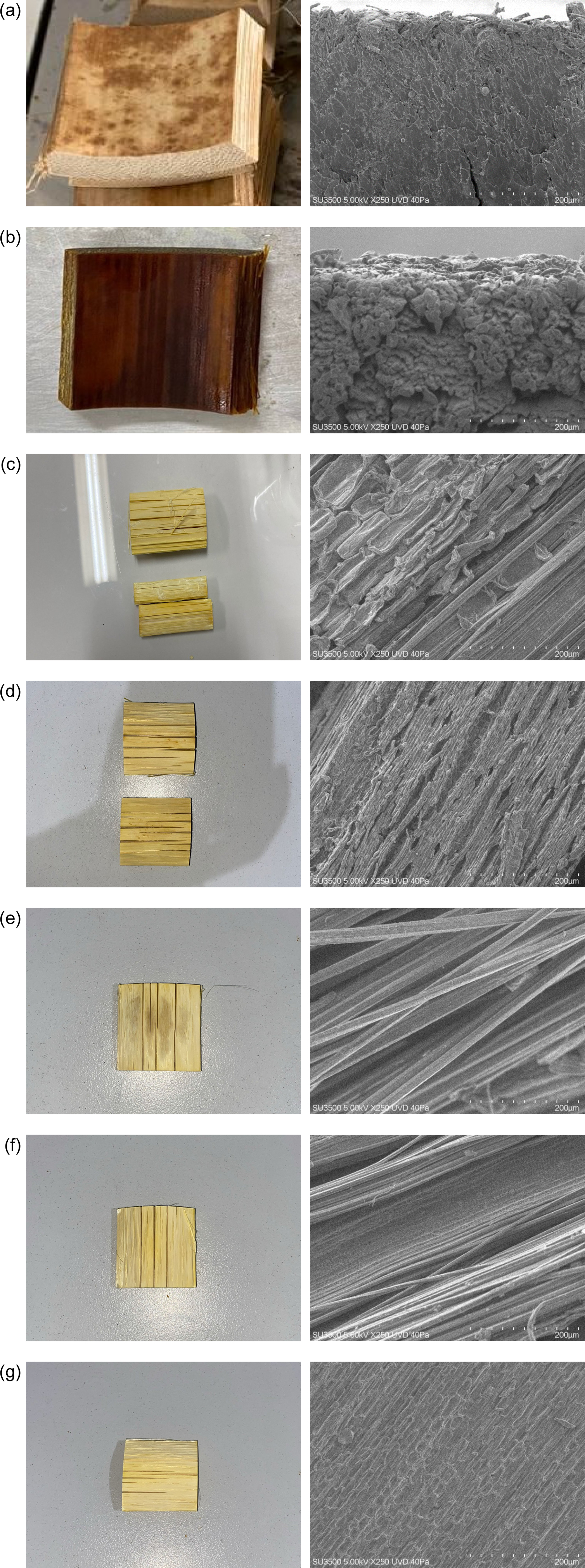
Following alkaline activation (Fig. 4b), partial disruption of the middle lamella was observed. The surface appears rougher, and localized cracks and interfacial gaps begin to emerge between adjacent fibres. This structural loosening can be attributed to the initial cleavage of lignin–carbohydrate complexes under alkaline conditions, which enhances chemical accessibility during the subsequent bleaching stages. Similar pre-delignification-induced structural relaxation has been reported in bamboo and non-wood fibers subjected to alkaline pre-treatments [27,31]. SEM images of the bleached samples (Fig. 4c–g) reveal a progressive transformation of the bamboo microstructure with increasing bleaching severity and proximity to the RSM-optimized condition. Under condition 3, partial delignification resulted in the formation of irregular pores and microvoids within the fiber walls, indicating selective lignin dissolution while the overall fiber integrity was preserved. This observation aligns with the moderate reduction in the Klason lignin content and the attenuation of lignin-associated FTIR bands (notably around 1,510 cm-1).
More pronounced structural changes were observed in conditions 6 and 11, where the SEM micrographs displayed clearly separated fiber bundles and elongated fibrillary features oriented along the longitudinal axis. The disappearance of the compact matrix and emergence of layered, lamellar-like cellulose structures suggest substantial lignin removal from both the middle lamella and secondary cell wall regions. This morphological evolution corroborates the significant decrease in the lignin content measured experimentally and the further suppression of aromatic skeletal vibrations in the FTIR spectra [23,24]. Under conditions 16 and 17, which are close to or coincide with the RSM-predicted optimum, the bamboo fibers exhibit a highly fibrillated and porous architecture. Individual cellulose microfibrils are distinctly exposed, and the cell walls appear thinner and more open, indicating effective delignification without catastrophic fiber collapse. This porous morphology is a key structural prerequisite for subsequent resin impregnation in translucent bamboo fabrication, because it facilitates resin penetration and interfacial bonding. Comparable fibrillation and pore development have been reported in bleached bamboo fibers and cellulose extracted from agricultural residues subjected to optimized peroxide-based bleaching [30,31,32].
Importantly, despite extensive lignin removal, no severe fiber fragmentation or excessive wall collapse was observed in the optimized samples. This suggests that the bleaching conditions achieved a selective delignification regime, where lignin was preferentially removed while the cellulose backbone remained structurally intact. Such a balance is critical for translucent bamboo applications, because excessive degradation would compromise mechanical stability. Similar observations were reported previously, which emphasized that controlled delignification is essential to preserve fiber strength while improving optical and interfacial properties [26,30]. Overall, the SEM results provided direct morphological evidence supporting the chemical trends observed in the Klason lignin analysis and FTIR spectroscopy. The gradual transition from a dense lignin-rich matrix to an open, fibrillated cellulose network confirms that the RSM-optimized bleaching parameters effectively regulate the extent of delignification. This structural coherence across chemical and morphological analyses underscores the robustness of the proposed bleaching strategy for developing bamboo substrates suitable for translucent building materials.
The Klason, FTIR, and SEM results provide complementary rather than directly interchangeable evidence of delignification. Klason analysis quantitatively determines the residual acid-insoluble lignin fraction, whereas FTIR identifies corresponding chemical changes through the attenuation of lignin-associated aromatic bands. SEM does not directly quantify lignin, but reveals the morphological consequences of matrix removal, including increasing pore visibility, fiber separation, and exposure of the cellulose-rich framework. Comparable transparent-bamboo studies have combined lignin measurement, FTIR, and SEM to relate chemical lignin reduction to changes in pore structure and subsequent resin distribution [33]. Other lignocellulosic extraction studies similarly report that chemical removal of lignin and hemicellulose is accompanied by FTIR changes and a transition from a compact matrix to a more fibrous and porous morphology [34]. Thus, the convergence of the present gravimetric, spectroscopic, and morphological observations supports progressive delignification, although a formal quantitative correlation among the three methods was not established.
3.5 Mechanistic summary of lignin removal and structural evolution
The bleaching behaviour of Mayan bamboo observed in this study can be explained by a selective oxidative delignification mechanism governed by the interplay between bleaching temperature, H2O2 concentration, and reaction time. Klason lignin measurements demonstrated that lignin degradation follows a non-linear trend, indicating that delignification efficiency is not solely controlled by bleaching severity. FTIR analysis supports this interpretation by showing a progressive attenuation of lignin-associated aromatic vibrations while preserving polysaccharide-related bands, suggesting preferential oxidation and cleavage of lignin structures rather than indiscriminate degradation of the cell wall components.
At the microstructural level, SEM observations reveal that lignin removal weakens the middle lamella and lignin-rich inter-fiber regions, facilitating fiber separation and the development of interconnected porous networks within the bamboo matrix. As bleaching progresses toward the RSM-optimized condition, aligned cellulose microfibrils become increasingly exposed, indicating effective lignin removal without catastrophic collapse of the fiber walls. This porous yet structurally coherent architecture is particularly significant, as it provides accessible pathways for subsequent resin impregnation while retaining sufficient structural integrity. Moreover, the retention of a moderate lignin fraction is expected to promote light scattering rather than full transparency, which is desirable for diffuse daylighting applications.
This coordinated chemical and structural transformation explains why intermediate bleaching conditions yield not only lower lignin content but also more favourable microstructures compared to more aggressive treatments. Such a mechanistic balance underpins the effectiveness of the proposed bleaching strategy and establishes a rational foundation for preparing bamboo substrates suitable for the fabrication of bio-based translucent building materials.
The numerical bleaching conditions identified in this study should not be directly generalized to other bamboo species. Comparative characterization has demonstrated important differences in lignin, cellulose, extractives, and inorganic composition among bamboo species and between different culm maturity stages [35]. In addition, the relatively high density and low permeability of bamboo can influence chemical penetration, lignin removal, and subsequent resin filling, thereby affecting optical and mechanical performance [36]. Accordingly, the specific temperature, H2O2 concentration, and reaction time reported for Gigantochloa robusta are considered material-specific. Nevertheless, the observed process-level trends—particularly the non-linear interaction among temperature, oxidant concentration, and reaction time and the need to avoid excessive treatment severity—provide a transferable framework for designing species-specific optimization studies in other bamboo and lignocellulosic systems.
This porous yet structurally coherent architecture is relevant to the subsequent fabrication of translucent bamboo. Lignin removal reduces visible-light absorption while generating voids and enlarged pathways that can facilitate resin penetration. However, a delignified bamboo template remains optically scattering because of the refractive-index mismatch between the cellulose-rich cell walls and air-filled pores. Impregnation with a transparent resin having a refractive index close to that of cellulose can replace air within these pores, reduce interfacial light scattering, and improve light transmission [36]. Experimental studies on transparent bamboo have shown that epoxy resin can occupy the cross-sectional surfaces and pores of delignified bamboo, accompanied by a substantial improvement in visible-light transmittance [33]. Recent transparent-bamboo research likewise emphasizes that lignin removal alone does not produce transparency, because air-filled cavities continue to scatter light until the voids are filled or the structure is densified [37]. Residual structural heterogeneity may still promote diffuse transmission and optical haze, which can be advantageous for glare-reducing daylight applications.
4. Conclusions
A RSM-based optimization approach was applied to regulate the hydrogen peroxide bleaching process of Mayan bamboo (Gigantochloa robusta), with lignin content as the primary response variable. Klason lignin analysis demonstrated that lignin removal exhibits a non-linear dependence on bleaching parameters, confirming that effective delignification is achieved within a defined processing window rather than by increasing bleaching severity. The RSM model predicted an optimal bleaching condition at approximately 88°C, 9.85% hydrogen peroxide concentration, and 60 min reaction time, corresponding to a fitted lignin content of approximately 3.5% and a composite desirability value of 0.806. This condition represents a balance between lignin reduction and structural preservation, as more aggressive parameter combinations did not yield proportionally lower lignin content.
FTIR spectroscopy provided chemical evidence supporting quantitative lignin reduction, showing the attenuation of lignin-associated aromatic bands while maintaining polysaccharide-related functional groups. SEM observations further confirmed that the optimized bleaching condition promoted fiber separation and the formation of a porous, fibrillated cellulose network without severe fiber collapse, indicating selective delignification rather than extensive degradation.
Overall, the integration of RSM optimization, Klason lignin determination, FTIR spectroscopy, and SEM imaging provides a coherent understanding of the bleaching mechanism in Mayan bamboo. The results highlight the importance of species-specific process optimization and demonstrate that controlled hydrogen peroxide bleaching can generate bamboo substrates with tailored chemical and microstructural characteristics suitable for the further development of translucent bamboo-based building materials. The conclusions of this study are therefore limited to residual lignin regulation and the associated chemical and microstructural evolution of the bamboo substrate. Evaluation of bleaching yield, overall mass recovery, and process-scale efficiency will require a dedicated mass-balance design and confirmation experiments in subsequent work.