


1. Introduction
2. The Role of AI in Industrial Innovation
3. Core Technologies in the AI Era
3.1 Blockchain technologies in the pulp and paper industry
3.2 Three-dimensional (3D) printing technology in the pulp and paper industry: Adaptive manufacturing
3.3 Internet of things (IoT) in the pulp and paper industry
3.4 Robot technologies in the pulp and paper industry
3.5 Emerging drone applications in the pulp and paper industry
3.6 Additional AI-related technologies
3.7 Summary
4. Strategic Pathways to Sustainable Growth in the AI-Era Pulp and Paper Industry
4.1 Challenges ahead
4.2 Visionary leadership in the AI era
4.3 Diagnostics of the industry in the AI era
4.4 Conclusion: From diagnosis to action
5. Fractal Science - A Roadmap to the AI Era
5.1 Introduction
5.2 Chaos theory in the AI era
5.3 Integrating complexity into AI systems
5.4 Summary
6. Fractal Science: Principles and Applications
6.1 The Richardson problem: Measurement and irregularity
6.2 Mandelbrot sets: Foundational fractals in geometry and industry
6.3 Living systems are fractal: Swedenborg’s intuitive fractal insight
7. Fractal Dimension Analysis Techniques
7.1 Box counting method
7.2 Variogram method
7.3 Power spectral density (FFT) method
8. Fractal Geometry and Log-Normal Distributions
9. Fractal Science in the Pulp and Paper Industry: Innovation in the AI Era
10. Conclusions
1. Introduction
The rise of artificial intelligence (AI) marks the dawn of a new era—commonly described as the Fifth Industrial Revolution. Unlike previous industrial transformations powered by steam, electricity, digital computing, or automation, this new phase is driven by intelligence itself. Its reach is profound, reshaping not only technology and labor but also education, governance, and the very nature of human identity.1,2,3)
In this rapidly evolving landscape, the pulp and paper industry—long rooted in traditional production models—faces both a challenge and an opportunity. To remain relevant, it must move beyond reactive adaptation and embrace a deeper form of creative reinvention.
This paper proposes a novel conceptual lens: fractal geometry. More than a mathematical idea, fractal geometry offers a powerful metaphor for creativity, adaptability, and resilience. Its recursive patterns reflect how complexity and coherence can emerge from simple rules—paralleling how innovation often arises in both nature and human design.4)
By exploring fractal principles, we aim to articulate a new vision for sustainable innovation within the pulp and paper sector. Fractal geometry, we argue, forms a conceptual and practical bridge—linking human imagination and AI to support creative problem-solving, adaptive operations, and sustainable innovation across the pulp and paper value chain.
Understanding and harnessing this synergy may prove vital not only for industrial survival, but for creative leadership in an AI-dominated future.
2. The Role of AI in Industrial Innovation
AI is increasingly recognized as a foundational technology driving the next wave of industrial transformation. By simulating cognitive processes such as learning, adaptation, and decision-making, AI enables smarter automation, predictive maintenance, and dynamic process control—capabilities already reshaping sectors like manufacturing, logistics, and energy. For instance, AI algorithms in power generation and steel manufacturing optimize thermal and chemical parameters in real time; in automotive and semiconductor plants, computer-vision systems pinpoint surface defects within milliseconds.5)
In the pulp and paper industry, AI’s potential lies in optimizing production efficiency, reducing waste, predicting equipment failures, and enabling adaptive supply chains. Notable real-world applications include:6)
• Predictive maintenance systems that integrate IoT sensors (monitoring vibration, temperature, acoustics) with AI analytics to anticipate equipment faults and avoid unplanned outages
• Webbreak prevention through AIdriven platforms like BIGAI, which predict sheet breaks in real time and pinpoint root causes before a 30 min halt occurs—demonstrated to markedly improve uptime and efficiency
• As routine and repetitive roles become increasingly automated, the human contribution will shift toward creative problem-solving, systems thinking, and strategic innovation—areas where fractal-based design and thinking can offer distinct advantages. Just as fractal patterns in nature enable scalable, resilient structures, integrating fractal-informed AI systems can foster more adaptive, robust, and efficient pulp-and-paper processes.
3. Core Technologies in the AI Era
AI serves as the foundation of a rapidly evolving technological ecosystem that is transforming industries across the globe. The following sections highlight key AI technologies particularly relevant to the pulp and paper industry.
3.1 Blockchain technologies in the pulp and paper industry
Blockchain is a type of distributed ledger technology (DLT) in which records of transactions are maintained in linked data structures called “blocks,” each containing a cryptographic hash of the previous block, a timestamp, and transaction data. Network participants validate new entries through a consensus mechanism, after which the block is appended to the ledger in an immutable manner, ensuring verifiable integrity, traceability, and resistance to unauthorized modification.7)
Emerging applications include:
• Sustainable Forest Certification: Traces wood from forest to mill, ensuring legal and environmental compliance.
• Recycled Fiber Verification: Tracks recycled content to meet circular economy and regulatory goals.
• Supply Chain Auditing: Automates audit trails, improving sourcing transparency and ESG reporting.
• Carbon Accounting: Links process data with emissions tracking for accurate carbon footprint assessments.
By embedding trust and automation into operations, blockchain complements AI-based strategies—enabling a more resilient, transparent, and efficient value chain.
3.2 Three-dimensional (3D) printing technology in the pulp and paper industry: Adaptive manufacturing
3D printing is an emerging adaptive manufacturing technology with growing relevance to the pulp and paper industry. By building structures layer by layer, it minimizes material waste and energy use—aligning with circular economy principles.8,9,10)
Key applications include:
• Rapid prototyping of new products,
• Localized fabrication of custom packaging, and
• Precision production of machine parts.
Especially promising is the use of renewable, biodegradable materials like cellulose and nanocellulose for sustainable manufacturing. Beyond material innovation, 3D printing bridges R&D and industrial application through high-fidelity prototyping, reducing the risks and costs of traditional trial-and-error methods.11,12)
As a low-risk, flexible tool for innovation, 3D printing supports faster development cycles, operational resilience, and sustainable growth—making it a strategic asset in the shift toward intelligent, AI-supported manufacturing.
3.3 Internet of things (IoT) in the pulp and paper industry
The Internet of Things (IoT) is an infrastructure of interconnected physical and virtual “things” that are uniquely identifiable, capable of sensing, actuating, and exchanging data over a network without requiring direct human intervention.13) In practical terms, IoT refers to a network of devices—such as industrial machinery, environmental sensors, and logistics assets—embedded with electronics, software, and communication technologies that enable them to collect, share, and act on data in real time.14,15)
IoT connects machines, sensors, and systems to enable real-time monitoring, data exchange, and autonomous control. In the pulp and paper industry, IoT is key to smart manufacturing—boosting efficiency, reliability, and sustainability.15,16,17,18)
Key applications include:
• Predictive Maintenance: Smart sensors detect anomalies in equipment (e.g., refiners, dryers), reducing downtime and maintenance costs.
• Process Optimization: IoT-driven systems adjust variables like pulp consistency and drying temperature, improving energy use and product quality.
• Supply Chain Integration: RFID tracking and real-time data support just-in-time inventory and streamlined logistics.
• Environmental Monitoring: Sensors track emissions and effluent data, aiding compliance and sustainability reporting.
As part of an AI-integrated ecosystem, IoT enables more agile, transparent, and sustainable operations—positioning the industry for long-term competitiveness.
3.4 Robot technologies in the pulp and paper industry
As mills pursue safer, leaner, and more efficient operations, robotic technologies are emerging as key enablers across production and logistics—especially in high-risk, repetitive, or labor-intensive environments—and include:19,20,21)
• Automated Material Handling: Robotic arms and automated guided vehicles (AGVs) handle tasks such as palletizing and transporting raw materials and paper rolls, reducing manual labor and improving material flow and safety.
• Packaging and Wrapping: End-of-line robots perform wrapping, strapping, and labeling with sensor-driven precision, enhancing throughput and minimizing defects in high-volume settings.
• Vision-Guided Inspection: AI-enabled robotic units detect surface defects in real time, enabling uninterrupted quality control and reducing waste without production stoppage.
• Maintenance in Hazardous Zones: Mobile robots with thermal and gas sensors support cleaning and inspection in confined or dangerous areas, improving safety and enabling remote diagnostics.
In summary, robotic technologies are playing a growing role in transforming the pulp and paper industry through smart manufacturing systems. According to Wang et al.,19) intelligent manufacturing environments increasingly incorporate robots for tasks such as automated material handling, precision cutting, packaging, and warehouse management. These robots, when integrated with AI, IoT, and digital twins, enhance operational flexibility, reduce labor intensity, and improve safety in mill environments. Such applications are particularly relevant in pulp and paper mills where high-volume, repetitive, and hazardous tasks—such as stacking large rolls, palletizing paper reams, or inspecting machinery—can be reliably delegated to robotic systems, forming a foundational part of the Industry 4.0 transition.
With tightening safety standards, labor constraints, and sustainability demands, robotics are becoming integral to mill modernization. When integrated with AI systems, they will drive predictive maintenance, process optimization, and smart manufacturing transformation.
3.5 Emerging drone applications in the pulp and paper industry
Drone technologies—unmanned aerial vehicles (UAVs) equipped with GPS, sensors, cameras, and increasingly, AI—are reshaping operations across the pulp and paper value chain. These systems enable real-time data collection, faster response times, and safer, more efficient workflows.22,23,24)
Key applications include:
• Forest Monitoring: Multispectral and LiDAR-equipped drones assess tree health, canopy density, and disease presence—enabling data-driven forest management and sustainable harvesting.24)
• Supply Chain Visibility: Drones monitor road conditions, transport routes, and mill yards in real time, improving coordination between forest sites and production facilities.25)
• Mill Site Inspection: Drones provide safe, rapid inspection of hard-to-reach areas such as chimneys, rooftops, and silos—reducing downtime and safety risks.23)
• Environmental Compliance: Aerial monitoring of emissions, wastewater, and land use supports regulatory reporting and environmental stewardship.23)
In summary, as drone technologies evolve—with advances in autonomy, sensing, and AI—they are moving beyond basic aerial surveys toward intelligent, integrated platforms. When combined with robotics, IoT, and digital analytics, drones become essential tools for achieving operational agility, safety, and sustainability in the AI era.
3.6 Additional AI-related technologies
Several emerging technologies are accelerating AI adoption and shaping the future of intelligent manufacturing:
• Extended Reality (XR): Encompassing VR, AR, and MR, XR is used for simulation training, remote support, and design visualization in industrial settings.26,27)
• Quantum Computing: Though in early stages, quantum systems promise breakthroughs in complex problem-solving, optimization, and materials research.28,29)
• 5G and Advanced Connectivity: High-speed, low-latency networks support real-time data exchange for IoT, automation, and smart infrastructure.30)
• Synthetic Biology: Merging biology with digital design, this field enables innovations in renewable materials and bio-based alternatives relevant to pulp and paper.31)
• Cybersecurity: AI-enhanced security tools are essential for protecting expanding industrial data networks and ensuring operational resilience.32)
• Energy and Storage Technologies: Advances in batteries, hydrogen, and renewables—supported by AI-driven optimization—are critical for sustainable industrial operations.33,34)
Table 1 summarizes the AI technologies discussed in Section 3, specifically related to the pulp and paper industry
Table 1.
The summary of the AI technologies related to the pulp and paper industry
3.7 Summary
AI technologies form the foundation for intelligent transformation across industries. In the global pulp and paper industry—facing increasing competition, environmental challenges, and labor constraints—the integration of AI with 3D printing, XR, biotechnology, 5G, and advanced energy systems offers a clear path to sustainable growth.
The true value lies in convergence: where data, automation, and intelligent infrastructure operate together. Realizing this vision demands visionary leadership, cross-sector collaboration, and long-term commitment to innovation.
Amid this global shift, Korea’s pulp and paper industry has a unique opportunity—not just to adapt, but to lead—by embracing converging technologies and shaping the direction of the Fifth Industrial Revolution.
4. Strategic Pathways to Sustainable Growth in the AI-Era Pulp and Paper Industry
4.1 Challenges ahead
AI has emerged as a global mega trend—converging with technologies like 3D printing, XR, IoT, and biotechnology. For the global pulp and paper industry, sustainable growth in this Fifth Industrial Wave requires more than upgrades; it calls for full alignment with technological and environmental shifts.35,36,37)
Yet, many firms remain stuck in outdated models, reflecting what Levitt termed myopia: the failure to anticipate future needs. The real challenge now is not just adopting new tools, but transforming mindsets. Creativity and visionary leadership are essential for the industry to lead—not just follow—global transformation.38,39,40)
4.2 Visionary leadership in the AI era
Levitt’s38) insight on short-term thinking remains relevant, but today’s AI era demands a redefinition of leadership. No longer centralized, leadership now emerges across functions—driven by data, collaboration, and agility.
As AI reshapes core processes—maintenance, supply chains, customer service—the absence of visionary leadership has become a central risk. Quoting Kuhn, true transformation requires paradigm shifts, not piecemeal reforms. Sustainable growth now hinges on cultivating leaders who foster innovation, adaptability, and creative problem-solving.41,42)
4.3 Diagnostics of the industry in the AI era
4.3.1 Strategic diagnosis
Transformation starts with clear diagnosis. Historically, the industry has pursued change without addressing structural constraints. A SWOT analysis helps clarify this landscape under AI influence.43)
SWOT analysis of the pulp and paper in the AI Era:
• Strengths: Global infrastructure, skilled workforce, strong brand presence
• Weaknesses: Outdated machinery, low digital adoption, high fixed costs
• Opportunities: AI automation, sustainable packaging, digitalized supply chains
• Threats: Stricter regulations, media competition, pricing pressure
4.3.2 Structural characteristics
Key features define both the strengths and constraints of the industry:
• Raw material dependence (wood, cellulose)
• High capital intensity and energy use
• Mature markets with tight margins
• Sustainability and tech adoption gaps
4.3.3 Key AI use cases in pulp and paper
• Predictive Maintenance: Reduce downtime through real-time monitoring.
• Supply Chain Optimization: Improve forecasting, logistics, and inventory.
• Energy Efficiency: Smart systems lower energy use and emissions.
• Automated Quality Control: Vision-based systems enhance product consistency.
• Sustainable Packaging R&D: Simulate and optimize new materials.
• Market Intelligence: Use NLP and analytics to forecast trends and risks.
4.4 Conclusion: From diagnosis to action
The pulp and paper industry stands at a critical junction. Diagnostics highlight long-standing constraints—but action is now essential. AI, while not a cure-all, is a catalyst for change. With bold leadership and strategic investment, the industry can shift from stagnation to intelligent, sustainable growth.
5. Fractal Science - A Roadmap to the AI Era
5.1 Introduction
Fractal science offers a powerful conceptual roadmap for navigating the complexity of the AI era. Originally developed to describe irregular patterns in nature, it reveals structure within apparent disorder—coastlines, clouds, and tree branches all exhibit self-similarity across scales.4,44,45,45,47)
As AI evolves, its systems increasingly mirror natural processes. Neural networks, genetic algorithms, and swarm intelligence draw from biological models, showing that AI is less a break from nature than a continuation of it. Understanding the geometry and dynamics behind such complexity is key to building adaptive and intelligent systems.
5.2 Chaos theory in the AI era
Chaos theory explains how small changes can lead to large, unpredictable outcomes in nonlinear systems—a concept known as the “butterfly effect.” While seemingly chaotic, these systems follow deterministic rules that reveal deeper patterns, or attractors.48)
Applications span climate modeling, financial forecasting, and material science—all highly relevant for AI systems operating in uncertain, dynamic environments. Chaos theory helps AI better interpret volatility and adapt to real-world complexity.49,50)
5.3 Integrating complexity into AI systems
AI technologies like deep learning and agent-based modeling benefit from principles found in fractal and chaotic systems. Examples include:
• Fractal analysis in medical imaging and diagnostics
• Chaos-based models for time series prediction
• Swarm intelligence for optimization and robotics
These tools allow AI to recognize not just raw data, but patterns within data—enhancing adaptability and resilience.
5.4 Summary
Fractal geometry and chaos theory provide more than technical models—they offer a mindset shift: from rigid control to adaptive learning. For industries like pulp and paper, this means enabling smarter systems for predictive maintenance, energy efficiency, and sustainable design.
In the AI era, these natural frameworks serve as both guide and inspiration—bridging complexity science with real-world innovation.
6. Fractal Science: Principles and Applications
6.1 The Richardson problem: Measurement and irregularity
Richardson’s51) classic question—“How long is the coastline of Britain?”—revealed that the measured length of a natural boundary depends on the scale used. The finer the measurement unit, the longer the result.
This counterintuitive finding challenged Euclidean assumptions and highlighted the complexity of natural forms. Richardson’s work led to the development of the Richardson plot, which later evolved into the box-counting method used to estimate fractal dimension—a key measure of geometric complexity.52)Fig. 1 shows the Richardson plot.
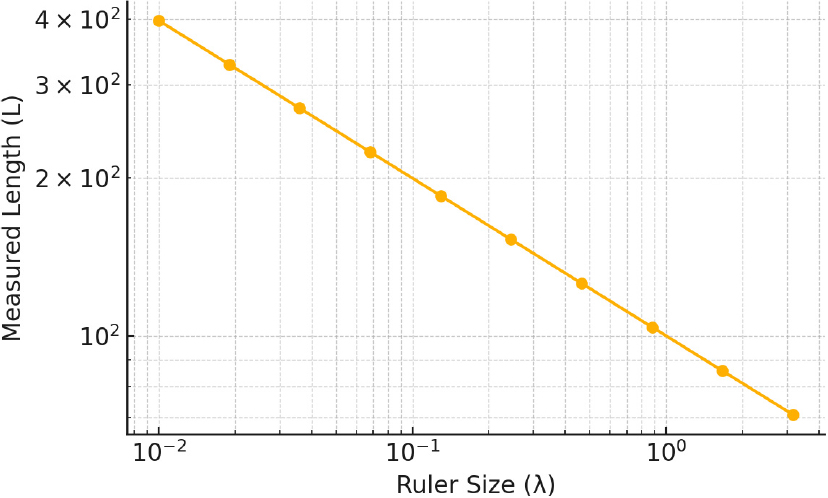
A log-log plot (as shown in Fig. 1) allows the calculation of fractal dimension (FD) using the formula:
As the unit of measurement becomes smaller, the measured length increases—approaching infinity. This reveals a core property of fractals: a natural form can have an infinite perimeter while enclosing a finite area. This geometric paradox highlights the limitations of traditional Euclidean geometry in capturing nature’s inherent irregularity.52)
6.2 Mandelbrot sets: Foundational fractals in geometry and industry
Benoît Mandelbrot extended Richardson’s insights by formalizing fractals—structures that repeat at multiple scales, revealing complex geometry through simple, recursive rules. Classic examples include: 1) Cantor Dust, 2) Koch Snowflake, 3) Sierpinski Carpet, and 4) Menger Sponge.4,52,53,54,55)
Example 1: Cantor Dust
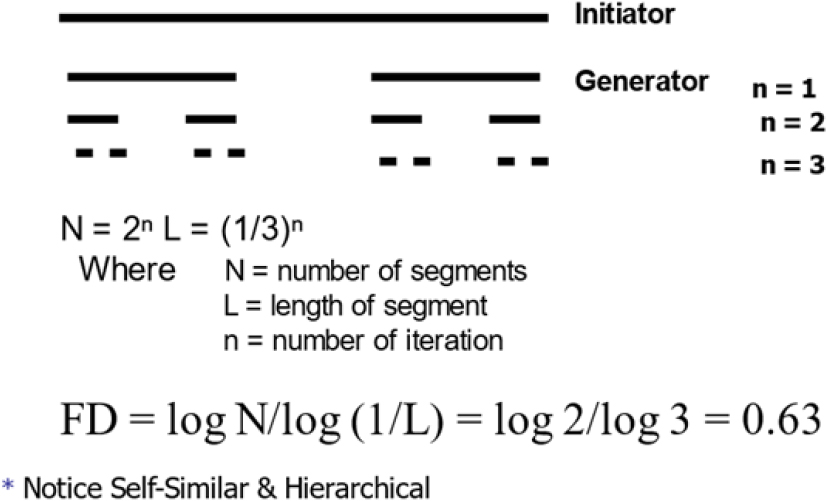
Cantor Dust is one of the simplest yet most illustrative fractals, defined by self-similarity, recursion, and dimensional reduction. It is created by repeatedly removing the middle third of a line segment, producing a structure that becomes increasingly fragmented while maintaining its pattern.
This infinite process within finite space highlights a core paradox of fractal geometry. With a fractal dimension of approximately 0.63, Cantor Dust lies between a set of points and a line—more than zero-dimensional, but less than one.
Its structure also mirrors the transition from analog to digital systems: longer segments resemble smooth analog waves, while shorter ones resemble discrete digital signals.
These properties make Cantor Dust highly relevant to fields like signal processing, data compression, quantum computing, and nanotechnology—where scalable, recursive architectures are key. Fig. 2 illustrates the iterative processes used to generate the Cantor Dust fractal.
Example 2: Koch Snowflake
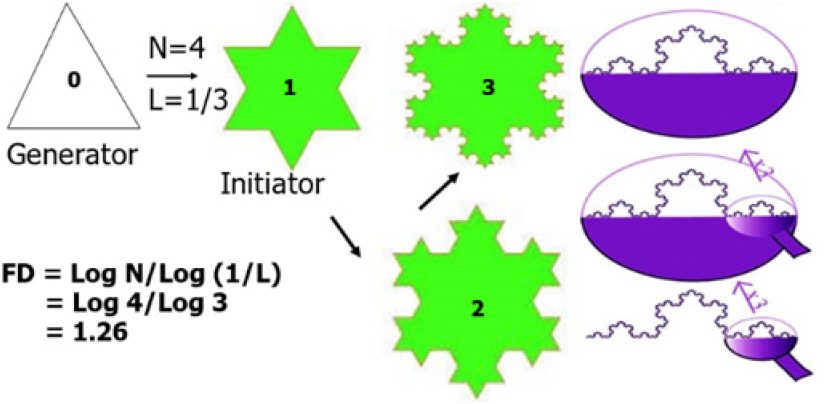
The Koch Snowflake is a classic fractal formed by recursively adding equilateral triangles to each side of a base triangle. With each iteration, the shape becomes more intricate, exhibiting self-similarity and infinite complexity within a finite space.
Its fractal dimension is approximately 1.26—between a line (FD = 1) and a surface (FD = 2)—reflecting its paradoxical nature: an infinite perimeter enclosing a finite area.
This geometry has real-world parallels in systems requiring maximum surface area in limited space, such as lung structures, blood vessels, and lightning patterns. The Koch Snowflake exemplifies how simple rules can produce elegant, space-filling forms relevant to both natural design and industrial modeling. Fig. 3 illustrates the iterative process used to generate the Koch Snowflake fractal.
Example 3: Sierpinski Carpet
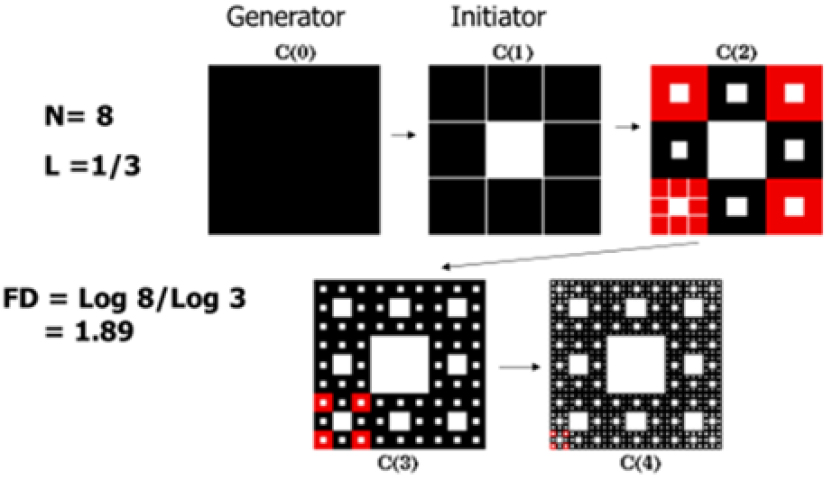
The Sierpinski Carpet is a classic fractal formed by recursively removing the center square from a 3 × 3 grid. With each iteration, the structure becomes increasingly intricate—demonstrating self-similarity, hierarchy, and infinite complexity within finite space.
Its fractal dimension is approximately 1.89, significantly higher than Cantor Dust (~0.63), reflecting its dense space-filling capability.
This pattern has real-world parallels:
• Biology: The human lung mirrors the carpet’s recursive logic—packing over 70 m2 of surface area into a compact chest cavity.
• Engineering: The design inspires filtration systems, biomedical scaffolds, and multiscale membranes, maximizing surface exposure for efficient flow and exchange.
In the pulp and paper industry, the Sierpinski Carpet offers a model for improving wet-end chemistry, drainage, and wastewater treatment, where flow dynamics depend on recursive, porous structures. Fig. 4 illustrates the iterative process used for generating the Sierpinski Carpet fractal.
Example 4: The Menger Sponge
The Menger Sponge is a three-dimensional fractal, analogous to the Sierpinski Carpet, constructed by recursively removing the center cube and the center square from each face of a larger cube (Fig. 5). With each iteration, the figure becomes increasingly porous, illustrating how void and structure can coexist in a highly ordered form. Fig. 5 illustrates the iterative process used for generating the Menger Sponge fractal.
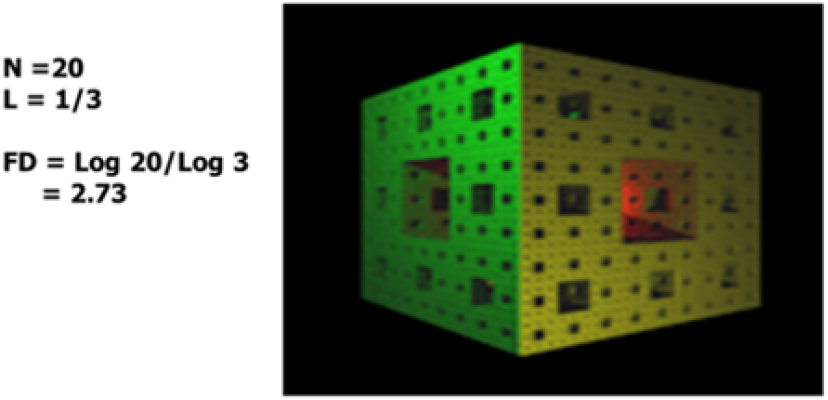
Its fractal dimension is:
This high FD reflects a space-filling yet porous structure—more complex than the Koch Snowflake (1.26) or Sierpinski Carpet (1.89). The Menger Sponge exemplifies how fractal geometry can maximize surface area and void volume within constrained three-dimensional spaces.
6.2.1 Applications in porous media and pulp systems
Due to its high porosity and structural hierarchy, the Menger Sponge serves as a model for fluid transport in porous media. Higher fractal dimensions often correlate with increased tortuosity and reduced permeability.56,57) These principles inform industrial applications like dewatering, wet-end chemistry, and filtration in the pulp and paper industry.
6.2.2 Fractal evolution: From line to volume
Together, the Cantor Dust, Koch Snowflake, Sierpinski Carpet, and Menger Sponge represent escalating complexity—from 1D fragmentation to 3D volume-filling. All arise from simple shapes and recursive rules, demonstrating nature’s use of scale-invariant design.
6.2.3 Core characteristics of fractal geometry
Two essential properties unify these models:
1. Self-Similarity - Patterns repeat at varying scales.
2. Hierarchy - Structures are nested in layers, each reflecting the whole.
These principles explain how nature achieves complexity through simple, rule-based geometry—a theme explored further in later sections with reference to biological systems and industrial design.
6.3 Living systems are fractal: Swedenborg’s intuitive fractal insight
Long before Mandelbrot’s formal theory, Emanuel Swedenborg (1688–1772) described biological structures as nested, self-similar systems—organs made of “little organs,” hands as “smaller spines” branching from larger ones. Though he never used the term fractal, his metaphysical writings remarkably prefigured the concept of recursive hierarchy and self-similarity in living systems.58)
Swedenborg saw the body as a series of embedded structures—tongues within tongues, hearts within hearts—anticipating the fractal organization found in lungs, blood vessels, and neurons. These biological forms maximize efficiency through self-similar branching, as modern science confirms: the human lung, with 23 levels of airway branching, creates a surface area of 70 m2—optimized through fractal design.
Importantly, Swedenborg perceived fractal order not merely as a form, but as a process. Today, developmental biology and morphogenesis reveal that life grows through recursive rules, echoing the fractal patterns he envisioned.
In bridging ancient insight and modern science, fractal geometry affirms a deep unity between form, function, and life’s generative structure.
7. Fractal Dimension Analysis Techniques
Fractal geometry offers a powerful framework for analyzing surface complexity and self-similarity across natural and engineered materials. Among the various methods developed, three have gained wide use in the pulp and paper industry and beyond.4,53,54)
7.1 Box counting method
Popular for its simplicity and versatility, this method overlays grids of decreasing size on a structure and counts the number of boxes that intersect it. The slope of a log-log plot of box size versus count yields the fractal dimension. It is widely applied in texture analysis, fiber morphology, and print quality due to its computational efficiency.
7.2 Variogram method
Often used in geostatistics and surface analysis, the variogram measures how variance between data points changes with distance (lag). This method is effective for evaluating surface roughness and coatings. However, it can be sensitive to lag selection and less reliable for structures with multiple scaling behaviors.42)
7.3 Power spectral density (FFT) method
This frequency-domain technique converts surface profiles using a Fast Fourier Transform. A log-log plot of power versus frequency reveals the fractal dimension using the equation:
The method excels in identifying multiple fractal zones in layered or textured materials but may be affected by noise and image resolution, especially at high frequencies.
In summary, each method—Box Counting, Variogram, and FFT—offers distinct advantages depending on the data type, domain (spatial or frequency), and scale. Selecting the appropriate technique is essential for accurately capturing the fractal properties of paper surfaces, coatings, and printed patterns.
8. Fractal Geometry and Log-Normal Distributions
Natural phenomena rarely follow uniform or Gaussian distributions. Instead, they often exhibit patterns shaped by deeper structural and energetic principles. Fractal geometry—marked by self-similarity, hierarchy, and scale invariance—underpins many of these systems.4,56,59,60)
Empirical studies show that many natural processes, from biological growth to sediment transport, follow log-normal distributions rather than Gaussian ones.61) This pattern suggests a strong link between fractal structures and log-normal statistics, both signatures of multiplicative, self-organizing systems.53)
Examples include:
• Airborne dust particle distributions56)
• Pore size in cellulose fibers53)
• Contact angle variations on cellulose surfaces62)
• Fine particle aggregation56)
In particular, Allan and Ko61) explained the log-normal pore distribution in cellulose via DLVO theory, showing how competing van der Waals and electrostatic forces lead to thermodynamically stable, energy-efficient configurations.63,64) This reflects a broader natural tendency toward low-energy, self-organizing states—as Emerson put it, “Nature works by short ways… through the principle of least action.”65)
Moreover, fractal analysis methods such as the Richardson plot often reveal power-law relationships closely associated with log-normal behavior. Thus, when a system exhibits log-normal frequency distributions, it often implies underlying fractal geometry.
To summarize, fractal geometry is not a mathematical abstraction but a universal design principle in nature. Its consistent pairing with log-normal statistics highlights how nature evolves—not randomly, but through hierarchical, energy-efficient structures that facilitate adaptive function across scales. This principle governs the flow of energy, the formation of structure, and the emergence of complexity in both living and physical systems.
9. Fractal Science in the Pulp and Paper Industry: Innovation in the AI Era
Fractal geometry provides a powerful analytical tool for understanding complex structures and behaviors in pulp and paper production. From microstructure to macro-processes, its applications span material characterization, efficiency improvement, and quality control. As summarized in Table 2, fractal analysis supports process enhancement across forming, dewatering, drying, and product design.53)
Table 2.
Applications of fractal geometry in pulp and paper manufacturing
As the industry transitions from Industry 3.0 to Industry 5.0, the convergence of AI technologies with fractal modeling marks a shift toward intelligent, human-centric, and sustainable systems. AI brings real-time data analytics, predictive maintenance, and adaptive learning—while fractal science explains the hierarchical, energy-efficient nature of material behavior.
Combined benefits include:
• Optimized energy and resource usage
• Reduced downtime through predictive control
• Enhanced product customization and quality assurance
• Alignment with circular economy and sustainability goals
More than a technical integration, this shift reflects a strategic necessity. AI is not a replacement for human insight but a partner in creative reinvention. As repetitive tasks are automated, creativity becomes the industry’s core asset — unreplicable by machines.
Fractal geometry serves both as a diagnostic tool and as a model for innovation. It reveals how complexity emerges from simplicity, how feedback loops build resilience, and how imperfections drive adaptive design. This is the spirit of Edison’s observation: “I have not failed. I’ve just found 10,000 ways that won’t work.”
10. Conclusions
In the AI era, sustainable growth in the pulp and paper industry requires more than system upgrades—it demands a strategic transformation. Fractal geometry, combined with AI and human creativity, offers a scalable framework for optimizing processes, conserving resources, and driving product innovation. Benefits include improved fiber network simulation for better strength and printability, enhanced resource efficiency through pattern-based energy and water use analysis, and advanced predictive maintenance using fractal-informed monitoring systems.
A practical roadmap begins with awareness and training to embed fractal thinking into R&D and operations. IoT-enabled data integration will supply high-resolution inputs for fractal modeling of fiber behavior and process dynamics. Pilot projects can validate improvements in bleaching, drying, and coating before scaling across facilities via digital twins and AI decision-support tools. Finally, aligning these efforts with sustainability goals will strengthen market positioning and regulatory compliance.
By placing creativity at the center and leveraging fractal science within an AI-driven framework, the pulp and paper sector can evolve from reactive adaptation to proactive leadership in the Fifth Industrial Wave.