1. 서 론
셀룰로오스는 광합성을 통하여 연간 1011톤에 해당하는 막대한 양을 얻을 수 있는 것으로 알려져 있는 재생산이 가능한 매우 풍부한 천연자원의 하나이다.1) 그럼에도 불구하고 오랜 기간 동안 석유화학산업의 발전에 가려 큰 관심을 끌지 못했었다. 그러나 산업의 급격한 발전과 더불어 수반된 지구온난화와 그에 따른 다양한 재앙의 징후가 나타남에 따라 1972년 로마클럽의 “The limits to growth”의 발간 및 스웨덴 스톡홀름에서의 유엔 인간환경회의(UN conference on human environment) 개최, 1985년 온실가스의 기후변화에 대한 영향 평가회의, 1988년 기후변화에 관한 정부간 협의체인 IPCC를 설립하고, 1992년 리우에서 유엔환경개발회의(UN conference on environment and development), 1997년 유엔 환경특별총회, 2001년 교토의정서 이행방안 합의 도출 등, 비록 이산화탄소 배출이 많은 일부 선진국들의 비협조로 어려움이 있기는 했지만, 지구온난화 및 기후변화의 진행을 늦추기 위한 노력이 가시화되어 감에 따라 지속가능한 발전에 대한 관심도 더욱 높아졌다. 이러한 추세는 석유화학제품의 이용보다는 천연 재생산이 가능하고, 에너지 소비가 적으며, 환경오염이 적은 셀룰로오스의 활용을 위한 연구가 활발히 이루어지게 되었다.2)
셀룰로오스는 그동안 다양한 형태로 널리 사용되어 왔는데 특히 셀룰로오스 섬유로부터 제조된 나노셀룰로오스의 경우 높은 강도를 제공하는 등 기존 셀룰로오스 사용 시 얻을 수 있는 여러 특성에 비하여 고기능성 소재 개발에 있어서 매우 우수함이 밝혀짐으로써3,4) 전 세계 학계 및 연구기관뿐만 아니라 각종 산업에서도 나노셀룰로오스의 유용성에 대한 인식을 하게 됨으로써 이와 관련된 연구가 매년 급격히 증가되고 있다. 2015년 핀란드 VTT Technical Research Center of Finland Ltd.에서 주관한 Webinar5)에서 제시한 자료에 의하면 나노셀룰로오스의 잠재적 시장은 Table 1에서 보는 바와 같이 무궁무진하다. 그럼에도 불구하고 실제로 실용화 된 경우가 매우 제한적인 것은 나노셀룰로오스 제조에 많은 에너지 및 제조 비용이 요구되고, 고분자 복합체 제조 시 균일하게 분산시키는 문제,6) 나노셀룰로오스 고유의 친수성으로 인한 공정상의 문제 등의 장애요인 때문이다. 이러한 문제를 해결하기 위한 일환으로 에너지 소비를 줄이기 위한 전처리,7-12) 나노셀룰로오스를 건조시키는 방법에 따른 성질 변화,13-15) lignocellulosic material을 원료로 사용한 나노셀룰로오스 제조 및 특성 조사16-19) 등에 대한 연구가 다수 진행되었다.
Table 1.
Potential in key application markets of nanocellulose
| Market | Market size (k ton) | Loading (%) | Market penetration (%) | Demand (k ton) | Estimated CAGR (%)* |
|---|
| Paper and paperboard | 400,000 | 5 | 5-10 | 1,000-2,000 | 6 |
| Excipients | 4,600-550,000 | 2-10 | 2.5-6 | 2-3,300 | 4-5 |
| Packaging composites | 16,000 | 5 | 5-10 | 40-80 | 4-5 |
| High barrier packaging film | 1,600 | 5 | 3-10 | 24-80 | 5 |
| Paints and coatings | 40-44,000 | 2 | 3-6 | 26-53 | 4 |
| Manufactured textiles | 50-56,000 | 2 | 2-5 | 20-56 | 4 |
| Natural textiles | 35,000 | 2 | 2-5 | 14-35 | 4 |
| Oil & gas | 17,500 | 1 | 5 | 9 | |
| Natural fiber composites | 5,500 | 2 | 3-7 | 3-8 | 10-12 |
| Nonwovens | 7,000 | 2 | 5 | 7 | |
| Adhesives | 4,000 | 2 | 5 | 4 | |
| Cement | 15-16,000 | 0.5-1 | 2-5 | 1.5-8 | 7-8 |
Functional and barrier coatings
(in paper and board) | 2,000 | 2 | 3-6 | 1-2 | 4-5 |
본 연구에서는 이 들 문제 중 생산 원가를 일부 감소시키고, 폐지의 고부가 가치 자원화를 위한 일환으로 white ledger를 이용한 NFC 제조 가능성을 평가하기 위하여 일련의 연구를 수행하였다.
2. 재료 및 방법
2.1 공시 재료
본 연구에 사용된 white ledger는 M사로부터 분양받아 사용하였다. 피브릴화 비교실험을 위하여 활엽수 표백 크라프트 펄프와 침엽수 표백 크라프트 펄프는 H사에서 분양받아 사용하였다.
2.2 실험 방법
White ledger의 경우 제지용 펄프와 달리 잉크, 회분 등 이물질을 지니고 있어서 바로 MFC를 제조할 수 없으며, 또한 이미 종이를 제조하는 과정뿐만 아니라 소비자가 사용하는 동안 펄프섬유의 각질화(hornification)가 일어나 버진펄프보다는 피브릴화가 어려운 특성을 지니고 있다. 하지만 표백 화학펄프가 주원료이기 때문에 리그닌 성분에서 비롯되는 피브릴화의 장애는 존재하지 않는다.
따라서 MFC를 제조하기 위해서 Fig. 1에서 보는 바와 같이 먼저 펄퍼로 해리를 시킨 다음 부유 탈묵 방법을 이용하여 잉크 및 기타 부유 이물질들을 제거하였다. 잉크 입자 및 부유 이물질이 제거된 펄프슬러리에는 약 25%의 충전제(무기질 분말)가 들어가 있어서 그대로 피브릴화 할 경우 무기질 분말이 포함되기 때문에 양질의 나노셀룰로오스를 얻기 어렵고, 장치의 마모를 야기할 수 있기 때문에 hyperwashing 방법을 이용하여 펄프 슬러리 내 무기질 분말을 제거하였다.

Fig. 1.
Manufacturing process of nanofibrillated cellulose from white ledger.
White ledger의 피브릴화는 grinder(MKCA6-2, Masuko Sangyo, Japan)를 이용하여 제조하였다. White ledger는 전술한 바와 같이 종이 제조 공정 및 소비자가 이용하는 동안 각질화 현상이 일어나 기존 나노셀룰로오스 제조용 원료로 사용하고 있는 버진펄프와 달리 피브릴화가 상대적으로 어렵기 때문에 알칼리 전처리를 통한 펄프의 팽윤을 실시하여 전처리를 하지 않은 경우 및 목재펄프와 피브릴화 정도를 비교하였다.
피브릴화 농도는 2%를 적용하였으며, 피브릴화 과정에서 조건이 변경될 경우 일정한 결과를 얻기 어렵기 때문에 그라인더 간격을 -150 μm로 조절하고, 피브릴화 에너지의 변이를 최소화하기 위하여 그라인더에 걸리는 전류가 2 A가 되도록 조절하면서 피브릴화를 실시하였고, 그라인더를 통과시킬 때마다 발생되는 열에 의하여 농도 변화가 생기기 때문에 매번 농도를 측정하고 보정을 실시하였다. 또한, white ledger로 제조된 NFC의 특성을 비교하기 위하여 SwBKP(softwood bleached kraft pulp)와 HwBKP(hardwood bleached kraft pulp)를 원료로 사용하고, 잉크 입자 및 이물질 제거를 제외한 나머지 조건은 동일하게 적용하여 MFC를 제조하였다.
상기 방법으로 제조된 MFC의 특성을 조사하기 위하여 SEM 이미지 촬영, FTIR 분석, CED 점도를 측정하였으며, 제지용 첨가제로서의 성능 비교 실험을 실시하였다.
3. 결과 및 고찰
3.1 피브릴화 특성
Figs. 2-4는 HwBKP, SwBKP 및 white ledger를 다른 조건으로 알칼리 전처리하여 피브릴화를 실시한 것으로 그라인더로 처리한 횟수 별로 얻어진 결과를 정리한 것이다. 활엽수 펄프의 경우에는 침엽수 펄프에 비하여 피브릴화가 용이하게 일어남을 확인할 수 있었다. 알칼리 전처리가 활엽수 표백펄프의 피브릴화에 미치는 영향은 0.5% 농도의 알칼리 전처리 시에는 피브릴화가 보다 용이하게 일어나지만 그 이상의 알칼리 농도에서의 전처리는 오히려 피브릴화를 저해하는 것으로 확인되었다.
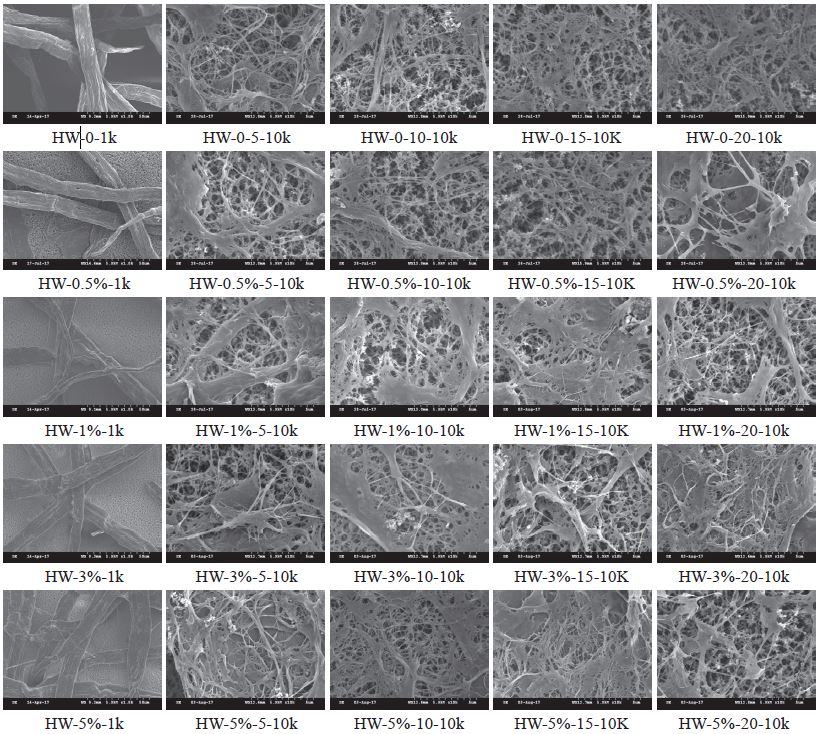
Fig. 2.
SEM images of NFCs manufactured from HwBKP pre-treated with various alkali treatment conditions.
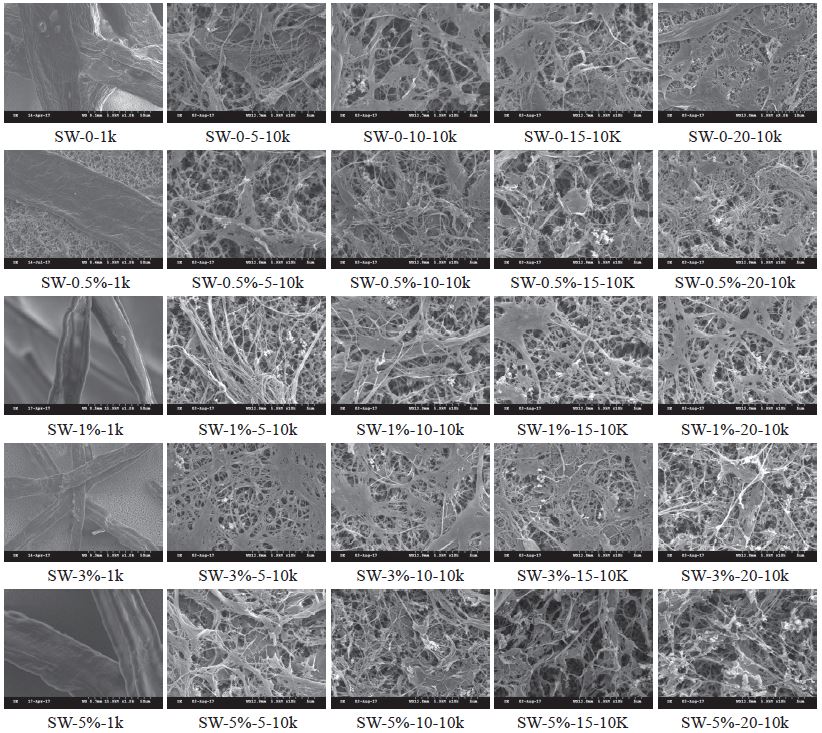
Fig. 3.
SEM images of NFCs manufactured from SwBKP pre-treated with various alkali treatment conditions.
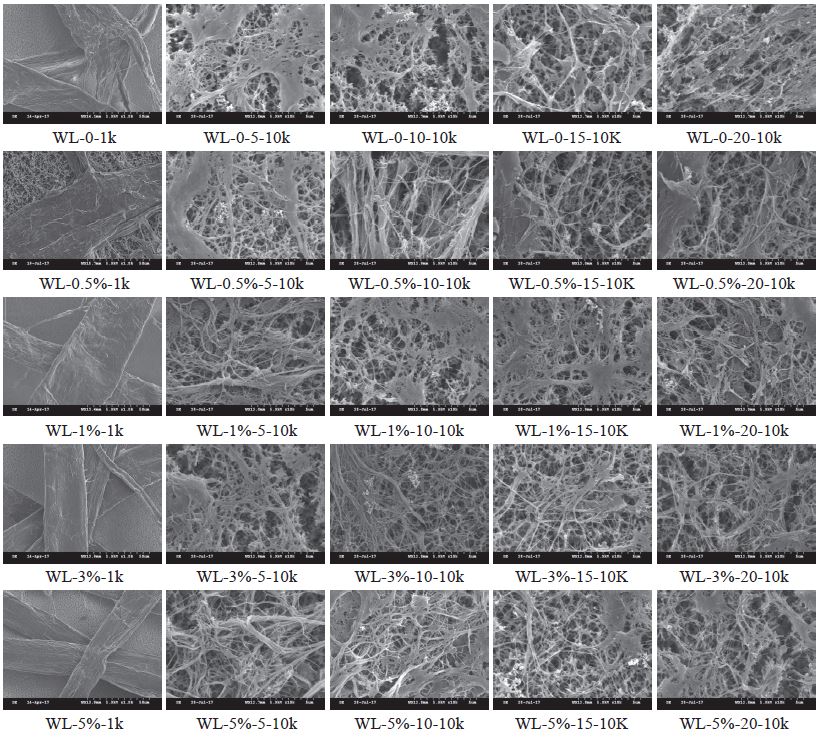
Fig. 4.
SEM images of NFCs manufactured from white ledger pre-treated with various alkali treatment conditions.
침엽수 펄프의 경우는 고해 시 활엽수 펄프(1.0 Ws/m미만)보다 높은 약 2.0 Ws/m의 SEL(specific edge load)이 적정 수준으로 알려져 있는 바와 같이20) 피브릴화가 어렵기 때문에 활엽수 펄프 알칼리 전처리 시보다 높은 1%까지 알칼리 처리에 의하여 피브릴화가 개선되었으나 그 이후는 오히려 피브릴화가 어려워지는 경향을 나타내었다. 이상과 같이 버진펄프의 경우에는 알칼리 전처리가 피브릴화 개선에 미치는 영향이 매우 미미하여 알칼리와 같은 팽윤제를 이용한 전처리의 필요성이 매우 낮은 것으로 확인되었다.
White ledger는 종이 제조공정을 통하여 각질화(hornification)가 일어나 물과의 결합 및 팽윤이 전술한 HwBKP와 SwBKP에 비하여 훨씬 떨어지기 때문에 피브릴화가 어려울 것으로 생각되었다. 따라서 알칼리 전처리에 의한 수화(hydration) 및 팽윤(swelling)의 개선이 피브릴화에 도움이 될 것으로 기대되어 다양한 조건으로 전처리를 실시하여 피브릴화를 실시하였다. 피브릴화 결과 Fig. 4에서 보는 바와 같이 미처리 시에는 피브릴화가 확실히 버진펄프에 비하여 지연되는 것이 확인되었다. 또한, 본 연구에서 적용한 5%까지는 알칼리 전처리 농도가 높아짐에 따라 피브릴화가 더 잘 일어남이 확인되어 white ledger를 원료로 사용하여 NFC 제조 시에는 알칼리 전처리가 도움이 됨을 알 수 있었다.
3.2 FTIR 분석 결과
일반적으로 12-18% 농도의 NaOH 용액으로 셀룰로오스 I을 처리할 경우 mercerization에 의하여 셀룰로오스 II로 바뀌는 것으로 알려져 있는데,21) Duchemin의 연구 결과에 의하면 비록 1% 농도의 NaOH 용액이라 할지라도 0°C 이하에서 처리할 경우 셀룰로오스 I이 셀룰로오스 II로 전환되는 머서화가 일어날 수 있다고 보고하였다.22) 본 연구에서 white ledger의 피브릴화를 용이하게 하기 위하여 알칼리 전처리를 실시하였는데 이러한 전처리가 화학적 성질의 변화 또는 셀룰로오스 분자 구조의 변화 발생 여부를 확인하기 위하여 미처리 및 알칼리 전처리를 실시한 HwBKP, SwBKP, white ledger 및 이들로부터 제조된 NFC(nanofibrillated cellulose)에 대하여 FTIR spectra를 찍은 결과 Figs. 5-7에서 보는 바와 같이 실온에서 처리할 경우 5% 농도의 알칼리 전처리까지는 3종의 소재에 대한 변화가 전혀 일어나지 않았음을 확인할 수 있었다.
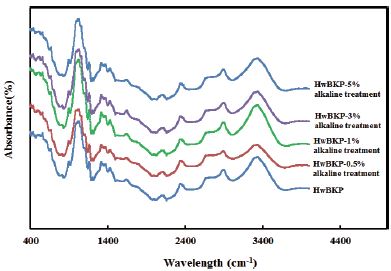
Fig. 5.
FTIR spectra of HwBKP pre-treated with alkali solution.
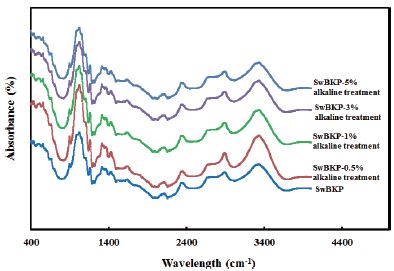
Fig. 6.
FTIR spectra of SwBKP pre-treated with alkali solution.
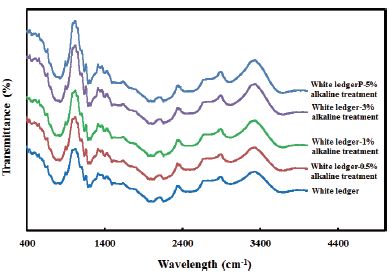
Fig. 7.
FTIR spectra of white ledger pretreated with alkali solution.
FTIR 분석 자료를 근거로 알칼리 처리에 의한 결정화도 및 수소결합지수의 변화 여부를 평가하기 위하여 lateral order index(LOI), total crystalline index-(TCI) 및 hydrogen bond intensity(HBI)를 산출한 결과 일부 변이를 나타내기는 하였지만 처리 간 일정한 경향이나 변화를 내타내지 않았다(Table 2).
Table 2.
LOI, TCI and HBI of raw materials and NFCs
| Material | LOI1)
(A1,430 cm-1/A897 cm-1) | TCI2)
(A1,372 cm-1/A2,900 cm-1) | HBI3)
(A3.308 cm-1/A1,330 cm-1) |
|---|
| HwBKP | 0.852 | 1.156 | 1.153 |
| 0.5% alkaline pre-treatment | 0.804 | 1.129 | 1.044 |
| 1% alkaline pre-treatment | 0.778 | 1.168 | 1.204 |
| 3% alkaline pre-treatment | 0.802 | 1.145 | 1.126 |
| 5% alkaline pre-treatment | 0.812 | 1.142 | 1.144 |
| SwBKP | 0.823 | 1.104 | 1.100 |
| 0.5% alkaline pre-treatment | 0.741 | 1.158 | 1.186 |
| 1% alkaline pre-treatment | 0.763 | 1.130 | 1.153 |
| 3% alkaline pre-treatment | 0.794 | 1.121 | 1.130 |
| 5% alkaline pre-treatment | 0.825 | 1.107 | 1.125 |
| White ledger | 0.896 | 1.088 | 1.076 |
| 0.5% alkaline pre-treatment | 0.840 | 1.126 | 1.077 |
| 1% alkaline pre-treatment | 0.857 | 1.107 | 1.125 |
| 3% alkaline pre-treatment | 0.836 | 1.162 | 1.136 |
| 5% alkaline pre-treatment | 0.813 | 1.152 | 1.144 |
3.3 CED 중합도
HwBKP, SwBKP 및 white ledger를 여러 조건으로 알칼리 전처리를 한 후 피브릴화를 통하여 제조한 MFC의 CED 점도를 측정하고 이로부터 중합도를 산출한 결과 Figs. 8-10에서 보는 바와 같이 전반적으로 그라인더를 이용한 피브릴화가 중합도의 감소를 가져왔으며, 알칼리 전처리가 미치는 영향이 일정한 경향을 나타내지 않아 5% 이하의 저농도의 알칼리 처리와 중합도 사이의 상관관계가 관찰되지 않았다.
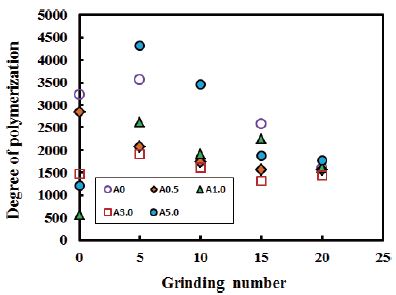
Fig. 8.
Effect of alkali pre-treatment and fibrillation on the degree of polymerization of HwBKP.
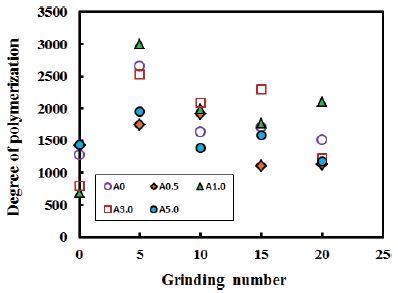
Fig. 9.
Effect of alkali pre-treatment and fibrillation on the degree of polymerization of SwBKP.
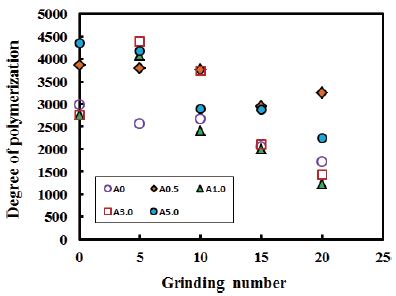
Fig. 10.
Effect of alkali pre-treatment and fibrillation on the degree of polymerization of white ledger.
3.4 평균 섬유장 변화
그라인딩 처리에 따른 피브릴화 특성 조사의 일환으로 평균섬유장 분석을 실시한 결과 Figs. 11-13에서 보는 바와 같이 활엽수 및 침엽수 표백 크라프트 펄프의 경우 그라인딩 회수가 진행됨에 따라 평균섬유장이 감소하는 경향을 나타내었으나 알칼리 전처리 효과는 뚜렷하게 나타나지 않았다. 그러나 white ledger는 알칼리 전처리를 할 경우 초기에는 미처리 시에 비하여 현저하게 평균섬유장이 감소하다가 그라인딩 회수가 20회에 가까워짐에 따라 그 차이가 감소하는 경향을 나타내어 피브릴화 정도의 목표에 따라 알칼리 전처리 효과가 달라짐을 확인할 수 있었다.
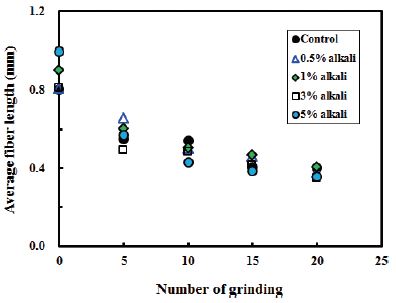
Fig. 11.
Effect of alkali pre-treatment and fibrillation on the average fiber length of HwBKP.
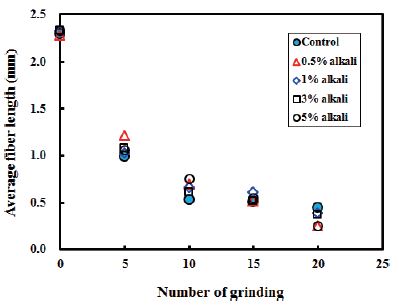
Fig. 12.
Effect of alkali pre-treatment and fibrillation on the average fiber length of SwBKP.
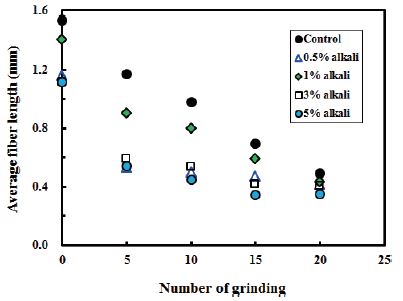
Fig. 13.
Effect of alkali pre-treatment and fibrillation on the average fiber length of white ledger.
3.5 에너지 소비
나노셀룰로오스 제조에 있어서 에너지 소비가 생산원가를 결정하는데 중대한 양향을 미치기 때문에 중요한 검토사항이라 할 수 있다. 본 연구 결과 비슷한 수준으로 피브릴화된 NFC를 제조하는데 소비된 상대적인 비에너지는 HwBKP가 17.8 Wh/g으로 가장 적었고, SwBKP 25.1 Wh/g, white ledger 37.4 Wh/g의 순으로 비에너지 소비(specific energy consumption)가 증가되었다. 알칼리 전처리는 원료의 특성에 따라 다른 효과를 나타내어 활엽수 및 침엽수 표백 크라프트 펄프의 경우 0.5-1%의 저농도 알칼리 처리가 피브릴화 개선에 도움이 되나 그 이상에서는 오히려 악영향을 미친 반면 white ledger의 경우는 3-5%의 알칼리 처리 시 HwBKP와 유사한 수준인 18.1 Wh/g의 비에너지 소비를 나타내어 알칼리 전처리를 통하여 에너지 소비를 크게 감소시킬 수 있었다.
4. 결 론
White ledger를 원료로 사용하여 NFC 제조 가능성을 평가하기 위하여 탈묵 및 회분 제거를 실시한 후 그라인더로 피브릴화를 실시하였다. White ledger의 피브릴화 특성을 비교하기 위하여 활엽수 및 침엽수 표백 크라프트 펄프의 피브릴화를 동일하게 실시하였다. 특히 white ledger의 경우 각질화 현상에 의하여 피브릴화가 어려울 것으로 예상되어 0.5, 1, 3 및 5% 농도의 알칼리 용액으로 전처리를 실시한 후 피브릴화를 실시하였다.
White ledger는 활엽수 및 침엽수 표백 화학펄프보다 피브릴화가 어려운 것이 확인되었으며, 5%까지의 저농도 알칼리 용액으로 전처리할 경우 피브릴화가 현저히 개선되어 white ledger로부터 NFC 제조하는데 큰 어려움이 없음을 확인할 수 있었다. FTIR 분석 결과 피브릴화 및 알칼리 전처리에 의하여 흡수밴드에 변화가 확인되지 않았고, 결정화도 및 수소결합지수에서의 명백한 변화가 관찰되지 않았다. NFCs의 CED 중합도는 피브릴화가 진행됨에 따라 감소되었으나 알칼리 전처리의 영향을 뚜렷하지 않았다. NFC의 평균 섬유장은 피브릴화에 의하여 전반적으로 감소하였으며, white ledger의 경우 알칼리 전처리에 의하여 초기에 현저히 감소되었으나 피브릴이 진행됨에 따라 미처리 경우와의 차이가 감소되었다.
비슷한 수준으로 피브릴화된 NFC를 제조하는데 소비된 상대적인 비에너지는 HwBKP가 17.8 Wh/g으로 가장 적었고, SwBKP 25.1 Wh/g, white ledger 37.4 Wh/g의 순으로 비에너지 소비(specific energy consump-tion)가 증가되었으며, white ledger를 3-5%의 알칼리 전처리 시 비에너지 소비가 18.1 Wh/g으로 감소되었다.
Acknowledgements
본 연구는 2017년 한국연구재단 주관 기본연구지원사업(과제번호: 2016R1D1A1B03932243)의 지원으로 수행되었습니다.
Literature Cited
E. M. Goodger, Hydrocarbon Fuels - Production, Properties and Performance of Liquids and Gases; 270, London. Macmillan. (1975)
Goodger, E. M., Hydrocarbon Fuels - Production, Properties and Performance of Liquids and Gases, London, Macmillan, p. 270 (1975).
J. George, M. S. Sreekala and S. Thomas, Polymer Engineering and Science,
A review on interface modification and characterization of natural fiber reinforced plastic composites,
41(9); 1471-1485 (2001)
George, J., Sreekala, M. S., and Thomas, S., A review on interface modification and characterization of natural fiber reinforced plastic composites, Polymer Engineering and Science 41(9):1471-1485 (2001).
10.1002/pen.10846F. W. Herrick, R. L. Casebier, J. K. Hamilton and K. R. Sandberg, Journal of Applied Polymer Science: Applied Polymer Symposium,
Microfibrillated cellulose: Morphology and accessibility,
37; 797-813 (1983)
Herrick, F. W., Casebier, R. L., Hamilton, J. K., and Sandberg, K. R., Microfibrillated cellulose: Morphology and accessibility, Journal of Applied Polymer Science: Applied Polymer Symposium 37:797-813 (1983).
A. F. Turbak, F. W. Snyder and K. R. Sandberg, Journal of Applied Polymer Science: Applied Polymer Symposium,
Microfibrillated cellulose, a new cellulose product: Properties, uses, and commercial potential,
37; 815-827 (1983)
Turbak, A. F., Snyder, F. W., and Sandberg, K. R., Microfibrillated cellulose, a new cellulose product: Properties, uses, and commercial potential, Journal of Applied Polymer Science: Applied Polymer Symposium 37:815-827 (1983).
P. Qvintus and H. Kangas, Cellulose nanofibrils (CNF) - A big hype or on the edge of a breakthrough, Webinar. (2015)
Qvintus, P. and Kangas, H., Cellulose nanofibrils (CNF) - A big hype or on the edge of a breakthrough, Webinar (2015).
T. Zimmermann, E. Pohler and T. Geiger, Advanced Engineering Materials,
Cellulose fibrils for polymer reinforcement,
6(9); 754-761 (2004)
Zimmermann, T., Pohler, E., and Geiger, T., Cellulose fibrils for polymer reinforcement, Advanced Engineering Materials 6(9):754-761 (2004).
10.1002/adem.200400097M. Pääkkö, M. Ankerfors, H. Kosonen, A. Nykänen, S. Ahola, M. Österberg, J. Ruokolainen, J. Laine, P. Larsson, O. Ikkala and T. Lindström, Biomacromolecules,
Enzymatic hydrolysis combined with mechanical shearing and highpressure homogenization for nanoscale cellulose fibrils and strong gels,
8; 1934-1941 (2007)
Pääkkö, M., Ankerfors, M., Kosonen, H., Nykänen, A., Ahola, S., Österberg, M., Ruokolainen, J., Laine, J., Larsson, P., Ikkala, O., and Lindström, T., Enzymatic hydrolysis combined with mechanical shearing and highpressure homogenization for nanoscale cellulose fibrils and strong gels, Biomacromolecules 8:1934-1941 (2007).
T. Saito, S. Kimura, Y. Nishiyama and A. Isogai, Biomacromolecules,
Cellulose nanofibers prepared by TEMPO-mediated oxidation of native cellulose,
8; 2485-2491 (2007)
Saito, T., Kimura, S., Nishiyama, Y., and Isogai, A., Cellulose nanofibers prepared by TEMPO-mediated oxidation of native cellulose, Biomacromolecules 8:2485-2491 (2007).
10.1021/bm0703970A. Hideno, H. Inoue, K. Tsukahara, S. Fujimoto, T. Minowa, S. Inoue, T. Endo and S. Sawayama, Bioresource Technology,
Wet disk milling without sulfuric acid for enzymatic hydrolysis of rice straw,
100; 2706-2711 (2009)
Hideno, A., Inoue, H., Tsukahara, K., Fujimoto, S., Minowa, T., Inoue, S., Endo, T., and Sawayama, S., Wet disk milling without sulfuric acid for enzymatic hydrolysis of rice straw, Bioresource Technology 100:2706-2711 (2009).
W. Chen, H. Yu, Y. Liu, P. Chen, M. Zhang and Y. Hai, Carbohydrate Polymers,
Individualization of cellulose nanofibers from wood using high-intensity ultrasonication combined with chemical pretreatments,
83(4); 1804-1811 (2011)
Chen, W., Yu, H., Liu, Y., Chen, P., Zhang, M., and Hai, Y., Individualization of cellulose nanofibers from wood using high-intensity ultrasonication combined with chemical pretreatments, Carbohydrate Polymers 83(4): 1804-1811 (2011).
10.1016/j.carbpol.2010.10.040K. Kekäläinen, H. Liimatainen, M. Illikainen, T. C. Maloney and J. Niinimäki, Cellulose,
The role of hornification in the disintegration behaviour of TEMPO-oxidized bleached hardwood fibres in a high-shear homogenizer,
21; 1163-1174 (2014)
Kekäläinen, K., Liimatainen, H., Illikainen, M., Maloney, T. C., and Niinimäki, J., The role of hornification in the disintegration behaviour of TEMPO-oxidized bleached hardwood fibres in a high-shear homogenizer, Cellulose 21:1163-1174 (2014).
C. Tian, J. Yi, Y. Wu, Q. Wu, Y. Qing and L. Wang, Carbohydrate Polymers,
Preparation of highly charged cellulose nanofibrils using high-pressure homogenization coupled with strong acid hydrolysis pretreatments,
136; 485-492 (2016)
Tian, C., Yi, J., Wu, Y., Wu, Q., Qing, Y., and Wang, L., Preparation of highly charged cellulose nanofibrils using high-pressure homogenization coupled with strong acid hydrolysis pretreatments, Carbohydrate Polymers 136:485-492 (2016).
10.1016/j.carbpol.2015.09.055Y. Peng, Y. Han and D. J. Gardner, Wood and Fiber Science,
Spraydrying cellulose nanofibrils: Effect of drying process parameters on particle morphology and size distribution,
44(4); 1-14 (2012)
Peng, Y., Han, Y., and Gardner, D. J., Spraydrying cellulose nanofibrils: Effect of drying process parameters on particle morphology and size distribution, Wood and Fiber Science 44(4):1-14 (2012).
Y. Peng, D. J. Gardner, Y. Han, Z. Cai and M. A. Tshabalala, Journal of Colloid and Interface Science,
Influence of drying method on the surface energy of cellulose nanofibrils determined by inverse gas chromatography,
405; 85-95 (2013)
Peng, Y., Gardner, D. J., Han, Y., Cai, Z., and Tshabalala, M. A., Influence of drying method on the surface energy of cellulose nanofibrils determined by inverse gas chromatography, Journal of Colloid and Interface Science 405: 85-95 (2013).
10.1016/j.jcis.2013.05.033Y. Peng, D. J. Gardner, Y. Han, A. Kiziltas, Z. Cai and M. A. Tshabalala, Cellulose,
Influence of drying method on the material properties of nanocellulose I: Thermostability and crystallinity,
20; 2379-2392 (2013)
Peng, Y., Gardner, D. J., Han, Y., Kiziltas, A., Cai, Z., and Tshabalala, M. A., Influence of drying method on the material properties of nanocellulose I: Thermostability and crystallinity, Cellulose 20:2379-2392 (2013).
10.1007/s10570-013-0019-zE. Abraham, B. Deepa, L. A. Pothan, M. Jacob, S. Thomas, U. Cvelbar and R. Anandjiwala, Carbohydrate Polymers,
Extraction of nanocellulose fibrils from lignocellulosic fibres: A novel approach,
86; 1468-1475 (2011)
Abraham, E., Deepa, B., Pothan, L. A., Jacob., M., Thomas, S., Cvelbar, U., and Anandjiwala, R., Extraction of nanocellulose fibrils from lignocellulosic fibres: A novel approach, Carbohydrate Polymers 86:1468-1475 (2011).
10.1016/j.carbpol.2011.06.034S. H. Osong, S. Norgren and P. Engstrand, Nordic Pulp & Paper Research Journal,
An approach to produce nano-ligno-cellulose from mechanical pulp fine materials,
28(4); 472-279 (2013)
Osong, S. H., Norgren, S., and Engstrand, P., An approach to produce nano-ligno-cellulose from mechanical pulp fine materials, Nordic Pulp & Paper Research Journal 28(4):472-279 (2013).
10.3183/npprj-2013-28-04-p472-479E. Espinosa, J. Domínguez-Robles, R. Sánchez, Q. Tarrés and A. Rodríguez, Cellulose,
The effect of pre-treatment on the production of lignocellulosic nanofibers and their application as a reinforcing agent in paper,
24; 2605-2618 (2017)
Espinosa, E., Domínguez-Robles, J., Sánchez, R., Tarrés, Q., and Rodríguez, A., The effect of pre-treatment on the production of lignocellulosic nanofibers and their application as a reinforcing agent in paper, Cellulose 24:2605-2618 (2017).
10.1007/s10570-017-1281-2C. Ibrahima, K. Diop, M. Tajvidi, M. A. Bilodeau, D. W. Bousfield and J. F. Hunt, Cellulose,
Isolation of lignocellulose nanofibrils (LCNF) and application as adhesive replacement in wood composites: Example of fiberboard,
24; 3037-3050 (2017)
Ibrahima, C., Diop, K., Tajvidi, M., Bilodeau, M. A., Bousfield, D. W., and Hunt, J. F., Isolation of lignocellulose nanofibrils (LCNF) and application as adhesive replacement in wood composites: Example of fiberboard, Cellulose 24:3037-3050 (2017).
C. F. Baker, Advances in different refining methods particularly refining of mixturesThe 6th Pira International Refining Conference (2001)
Baker, C. F., Advances in different refining methods particularly refining of mixtures, The 6th Pira International Refining Conference (2001).
E. H. Immergut and B. L. Browning (ed.), Cellulose, The Chemistry of Wood; 164, Interscience Publishers. (1963)
Immergut, E. H., Cellulose, The Chemistry of Wood, Browning, B. L. (ed.), Interscience Publishers, p. 164 (1963).
B. J. Duchemin, Green Chem,
Mercerization of cellulose in aqueous NaOH at low concentrations,
17; 3941-3947 (2015)
Duchemin, B. J., Mercerization of cellulose in aqueous NaOH at low concentrations, Green Chem. 17:3941-3947 (2015).
10.1039/c5gc00563a