1. 서 론
재생 가능한 자원을 기반으로 한 나노 물질은 기초적 연구와 더불어 새로운 구조 및 기능적 물질 개발의 관점에서 급속도로 관심을 끌고 있다. 이러한 바이오 기반 물질은 환경에 미치는 영향이 적은 다양한 고부가가치 제품을 생산할 잠재력이 크기 때문에 최근 몇 년간 많은 연구결과가 보고되어 왔다.1-3)
제지 분야에서는 친환경 및 고부가가치 소재로서 나노 셀룰로오스가 주목받고 있다.4-6) 나노셀룰로오스는 천연에 존재하는 가장 풍부한 천연 유기고분자인 셀룰로오스를 기계적, 화학적, 생물학적 처리를 통해 그 크기를 나노사이즈로 만든 소재를 말한다. 화학적 처리를 통해 제조된 나노셀룰로오스(CNC)는 기계적 처리를 통해 제조된 나노셀룰로오스(CNF)에 비해 더 작고 균일한 입자분 포를 가지며 침상형 구조로서 배향성을 가지는 등의 특징이 있다.
CNC는 독성이 없으며 생분해성, 재생가능성, 풍부한 자원 측면에서 지속가능성을 가지고 있다. 그리고 CNC는 높은 탄성 계수(150±50 GPa)와 높은 인장강도(7.5 GPa)를 가져 우수한 기계적 성질을 나타내고 치수안정성이 우수한 특징이 있다. 또한, CNC는 직경이 5 nm에서 수십 nm이고 길이가 100 nm 정도로 높은 종횡비를 가지고 있다.7) 필름 형성 능력도 우수하고 필름 형성 후 투명성을 가지기 때문에 복합체로서 기계적 물성을 보강하기 위해 고분자 매트릭스에 적용하기 위한 연구가 진행되기도 하였다.8-10)
또한 나노셀룰로오스를 최근 도공액의 증점제로 사용하기 위한 연구가 보고되었다. 그 이유는 앞서서 설명한 것처럼 나노사이즈로 넓은 비표면적을 가지고 있고, 하이드록실기가 많아 현탁액에서 겔(gel)형 구조를 형성하고 전단속도 유동화 유동(shear thinning behavior) 거동을 나타내기 때문이다. 이러한 나노셀룰로오스는 도공액에서 코팅 주성분의 응집을 발생시키지 않고 보수도와 레올로지에 영향을 미칠 수 있다. 이러한 특성은 본래 사용하던 증점제인 CMC를 첨가한 도공액보다 높은 흐름 특성을 가지고 그에 따라 우수한 레벨링 특성을 나타낸 다고 보고되었다.11-16) 따라서 본 연구에서는 CNC를 도공액에 첨가하여 도공액의 물성을 측정하고 원지에 도포하여 도공지의 물성과 인쇄적성을 평가하고 적용 가능성을 알아보고자 한다.
2. 재료 및 방법
2.1 공시재료
2.1.1 원지
본 연구에 사용된 원지는 평량 80 g/m2, 두께 110 μm의 원지를 사용하였으며 그 물성은 Table 1에 나타내었다.
Table 1.
Properties of base paper
| Basis weight (g/m2) | 80 |
|---|
| Thickness (μm) | 110 |
|---|
| Opacity (%) | 99 |
|---|
| Brightness (%) | 89 |
|---|
| Air permeability (s.) | 16 |
|---|
2.1.2 Cellulose nanocrystal(CNC), Carboxyl methylcellulose(CMC)
본 연구에서는 화학적 가수분해를 통해 제조된 CNC를 Canada의 CelluForce 社에서 NanoCrystalline Cellulose(NCCTM) 제품을 분말 형태로 분양받아 사용하였으며, 물성은 Table 2에 나타내었다. CMC는 중합도 600, 치환도 0.85-0.95, 분자량 12×104-135×104를 사용하였다.
Table 2.
Properties of cellulose nanocrystal
| Parameter | Specification |
|---|
| Form | Spray dried powder |
| Color | White |
| Bulk density | 0.7 g/cm3 |
| Molecular formula | [(C6O5H10)22-28 SO3 Na]4-6 |
| Particle diameter (crystallite) | 2.3-4.5 nm (by AFM) |
| Particle length (crystallite) | 44-108 nm (by AFM) |
| Zeta potential | -37 mV |
2.1.3 안료
본 연구에 사용된 도공용 안료는 중질 탄산칼슘(GCC)을 사용하였다. 기본 물성은 Table 3에 나타내었다.
Table 3.
Mean particle diameter of pigments
(unit: μm)
| %. <d10 | %. <d25 | %. <d50 | %. <d75 | %. <d90 |
|---|
| GCC95※1) | 0.203 | 0.298 | 0.722 | 1.147 | 1.526 |
2.1.4 바인더
본 연구에 사용된 도공용 바인더로서 Korea, K 社의 SB-Latex를 사용하였고 그 물성은 Table 4에 나타냈다.
Table 4.
Properties of the binder
| Particle size (nm) | Viscosity (cPs)※1) | Tg (℃) | pH |
|---|
| SB latex | 170 | <200 | +11 | 8.0 |
2.1.5 기타 첨가제
기타 첨가제로는 안료 분산제와 pH를 조절하기 위하여 NaOH를 사용하였고 도공액의 pH는 10으로 조절하였다.
2.2 실험방법
2.2.1 도공액 제조
도공액 고형분 농도는 65%로 조절하였고, 안료와 바인더의 비율은 일정하게 고정하고 CMC와 CNC의 배합비를 달리하여 제조하였다. 이때, 도공액의 배합비는 Table 5에 나타내었다.
Table 5.
Formulations of the coating colors
(unit: pph)
| | #1 | #2 | #3 | #4 | #5 | #6 |
|---|
| GCC | 100 |
| Binder | SB latex | 12 |
| Dispersant | 0.2 |
| NaOH | 0.12 |
| CMC (carboxyl methylcellulose) | 0.5 | 0 | 0.2 |
| CNC (cellulose nanocrystal) | 0 | 0.5 | 0 | 0.1 | 0.2 | 0.3 |
| Total solid content (%) | 65 |
2.2.2 도공액 물성측정
저전단 점도는 DV-II viscometer(Brookfield, USA)를 이용하여 60 rpm 조건으로 측정하였다. 보수성은 보수성 측정기(AÅ-GWR, Kaltex Scientific Inc., USA)를 사용하여 도공액 10 mL, 압력 2 bar, 시간 30초의 조건으로 측정하였다.
2.2.3 도공지 제조
도공지는 실험실용 반자동 코터(K-control, RK Print Coat Instrument Co. Ltd., UK)를 사용하여 제조하였다. 코팅층의 도공량은 편면 20±1 g/m2로 조절하였다. 도공액을 도포한 원지는 열풍건조기(YJ-8600D, Yujin Electronics, S. Korea)에서 105℃, 25초의 조건으로 건조하였다. 그 후 슈퍼캘린더(Supercalender, Beloit Coporation, USA)를 사용하여 도공면이 steel roll을 향하게 하여 온도 70℃, 선압 300 psi의 조건으로 2 nip 처리하였다.
2.2.4 도공지 물성측정
도공지의 거칠음도는 Parker Print Surf(L&W Co. Ltd., Sweden), 광택도는 Gloss meter(model T480A, Technidyne Corporation, USA), 백색도와 백감도, 불투명도는 Elrepho 3300(Datacolor International, USA)을 이용하여 측정하였다.
2.2.5 도공지 인쇄적성 평가
RI 인쇄 시험기(RI-II, KRK, Japan)를 이용하여 잉크 전이량 1 cc 조건으로 dry pick, wet pick, print gloss를 측정하고 측정된 샘플은 화상분석프로그램(Image-J)을 통해 화상을 분석하여 5점법으로 나타내었다.
3. 결과 및 고찰
3.1 도공액 물성 평가
Fig. 1은 CMC와 CNC를 첨가한 도공액의 저전단 점도를 나타낸다. 점도는 CMC 0.5파트를 첨가하였을 때 가장 높은 점도값을 나타내었고 CNC 0.5파트를 첨가하였을 때 가장 낮은 점도를 나타내었다. 이는 CMC 첨가가 depletion force를 통해 주성분의 응집을 발생하여 점도가 가장 높게 나온 것으로 사료된다.17) CNC도 마찬가지로 첨가량이 증가할수록 점도가 상승하였는데 이는 비표면적이 넓고 다량의 -OH기로 인해 그 자체로 점도가 높은 물질이기 때문이지만, 안료 응집을 일으키지 않기 때문에 그 수준이 CMC보다 낮았다.
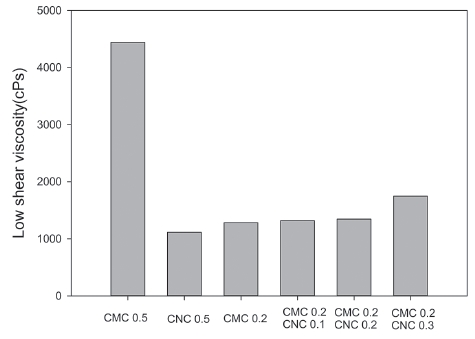
Fig. 1.
Low shear viscosity of coated paper according to ratio of CMC and CNC.
Fig. 2는 CMC와 CNC를 첨가한 도공액의 보수성(water retention)을 나타낸다. 보수성은 일반적으로 도공액의 점도에 많은 영향을 받는 것으로 알려져 있다. 본 실험결과에서도 마찬가지로 점도가 높을수록 탈수량이 감소하는 결과를 나타냈다. 그러나 CNC 0.5 첨가된 경우에 특히 탈수량이 많은 경향을 보였는데 이는 앞선 설명처럼 CMC와 달리 CNC는 안료와 바인더와의 응집을 일으키지 않고 그 크기가 나노사이즈로 매우 작아 탈수량이 더 많은 것으로 사료된다.
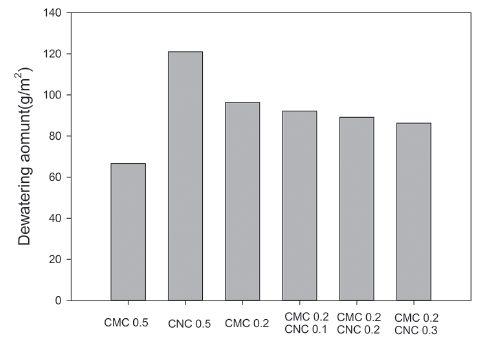
Fig. 2.
Dewatering amount of coated paper according to ratio of CMC and CNC.
3.2 도공지 물성 평가
3.2.1 두께
Fig. 3은 CMC와 CNC를 첨가한 도공액을 도포한 도공지의 두께를 나타낸다. 두께는 점도가 높을수록 도공층의 두께가 두꺼워지는 경향을 나타내었다. 그러나 CMC 0.5와 CMC 0.2를 비교하였을 때 CMC 0.5 도공지의 두께가 다소 얇은 결과를 나타내었다. 이는 과량의 CMC의 첨가는 위의 도공액의 결과처럼 depletion flocculation을 유발하고 보수성이 높기 때문에 건조 과정에 있어 도공액이 원지로의 침투가 많아 두께가 감소한 것으로 사료된다.
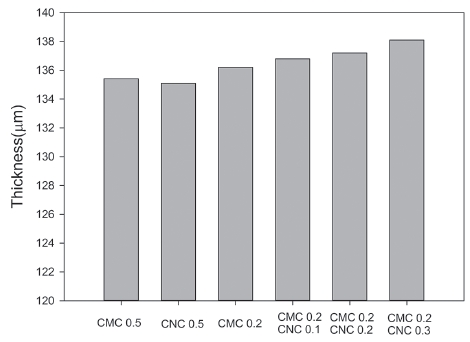
Fig. 3.
Thickness of coated paper according to ratio of CMC and CNC.
CMC와 CNC가 혼합된 도공지에서는 CNC 첨가량이 증가할수록 두께가 상승하는 경향을 보였다. 이는 CNC가 혼합된 도공액의 점도가 첨가량이 증가함에 따라 증가하였고 CNC가 CMC의 응집효과를 일정 부분 상쇄하였기 때문이라고 사료된다.
3.2.2 인쇄광택
Fig. 4는 CMC와 CNC를 첨가한 도공액을 도포한 도공지의 백지광택을 나타낸다. CMC 0.5에 비해 CNC 0.5의 광택이 크게 떨어지는 결과를 나타내었다. 이러한 특성은 CNC 자체 보수성이 높기 때문에 건조 시 불균일한 수축을 야기하고 이러한 원인은 표면 거칠음이 증가시키고 광택측정에 있어 난반사율을 높이기 때문에 다음과 같은 결과가 나타났다고 사료된다. CMC에 CNC를 첨가하였을 때도 CNC 첨가량이 증가할수록 같은 이유로 광택이 감소하는 것으로 사료된다. CMC 0.5에 비해 CMC 0.2가 광택이 감소하는 경향을 보였는데 이는 건조 과정중 건조임계농도가 다르기 때문이라고 보고된 바 있다.18-19)
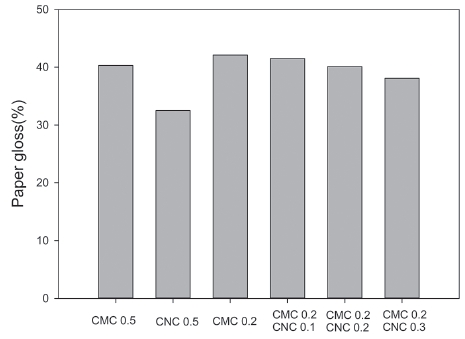
Fig. 4.
Paper gloss of coated paper according to ratio of CMC and CNC.
3.3 도공지의 인쇄 적성 평가
3.3.1 Dry-pick
Fig. 5는 CMC와 CNC를 첨가한 도공액을 도포한 도공지의 dry-pick을 나타낸다. Dry-pick은 CMC 첨가량이 많을수록 향상되었는데, 이는 CMC가 안료와 바인더와의 응집을 유발하여 나타낸 결과라고 사료된다. 하지만 CMC 0.2파트 첨가한 도공지에 비해 CNC를 추가로 첨가한 도공지의 dry-pick이 감소하는 경향을 보였다. 이는 높은 분자량의 CMC가 CNC에 비해 더 많은 결합이 형성되었기 때문으로 사료된다. 하지만 CNC 첨가량이 증가할수록 강도가 높아졌는데, 이러한 결과는 건조됨에 따른 CNC의 자체강도와 더불어 다량의 -OH기로 인한 원지와의 결합력을 증가시킨 것으로 사료된다.
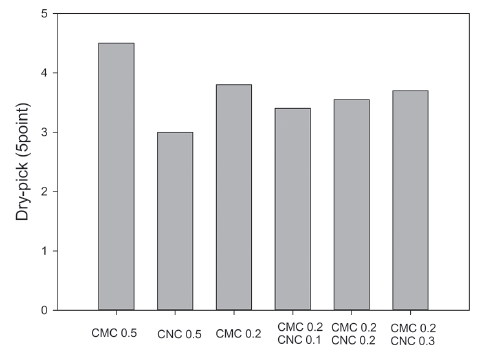
Fig. 5.
Dry pick by 5point evaluation method according to the ratio of CMC and CNC.
3.3.2 Wet-pick
Fig. 6은 CMC와 CNC를 첨가한 도공액을 도포한 도공지의 wet-pick을 나타낸다. wet pick은 수산기가 많은 CNC가 첨가되었을 때 다소 떨어질 것으로 예상되었지만 결과는 샘플 간 큰 차이가 없었다. 이는 CNC 첨가량이 매우 적어 도공지 내수성의 저하를 가져오지 않은 것으로 사료된다.
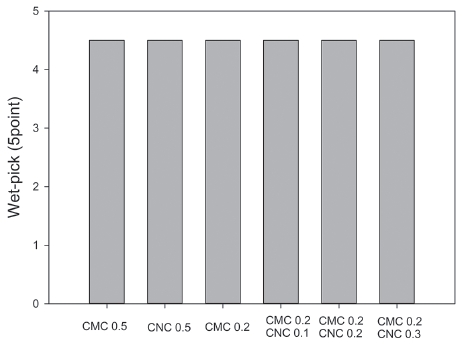
Fig. 6.
Wet pick by 5point evaluation method according to the ratio of CMC and CNC.
3.3.3 인쇄광택
Fig. 7은 CMC와 CNC를 첨가한 도공액을 도포한 도공지의 인쇄광택 결과를 나타낸다. CNC 첨가량이 증가함에 따라 인쇄광택은 향상되었다. 이는 나노사이즈의 CNC를 첨가함으로 CNC가 도공층의 공극구조의 변화를 나타내 잉크의 흡수거동을 방해하는 것으로 사료된다. Hamada 등은 NFC를 코팅하였을 때 낮은 투과성을 가지며 잉크 입자가 NFC 층에 흡착될 수 있으며, 침투에 대한 내성을 증가시킨다고 보고하였다.20) 하지만 CNC를 단독으로 첨가한 경우는 인쇄광택이 낮은 결과를 나타내었다. 이는 앞선 Fig. 2의 보수성 결과와 Fig. 4의 백지광택의 결과에서 나타내듯이 실험실적 한계로 느린 건조속도로 인해 나노사이즈의 CNC의 원지로의 침투 및 건조 시 불균일한 수축으로 나타낸 결과로 사료된다.
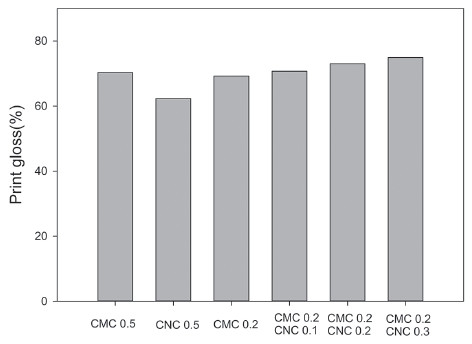
Fig. 7.
Print gloss of coated paper according to ratio of CMC and CNC.
4. 결 론
본 연구에서는 CMC와 비교하여 CNC를 도공액에 첨가하여 도공액의 물성을 측정하고 원지에 도포하여 도공지의 물성과 인쇄적성을 평가하고 적용 가능성을 평가하였다.
본 실험결과를 통해 CMC와 CNC는 도공액 및 도공지 물성에 있어 다른 경향을 나타내는 것을 알 수 있었다. 도공액의 점도와 보수도를 보았을 때 CMC 첨가한 도공액에 비해 CNC만 첨가한 도공액의 점도가 더 낮았지만 탈수량이 많은 결과를 나타내었다. 따라서 도공액 보수제로 CNC를 단독으로 사용하기에는 무리가 있는 것으로 사료된다. CMC를 첨가한 도공액에 CNC 첨가량이 증가할수록 보수성이 향상되었고 도공지의 두께는 향상되는 긍정적인 결과를 나타내었지만 백지광택이 떨어지는 경향을 보였다. 이는 보수성이 높음에 따라 건조 시 불균일한 수축에 의해 발생한 것으로 사료된다. 또한 CNC 첨가량 증가에 따른 표면 픽 강도가 향상되며, 인쇄광택이 향상되는 긍정적인 결과가 있었지만, CMC 단독으로 사용한 것보다는 픽 강도가 감소하는 결과를 나타내었다.
결과적으로 CMC와 CNC는 도공에 있어 다른 거동을 나타내는 것으로 보였다. 어떤 것이 더 우수한 것으로 평가할 수 없지만 각기 다른 특성을 지니고 있기 때문에 원하는 도공지의 성질에 따라 선택 적용이 가능할 것으로 판단되어진다. 하지만 아직까지 나노셀룰로오스에 대한 제조 원가가 높고 대량생산을 위한 산업적 투자가 늘어 나고 있지만 아직까지 한계가 있다. 따라서 현재 산업에 대한 적용가능성은 적다고 생각되지만 추후 사용이 범용화 된다면 친환경 소재로서 사용가치가 있다고 판단된다.
Acknowledgements
본 연구는 2017년도 정부(교육부)의 재원으로 한국연구재단의 지원을 받아 수행된 기초연구사업임(No. NRF-2017R1D1A3B03034031).
Literature Cited
P. Fratzl, Journal of the Royal Society Interface,
Biomimetic materials research: What can we really learn from nature’s structural materials,
4(15); 637-642 (2007)
Fratzl, P., Biomimetic materials research: What can we really learn from nature’s structural materials, Journal of the Royal Society Interface 4(15):637-642 (2007).
10.1098/rsif.2007.0218B. Wicklein and G. Salazar-Alvarez, Journal of Materials Chemistry A,
Functional hybrids based on biogenic nanofibrils and inorganic nanomaterials,
1(18); 5469-5478 (2013)
Wicklein, B. and Salazar-Alvarez, G., Functional hybrids based on biogenic nanofibrils and inorganic nanomaterials, Journal of Materials Chemistry A 1(18):5469-5478 (2013).
10.1039/c3ta01690kX. Xu, F. Liu, L. Jiang, J. Y. Zhu, D. Haagenson and D. P. Wiesenborn, ACS Applied Materials & Interfaces,
Cellulose nanocrystals vs. cellulose nanofibrils: A comparative study on their microstructures and effects as polymer reinforcing agents,
5(8); 2999-3009 (2013)
Xu, X., Liu, F., Jiang, L., Zhu, J. Y., Haagenson, D., and Wiesenborn, D. P., Cellulose nanocrystals vs. cellulose nanofibrils: A comparative study on their microstructures and effects as polymer reinforcing agents, ACS Applied Materials & Interfaces 5(8):2999-3009 (2013).
10.1021/am302624tK. Sim, H. J. Youn and Y. Jo, Journal of Korea TAPPI,
Surface Modification of Cellulose Nanofibrils by Carboxymethylation and TEMPO-Mediated Oxidation,
47(2); 42-52 (2015)
Sim, K., Youn, H. J., and Jo, Y., Surface Modification of Cellulose Nanofibrils by Carboxymethylation and TEMPO-Mediated Oxidation, Journal of Korea TAPPI 47(2):42-52 (2015).
10.7584/ktappi.2015.47.2.042H. A. Kwon, S. J. Shin and O. Kwon, Journal of Korea TAPPI,
Optimal conditions of TEM grid for quantitative morphological investigation of nanocelluloses by transmission electron microscopy,
49(1); 25-31 (2017)
Kwon, H. A., Shin, S. J., and Kwon, O., Optimal conditions of TEM grid for quantitative morphological investigation of nanocelluloses by transmission electron microscopy, Journal of Korea TAPPI 49(1):25-31 (2017).
10.7584/JKTAPPI.2017.02.49.1.25H. Park, J. Lee, H. Park, S. Lee and H. J. Youn, Journal of Korea TAPPI,
Preliminary study on effect of addition of cellulose nanofibrils on impregnation of polyvinyl alcohol into paper,
49(4); 97-103 (2017)
Park, H., Lee, J., Park, H., Lee, S., and Youn, H. J., Preliminary study on effect of addition of cellulose nanofibrils on impregnation of polyvinyl alcohol into paper, Journal of Korea TAPPI 49(4):97-103 (2017).
10.7584/jktappi.2017.08.49.4.97Y. Habibi, L. A. Lucia and O. J. Rojas, Chemical Reviews,
Cellulose nanocrystals: Chemistry, self-assembly, and applications,
110(6); 3479-3500 (2010)
Habibi, Y., Lucia, L. A., and Rojas, O. J., Cellulose nanocrystals: Chemistry, self-assembly, and applications, Chemical Reviews 110(6):3479-3500 (2010).
10.1021/cr900339wM. A. Herrera, A. P. Matthew and K. Oksman, Carbohydrate Polymers,
Gas permeability and selectivity of cellulose nanocrystals films (layers) deposited by spin coating,
112; 494-501 (2014)
Herrera, M. A., Matthew, A. P., and Oksman, K., Gas permeability and selectivity of cellulose nanocrystals films (layers) deposited by spin coating, Carbohydrate Polymers 112:494-501 (2014).
10.1016/j.carbpol.2014.06.036K. Y. Lee, Y. Aitomäki, L. A. Berglund, K. Oksman and A. Bismarck, Composites Science and Technology,
On the use of nanocellulose as reinforcement in polymer matrix composites,
105; 15-27 (2014)
Lee, K. Y., Aitomäki, Y., Berglund, L. A., Oksman, K., and Bismarck, A., On the use of nanocellulose as reinforcement in polymer matrix composites, Composites Science and Technology 105:15-27 (2014).
10.1016/j.compscitech.2014.08.032M. Mariano, N. El Kissi and A. Dufresne, Journal of Polymer Science Part B: Polymer Physics,
Cellulose nanocrystals and related nanocomposites: Review of some properties and challenges,
52(12); 791-806 (2014)
Mariano, M., El Kissi, N., and Dufresne, A., Cellulose nanocrystals and related nanocomposites: Review of some properties and challenges, Journal of Polymer Science Part B: Polymer Physics 52(12):791-806 (2014).
10.1002/polb.23490T. Salo, K. Dimic-Misic, P. Gane and J. Paltakari, Nordic Pulp and Paper Research Journal,
Application of pigmented coating colours containing MFC/NFC: Coating properties and link to rheology,
30(1); 165-178 (2015)
Salo, T., Dimic-Misic, K., Gane, P., and Paltakari, J., Application of pigmented coating colours containing MFC/NFC: Coating properties and link to rheology, Nordic Pulp and Paper Research Journal 30(1):165-178 (2015).
10.3183/npprj-2015-30-01-p165-178K. Dimic-Misic, P. A. C. Gane and J. Paltakari, Industrial & Engineering Chemistry Research,
Micro and nanofibrillated cellulose as a rheology modifier additive in CMC-containing pigment-coating formulations,
52(45); 16066-16083 (2013)
Dimic-Misic, K., Gane, P. A. C., and Paltakari, J., Micro and nanofibrillated cellulose as a rheology modifier additive in CMC-containing pigment-coating formulations, Industrial & Engineering Chemistry Research 52(45):16066-16083 (2013).
10.1021/ie4028878B. Nazari and D. W. Bousfield, Nordic Pulp and Paper Research Journal,
Cellulose nanofibers influence on properties and processing of paperboard coatings,
31(3); 511-520 (2016)
Nazari, B. and Bousfield, D. W., Cellulose nanofibers influence on properties and processing of paperboard coatings, Nordic Pulp and Paper Research Journal 31(3):511-520 (2016).
10.3183/npprj-2016-31-03-p511-520K. Oh, J. H. Lee, W. Im, A. R. Abhari and H. L. Lee, Industrial & Engineering Chemistry Research,
Role of cellulose nanofibrils in structure formation of pigment coating layers,
56(34); 9569-5577 (2017)
Oh, K., Lee, J. H., Im, W., Abhari, A. R., and Lee, H. L., Role of cellulose nanofibrils in structure formation of pigment coating layers, Industrial & Engineering Chemistry Research 56(34):9569-5577 (2017).
10.1021/acs.iecr.7b02750M. R. Kamal and V. Khoshkava, Carbohydrate Polymers,
Effect of cellulose nanocrystals (CNC) on rheological and mechanical properties and crystallization behavior of PLA/CNC nanocomposites,
123; 105-114 (2015)
Kamal, M. R. and Khoshkava, V., Effect of cellulose nanocrystals (CNC) on rheological and mechanical properties and crystallization behavior of PLA/CNC nanocomposites, Carbohydrate Polymers 123:105-114 (2015).
10.1016/j.carbpol.2015.01.012H. Oguzlu, C. Danumah and Y. Boluk, The Canadian Journal of Chemical Engineering,
The role of dilute and semi-dilute cellulose nanocrystal (CNC) suspensions on the rheology of carboxymethyl cellulose (CMC) solutions,
94(10); 1841-1847 (2016)
Oguzlu, H., Danumah, C., and Boluk, Y., The role of dilute and semi-dilute cellulose nanocrystal (CNC) suspensions on the rheology of carboxymethyl cellulose (CMC) solutions, The Canadian Journal of Chemical Engineering 94(10):1841-1847 (2016).
10.1002/cjce.22597E. H. Choi, C. H. Kim, H. J. Youn and H. L. Lee, BioResources,
Influence of PVA and CMC on the properties of pigment coating colors and their effects on curtain stability,
10(4); 7188-7202 (2015)
Choi, E. H., Kim, C. H., Youn, H. J., and Lee, H. L., Influence of PVA and CMC on the properties of pigment coating colors and their effects on curtain stability, BioResources 10(4):7188-7202 (2015).
10.15376/biores.10.4.7188-7202J. Watanabe and P. Lepoutre, Journal of Applied Polymer Science,
A mechanism for the consolidation of the structure of clay-latex coatings,
27(11); 4207-4219 (1982)
Watanabe, J. and Lepoutre, P., A mechanism for the consolidation of the structure of clay-latex coatings, Journal of Applied Polymer Science 27(11):4207-4219 (1982).
10.1002/app.1982.070271112K. Oh,
The role of cellulose nanofibrils in structure formation and drying stress development of pigment coating layer, Seoul National University. (2017)
Oh, K., The role of cellulose nanofibrils in structure formation and drying stress development of pigment coating layer, Ph. D. Dissertation, Seoul National University (2017).
H. Hamada and D. W. Bousifled, TAPPI Journal,
Nanofibrillated cellulose as a coating agent to improve print quality of synthetic fiber sheets,
9(11); 25-29 (2010)
Hamada, H. and Bousifled D. W., Nanofibrillated cellulose as a coating agent to improve print quality of synthetic fiber sheets, TAPPI Journal 9(11):25-29 (2010).