


1. Introduction
Cellulose is an interesting material that has been used in a wide range of applications in biomedicals, pharmaceuticals, composites, cosmetics, etc.1-7) It is the main constituent of wood, consisting of glucose units connected by β-1,4-glycosidic bond.8) Generally, cellulose polymer hydrolyzed into monosaccharides (simple sugars) or oligosaccharides using chemicals or cellulases.9) Cellulases are enzymes produced by bacteria, fungi, protozoans, and animals that help to decompose cellulose and other related polysaccharides.10) Several microorganisms such as Bacillus, Staphylococcus, Candida, and Aspergillus species are used to produce cellulases that are able to degrade cellulose.11-15) Furthermore, these microorganisms are also frequently found in contaminated cosmetic products.16-18)
Cellulose nanofibril (CNF) is material composed of nanometer-sized particles of cellulose with a high aspect ratio.19-21) CNF is derived from cellulose containing wood pulp obtained through grinding, high-pressure homogenization, or microfluidization.22-24) To reduce the energy usage and ease the fibrillation process, enzymatic or chemical pretreatments such as enzymatic hydrolysis, carboxymethylation, TEMPO-mediated oxidation, and oxidative sulfonation is necessary.25-28) CNF has been applied in cosmetic products because of high water absorption capacity, non-toxic, eco-friendly, viscoelasticity, and thickening effect. However, CNF suspensions used are generally dispersed in water and presented moisture-rich. These conditions are suitable for microorganisms to grow easily; thus, contamination can occur rapidly. In particular, microorganisms such as Bacillus and Aspergillus that decompose cellulose use the suspension as a nutrient source. Therefore, even though the suspension is prepared as sterile, it can be contaminated by brief exposure to air during preparation.
Cellulose nanofibril can be used in cosmetics as a skin hydrating, thickening, stabilizing, anti-wrinkle agent and applied in skin treatment as facial masks, skin healing, skin cleansing, etc.29-32) However, it can be easily contaminated by microorganisms. 33) Microbial contamination in cosmetics has been attracting attention because of its potential risk in product quality and human life by the presence of endotoxins and harmful substances released from microbial metabolism.32,34-35) Cosmetic ingredients provide nutrients that can be facilitated microorganisms’ growth such as proteins, water, polysaccharides, vitamins, lipids, amino acids, and so on.36) The growth of microorganisms is also affected by conditions such as appropriate temperature, pH, and moisture. Hence, cosmetic industries are responsible for making sure the products are safe and not contaminated with harmful microorganisms. Several incidents related to microbial contamination in cosmetic products are reported. For example, contamination of Enterobacter spp.and aerobic mesophilic flora in eye cosmetics, Pseudomonas spp., and Staphylococcus spp., in hair and skincare cosmetics, Klebsiella spp., and Bacillus spp. in hand and body cream.37-39)
Cosmetics are easily contaminated by microorganisms during long-term storage and use because they are rich in nutrients for microbial growth. Therefore adding preservatives is very important to avoid contamination. The use of preservatives in the production of cosmetics has such advantages for preventing microbial contamination and increasing customers’ trust in the product, which has a good impact on the marketing image. The types of preservatives used in cosmetics are diverse. In general, parabens are the most chemical preservative used in cosmetics to prevent harmful microorganisms growth during a period of usage to protect both products and consumers.34) However, parabens are unsafe because they risk to human health by causing skin allergies such as dermatitis, irritations.40-42) Alternative preservatives such as 1,2-alkanediols are suggested to use in cosmetic ingredients because of its ability to prevent human skin microbiome contamination and allowed the reduction in the use of parabens.43-44) These chemicals are known to have no significant skin irritation even at high concentrations.45) However, there is limited information related to preservatives’ effect on cosmetic microbial contamination.
In this study, we investigated the effect of preservatives added in CNF suspension against four cellulase-producing microbes commonly also found in cosmetic contaminants such as B. subtilis, S. xylosus, C. albicans, and A. niger. The viscosity drop of the suspensions after contamination and the effect of adding preservatives are also examined. In cosmetics, preservatives must be used at the lowest concentration that ensures their efficacy. The mixture combination of alkane diol compounds such as 1,2-hexanediol, 1,2-octanediol, and 4-hydroxy acetophenone is used to reduce the amounts of preservatives. We expected that by using a mixture combination, lower concentrations of preservatives could be reached.
2. Materials and Methods
2.1 Materials
Materials used in this study were bleached kraft pulp manufactured by M company. Chemicals used for TEMPO-oxidation pre-treatment are 2,2,6,6-Tetramethylpiperidine-1-oxyl (TEMPO), sodium bromide (NaBr), sodium hypochlorite (NaClO), and potassium hydroxide (KOH). BactoTM tryptic soy broth (TSB), Bacto® tryptone, BactoTM yeast extract, and BactoTM agar obtained from Becton, Dickinson (BD) Company, and sodium chloride (NaCl) from Junsei Chemical Co., Ltd. were used for microbial growth media. Microorganisms used such as B. subtilis (Bacillus subtilis, KCCM 11316), S. xylosus (Staphylococcus xylosus, KCCM 40887), C. albicans (Candida albicans, KCCM 11282), and A. niger (Aspergillus niger, KCCM 11239) were obtained from the Korea Microbial Conservation Center. 4-Hydroxyacetophenone (A) from Chemsol Korea Co., Ltd., 1,2-hexanediol (H) and 1,2-octanediol (O) from COEM Co., Ltd. were used as preservatives to prevent microbial contamination.
2.2 Preparation of cellulose nanofibrils
TEMPO oxidation pre-treatment was used to easy the cellulose nanofibril production. The reaction was started by adding 1.5 g TEMPO and 2.5 g NaBr to pulp suspension (100 g pulp in 2.5 L distilled water) and mixed using a stirrer for 10 min. The oxidation process was initiated by adding 5.4% NaClO solution into the suspension. Then, 1 M of KOH solution was added to keep the pH at 10 until the pH was constant. After completed the reaction, the fiber suspension was neutralized by washing through distilled water. Nanofibrillation process was carried out by passing a 2% fiber suspension through a supermasscolloider (MKZA10-15IV; Masuko Sangyo, Japan) 2 times, followed by homogenization twice using a high-pressure homogenizer processor (Panda Plus, GEA, Italy). The pressure was maintained at 600–800 bar.
2.3 Transmission electron microscopy (TEM) analysis
TEM analysis was performed using TEM (Libra120, Carl Zeiss, Germany) to determine the size of CNF under the condition of an acceleration voltage of 120kV and magnification of 200,000. The sample was prepared by diluting CNF to 0.001% and dyeing with 1% uranyl acetate. Then, the sample was placed on a grid (Silicon monoxide Type-A, 300 mesh, Cu) that was treated with glow discharge at 15 mA for 4 min before.
2.4 Preparation of cellulose nanofibrils with preservatives
Samples were prepared by using various concentrations of preservatives to prevent microbial contamination. Briefly, 2% CNFs were diluted to 1% (w/w) by adding preservatives solution of 1,2-hexanediol, 1,2-octanediol, 4-hydroxyacetophenone, combination among them (1:1). The combinations were 1,2-hexanediol:1,2-octanediol (H+O), 1,2-hexanediol:4-hydroxyacetophenone (H+A), and 1,2-octanediol:4-hydroxyacetophenone (O+A). The final concentrations for each preservative were 0.25, 0.5, 1, 1.5, and 2%.
2.5 Antimicrobial properties of CNF contained preservatives
2.5.1 Preparation of microbial culture solution
Tryptic soy broth (30 g/L) was suspended with distilled water and autoclaved at 121°C for 15 min, then used as microbial growth media. One microbial colony was cultured in 50 mL TSB media and placed in a shaking incubator at 30°C for 24 h. After incubation, 0.5 mL of microbial solution was dispensed into 50 mL of TSB media and incubated at 30°C for one day.
2.5.2 Antimicrobial assay
CNF suspension was prepared by sterilizing 20 g of CNF contained preservatives in an autoclave at 121 °C for 15 min. Contaminated CNF was prepared by adding1 mL microbial solution to sterilized CNF and put in a shaking incubator at 30 °C for three days. Afterward, contaminated CNF was spread over the surface of nutrient agar media (yeast extract 5 g/L, tryptone 10 g/L, NaCl 10 g/L, agar 15 g/L) and incubated for 24 h at 30 °C. Antimicrobial activity of CNF was evaluated by a colony count method for B. subtilis, S. aureus, and C. albicans. A. niger was analyzed based on the percentage of the contaminated area after 24 h incubation.
2.6 Viscosity measurement of contaminated CNF
The viscosity of contaminated CNF was performed using a Rheometer (MCR 102, Anton Paar, Austria). The measurement was conducted at 25 °C at the shear rate of 1 s-1 to 100 s-1. Viscosity drop was calculated to determine cellulose degradation before and after 3 days incubation using the following formula 1:
3. Result and Discussion
3.1 Antimicrobial evaluation of CNF treated by various concentrations of preservatives
TEM analysis was used to measure the size (width and length) of CNF. Fig. 1 shows the transmission electron microscopy of CNF treated by TEMPO-mediated oxidation. As can be seen, CNF had a width of 8.2–17.2 nm (average: 12.2 nm) and a length of 80.4–238.6 nm (average: 168.2 nm).
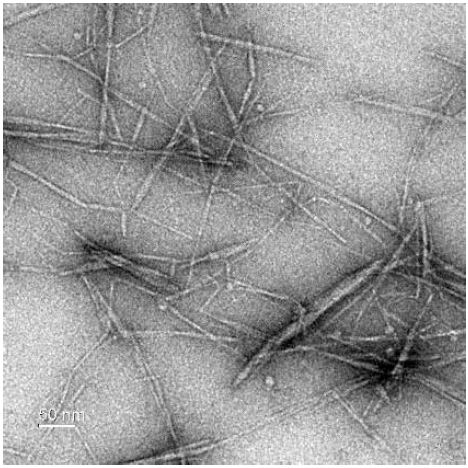
Fig. 1.
Transmission electron microscopy image of cellulose nanofibril from TEMPO-mediated oxidation (scale bar: 50 nm).
Antimicrobial properties of CNF containing various concentrations of preservatives (1,2-hexanediol, 1,2-octanediol, 4-hydroxy acetophenone, H+O, O+A, and H+A) against cosmetic microorganisms were evaluated by colony count method for S. xylosus, B. subtilis, C. albicans and percentage of contaminated area for A. niger according to Song et al.33,46)
Results showed that with increasing the concentration of the preservatives, the effectiveness of CNF in preventing microbial growth increased. Table 1 shows the antimicrobial activity of CNF containing various concentrations of preservatives against B. subtilis. As can be seen, 1,2 hexanediol was the most effective preservative to prevent B. subtilis growth at low concentrations (0.25%). In comparison, 0.5% of 4-hydroxy acetophenone, 0.5% of H+O, 1% of H+A are needed for B. subtilis growth preventing. Otherwise, 1,2-octanediol did not show any significant effect on B. subtilis contamination at the concentration lower than 1.5%, even after mixed with 4-hydroxy acetophenone (O+A). Yogiara et al.47) reported that 1,2-hexanediol has the ability to inhibit the growth of Bacillus spp. at 1% concentration and the bacterial killing activity at 2% concentration. It was reported that 1% 1,2-hexanediol shows the high toxicology at 1% concentration.48) Therefore, to prevent 1,2-hexanediol harmless to human health, concentrations lower than 1% is required. Interestingly, 1,2-hexanediol used in this study has the ability to inhibit the growth of both B. subtilis and S. xylosus at a low concentration (0.25%). The use of 0.5% 1,2-hexanediol in a leg and foot gel does not induce skin irritation or sensitization.49)
Table 1.
Effect of CNF containing various concentration of preservatives on B. subtilis contamination
| Preservatives’ concentration (%) | ||||||
|---|---|---|---|---|---|---|
| 0 | 0.25 | 0.5 | 1 | 1.5 | 2 | |
| 1,2-hexanediol | +++ | - | - | - | - | - |
| 1,2-octanediol | +++ | + | + | + | - | - |
| H+O | +++ | +++ | - | - | - | - |
| 4-hydroxy acetophenone | +++ | +++ | - | - | - | - |
| O+A | +++ | +++ | + | + | - | - |
| H+A | +++ | +++ | +++ | - | - | - |
Similar effect to that of B. subtilis contamination, 1,2-hexanediol also showed the best antibacterial activity for S. xylosus at 0.25% concentration as presented in Table 2. It was noteworthy that using a single preservative (1,2-hexanediol, 1,2-octanediol, and 4-hydroxy acetophenone) is more effective than a mixture (H+O, O+A, and H+A) in terms of reducing the preservative amounts used in preventing S. xylosus contamination. Specifically, a preservative combination required a greater amount (1% or more) than a single preservative (0.25 and 0.5%). Okukawa et al.42) reported that antibacterial activity increases as the alkyl chain length of 1,2-alkanediol increases. For example, long alkyl chains such as 1,2-octanediol and 1,2-decanediol are more hydrophobic and able to penetrates the cell membrane and inhibit the growth of Staphylococcus spp compare to short-chain (1,2-pentanediol). However, in this study 1,2-octanediol was not more efficient compared to 1,2-hexanediol in inhibiting the growth of S. xylosus.
Table 2.
Effect of CNF containing various concentration of preservatives on S. xylosus contamination
| Preservatives’ concentration (%) | ||||||
|---|---|---|---|---|---|---|
| 0 | 0.25 | 0.5 | 1 | 1.5 | 2 | |
| 1,2-hexanediol | +++ | - | - | - | - | - |
| 1,2-octanediol | +++ | ++ | - | - | - | - |
| H+O | +++ | +++ | +++ | - | - | - |
| 4-hydroxy acetophenone | +++ | +++ | - | - | - | - |
| O+A | +++ | +++ | +++ | - | - | - |
| H+A | +++ | +++ | +++ | - | - | - |
Antimicrobial activity and sensory skin irritation increase as the alkane chain length increases, whereas percutaneous absorption decreases. However, the six-carbon chain of 1,2-alkanediol shows the lowest skin irritation potential.50) Therefore, the use of 1,2-hexanediol in cosmetics was more suggested because of not to cause significant skin irritation and able to inhibit bacterial growth at a low concentration (0.25%).
Table 3 presents the effect of preservatives in CNF against C. albicans. As can be seen, 1,2-octanediol was the most effective preservative for C. albicans tested in this study. Whereas, 1,2-hexanediol did not show any effect in inhibiting the growth of C. albicans within a certain concentration range. However, C. albicans did not grow when using H+O at the concentrations greater than or equal to 0.5%, indicating 1,2-hexanediol could reduce the concentration effective for C. albicans from 2% to 0.5% when mixed with 1,2-octanediol. 4-hydroxy acetophenone showed a relatively weak inhibitory in which a concentration greater than 1% is required to prevents C. albicans growth. Therefore, 4-hydroxy acetophenone is mixed with 1,2-octanediol (O+A) to enhance the effectiveness of C. albicans contamination. However, there was no difference in the ability to prevent C. albicans growth when using the same concentration. In the case of H+A also did not show any interesting results.
Table 3.
Effect of CNF containing various concentration of preservatives on C. albicans contamination
| Preservatives’ concentration (%) | ||||||
|---|---|---|---|---|---|---|
| 0 | 0.25 | 0.5 | 1 | 1.5 | 2 | |
| 1,2-hexanediol | +++ | +++ | +++ | +++ | +++ | ++ |
| 1,2-octanediol | +++ | - | - | - | - | - |
| H+O | +++ | +++ | - | - | - | - |
| 4-hydroxy acetophenone | +++ | +++ | ++ | - | - | - |
| O+A | +++ | +++ | +++ | - | - | - |
| H+A | +++ | +++ | +++ | ++ | ++ | ++ |
The results for fungi in Table 4 indicate that all preservatives, in the test concentration greater than 0.5% presented effective prevention against A. niger contamination. Interestingly, 1,2-octanediol is the most effective preservative for A. niger as it exerts a strong effect in preventing A. niger contamination at a relatively low concentration (0.25%). Furthermore, 1,2-octanediol had the ability to increase the effectiveness of 1,2-hexanediol and 4-hydroxy acetophenone through a mixture (H+O and O+A), thus able to reduce the concentration used from 5% to 0.25%. The mixture combination between 1,2-octanediol and 1,2-hexanediol or 4-hydroxy acetophenone showed the synergistic preservative to prevent A. niger contamination. It was demonstrated that the use of 0.5% a mixture of 1,2-octanediol and 1,2-hexanediol (50:50) in carbomer gel does not generate eliciting skin irritation and sensitization.45) Skin irritation and sensitization reactions occurring when using 15% of the mixture were also reported.
3.2 Evaluation of viscosity drop of CNF by cellulase-producing microbes
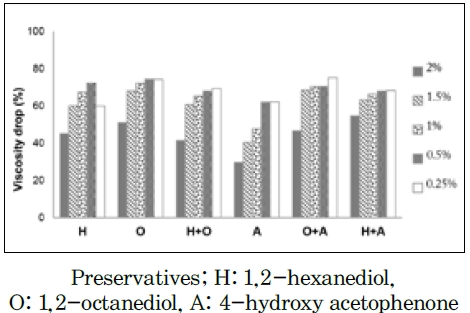
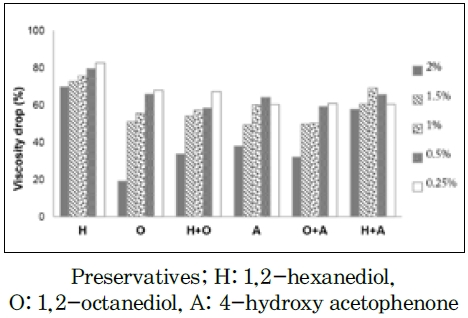
Cellulose degradation by four cellulase-producing microbes was evaluated by viscosity measurement after culturing B. subtilis, S. xylosus, C. albicans, and A. niger in CNF suspension before and after incubation for three days. The viscosity of CNF with various concentrations of preservatives before incubation was differents because each preservative had a different effect on CNF. The viscosity of CNF before the contamination was increased as the concentration of preservative increased, however after adding about 1.5 to 2% of preservative, CNF viscosity decreased monotonically. Therefore, the viscosity drop was calculated by the viscosity of CNF before incubation (after adding preservatives and microorganisms) and after 3 days incubation to avoid the effect of preservative in CNF. The effect of preservatives in preventing CNF degradation was investigated using various concentrations of preservatives and combinations among them. Figs. 2–5 present the changes in viscosity caused by microbial degradation.
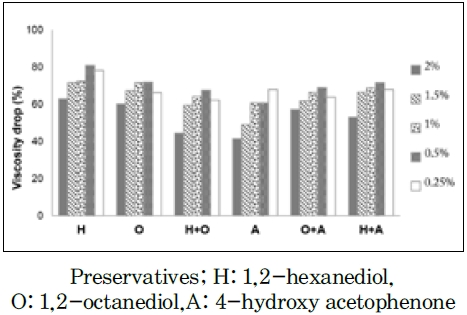
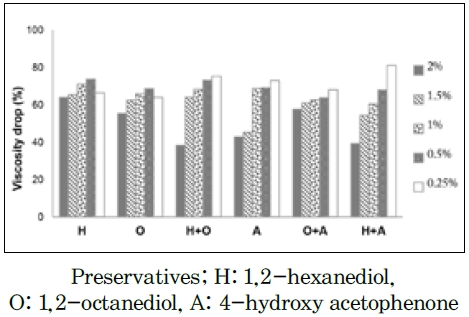
The degradation of CNF was able to reduce by increasing the concentration of preservative used because of their ability to prevent the growth of microbial increased. Fig. 2 shows the viscosity drop of CNF treated by the various concentration of preservatives against B. subtilis. CNF degradation by B. subtilis was more effectively reduced by using 4-hydroxy acetophenone. 1,2-hexanediol was not able to reduce the viscosity drop of CNF greater than 4-hydroxy acetophenone even though it was the most effective preservatives to inhibit the growth of B. subtilis. It was noteworthy that mixing 4-hydroxy acetophenone with 1,2-hexanediol and 1,2-octanediol (H+A and O+A) did not show any satisfying results to reduce viscosity drop of CNF.
In the case of S. xylosus degradation, 4-hydroxy acetophenone was more effective in reducing the viscosity drop of CNF to 29.64% compare to other preservatives (Fig. 3). Similar effect to that of B. subtilis degradation, using H+A and O+A did not give significant results in preventing the degradation of CNF by S. xylosus.
Fig. 4 shows the viscosity drop of CNF with various concentrations of preservatives caused by C. albicans. It was found that 1,2-octanediol was the most potent preservative for both inhibiting the growth of C. albicans and reducing the viscosity drop of CNF. In addition, 1,2-octanediol was able to increase the ability of 1,2-hexanediol and 4-hydroxy acetophenone in reducing the viscosity drop of CNF using H+O and O+A. As seen in Fig. 4, the viscosity drop of CNF could be reduced to 18.96% by 1,2-octanediol addition, followed by O+A (31.96) and H+O (33.64), respectively.
Fig. 5 presents the viscosity drop of CNF using various concentrations of preservatives by A. niger. In particular, A niger contamination could be inhibited by adding 0.5% preservative. However, it was confirmed that using a single preservative such as 1,2-hexanediol and 1,2-octanediol to be less affected in preventing the viscosity drop of CNF even at 2% concentration than a mixture (H+O and H+A).
Viscosity drop of CNF was related to the presence of cellulose-degrading enzyme secreted by microorganisms. Therefore, when the microbial cultures were inoculated into the CNF suspension, cellulose degradation occurred which resulted in the decrease of viscosity. B. subtilis is a well-known enzyme-producing bacteria that degrade cellulose.51)S. xylosus is not general cellulose-degrading bacteria like B. subtilis, it is a pathogenic bacteria that uses carbohydrates as a nutrient source.52) Therefore, a decreased in viscosity still occurred even though it was not significant as B. subtilis. On the other hand, Song et al.33) reported that the viscosity of S. xylosus decreased more significantly because it was more decomposed and less affected by the preservative than that of B. subtilis. A. niger was reported to utilize cellulose materials for growing and cellulose-degrading enzyme production.53) Also, A. niger produces cellulase enzymes which were highly active compare to C. albicans resulted in a higher viscosity reduction in CNF. Similar effects to the results in Figs. 4 and 5, where the viscosity drop of CNF by C. albicans were mostly lower than A. niger.
When comparing the results of microbial growth on the solid media and viscosity drop by microorganisms tested, we found that the decrease in viscosity still occurred even though the growth of microorganisms could not be found on a solid medium. Degradation of cellulose caused a decrease of viscosity of CNF by enzymes secreted by microorganisms during the culture period. It can be explained that the strains were highly active when the culture media was inoculated, then they already killed or no bacteria/fungi identified after three days of incubation when transferred to the solid medium. In addition, microorganisms act as surfactants that able to change long alkyl chains of CNF from hydrophilic to hydrophobic leading to a decrease in viscosity drastically.
4. Conclusions
In this study, the viscosity of CNF suspension was decreased by microbial degradation, and various concentrations of preservatives were used for microbial contamination prevention. It was confirmed that the viscosity of CNFs was decreased drastically as the concentration of preservatives decreased in all microbial test (B. subtilis, S. xylosus, C. albicans, and A. niger). Interestingly, 1,2-hexanediol is the most powerful preservative in preventing bacterial contamination by B. subtilis and S. xylosus. However, the decrease of CNF viscosity still occurred even with 2% of 1,2-hexanediol addition, indicating 1,2-hexanediol was less effective to reduce the degradation by B. subtilis and S. xylosus. Furthermore, 4-hydroxy acetophenone was more effective than other preservatives used in this study to reduce the degradation of CNF by B. subtilis and S. xylosus. 1,2-octanediol was the best antifungal for CNF suspension contaminated by C. albicans and A. niger. It was evident by its ability to inhibit the growth of C. albicans and A. niger even at the lowest concentration used (0.25%). It also could increase the effectiveness of 1,2-hexanediol and 4-hydroxy acetophenone (from 0.5 to 0.25% concentration) by using H+O and O+A to preventing A. niger contamination. Moreover, 1,2-octanediol was the most effective preservative to decrease CNF degradation by C. albicans of 18.96%, followed by O+A of 31.96% and H+O of 33.64% compared to other preservatives. In the case of A. niger contamination, 1,2-octanediol was not really effective to reduce the degradation of CNF, which causes a decrease in the viscosity of 55.32% at 2% concentration. Otherwise, H+O and H+A were more effective in reducing CNF degradation of 38.32 and 39.21% respectively. As expected, increasing concentration of preservatives contributes to reducing the degradation of CNF and preventing microbial contamination. In this study, we proposed the use of 0.25% 1,2-hexanediol to prevent the growth of cosmetic bacterial such as B. subtilis and S. xylosus, and 0.25% of 1,2-Octanediol for preventing the growth of fungus (C. albicans and A. niger) in cosmetics. In addition, using a single preservative such as 1,2-hexanediol and 1,2-octanediol is more effective to treat microorganisms’ growth rather than preservatives combination.