


1. Introduction
Fast-growing poplar has emerged as the principal papermaking feedstock in China to help overcome the specter of imminent raw materials shortage. 1) High yield pulp, in general, has received continuing attention due to its effective use of resources, low cost of production and low-environmental impacts.2) Chemithermo-mechanical pulp (CTMP) is a type of high yield pulp that has been in production since 1970s. It is produced by treating wood chips with chemicals and steam followed by grinding these latter pre-treated chips in a refiner for defibration, and fulfills raw materials saving and environmental friendliness.3) In addition, CTMP has been widely used in different paper grades due to its unique properties such as high yield, low production cost, high bulk, high opacity, and good printability.4,5)
However, high fines content, low physical properties and weak bonding capacity have hampered its papermaking potential.6-8) The weak physical strength of CTMP is likely due to the high content of lignin and hemicellulose. High lignin content adversely contributes to fiber stiffness reducing the flexibility, swellability and thus capacity of fibers to engage in a high strength bonding between fibers. The presence of hemicellulose has a significant positive influence on many vital physical properties of pulp such as pulp beating ability.9) However, more hemicellulose does not necessarily equate to greater benefits. Over the last several years, many studies have been performed to remove hemicellulose from lignocellulose materials or pulp, such as hot water extraction,10,11) alkaline extraction,12-14) enzymatic pretreatment,15) dilute acid pretreatment, 16) steam explosion,17) and ionic liquid extraction. 18) Cold caustic extraction (CCE) has received significant attention due to prominent advantages such as low cellulose loss and high quality hemi-caustic-lyes.19) In addition, it is more effective than hot caustic extraction (HCE) to remove hemicellulose from pulp. Hemicellulose removal at 25°C was 64.24%, higher than that of HCE at 135°C at 10% NaOH from softwood sulfite pulp (55.72%).20) In recent years, mechanical pretreatment, such as pulp refining, was shown to enhance hemicellulose removal during CCE. The combined action of mechanical refining and CCE were applied to a softwood sulfite sample for enhancing hemicellulose removal during CCE alone, whereas reduction of the alkali concentration (from 8% to 4%) achieved similar hemicellulose removal.21) Finally, low alkali concentration upgraded paper-grade pulp to dissolving pulp with high reactivity,22) although a fewer number of studies were carried out for investigating the effect of CCE on CTMP.
Ultrasonic has been applied widely in papermaking. Researchers found that the fibrillation of cellulose fibers were significantly enhanced after ultrasonic treatment, similar to a mechanical beating effect.23,24) In addition, ultrasonics are an effective technologies for extraction of hemicellulose from lignocellulosic materials.25,26) Ultrasonic is often used as an auxiliary means. Jiang et al. investigated the influence of ultrasonic-assisted xylanase treatment and ultrasonic-assisted ionic liquid treatment of chemi-mechanical poplar pulp.27) Results showed that ultrasonic enhanced effect of xylanase treatment to improve chemi-mechanical poplar pulp properties including specific surface area and drainability. Moreover, the ultrasonicassisted ionic liquid treatment improved the surface charge density and area of fibers, as well as the tensile, tear and burst indices of pulp.28) However, most of ultrasonic processing is still in the stage of laboratory due to its high cost. It is crucial to optimize the technological parameters and improve the efficiency of ultrasonic to promote the popularization and application of ultrasonic technology.
The objective of this study is to therefore employ ultrasonic treatment to reduce the alkali concentration to achieve a similar hemicellulose removal in traditional CCE and observe its influence on the properties of CTMP fast-growing poplar.
2. Materials and Methods
2.1 Materials
CTMP pulp was obtained from Shandong Sun Paper Industry. The chemical composition (based on mass) of the CTMP is listed in Table 1 according to National Renewable Energy Lab (NREL) methods. 29)
2.2 Methods
2.2.1 Extraction methods
The procedure for CCE and ultrasonic-assisted CCE is shown in Fig. 1. Cold caustic extraction (CCE) was carried out in polyethylene bags. A 20 g (equivalent to oven dried) pulp was treated at 1, 2, 3, 4, 5 wt% NaOH concentrations, respectively with other conditions remaining the same: 5% pulp consistency, 25°C and 30 min. The samples were washed to neutralize after treatment.
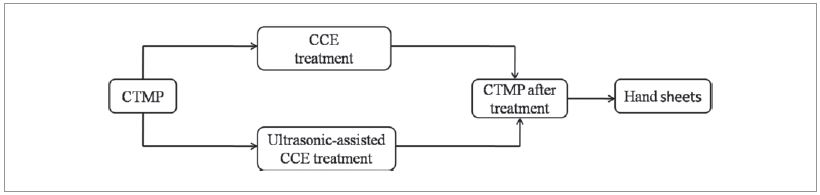
Ultrasonic-assisted CCE was performed by using a sonicator (JY98-DN, Ningbo Scientz Biotechnology Co. Ltd., China) at 120, 240, 360, 480 W over 10, 20, 30, 40 min. Other conditions were same. The samples were washed to neutralize after treatment.
2.2.2 Hemicellulose content analysis
Hemicellulose contents were determined using theNREL method. The samples were hydrolyzed tomono-sugars under two stages hydrolysis. Thefirst hydrolysis was conducted in 72% concentratedsulfuric acid at 30°C for 1 h, and then followed bythe second hydrolysis in 4% dilute acid at 121°C for1 h.29) The mono-sugars contents were quantifiedby ion chromatography (IC; ICS5000+, AmericaThermofisher), equipped with CarboPacPA20 (3mm × 150 mm) analysis column, CarboPacPA20 (3mm × 30 mm) guard column and an electrochemicaldetector (ED; Au as the working electrode, Ag/AgCl as the reference electrode). Distilled waterand 250 mM NaOH were the eluent at a flow rateof 0.4 mL/min. The column temperature was set at30°C. The sum of xylose and mannose were expressedas a total hemicellulose content.
2.2.3 Hemicellulose removal and pulp yield
The hemicellulose removal was calculated as the following equation (Eq. 1):
where Cr and Ce are the hemicellulose content of raw sample and CCE treated samples, respectively. The mass ratio of samples before and after treatment were calculated as pulp yield.
2.2.4 Pulp properties testing
The freeness of samples were determined by a Canadian standard freeness tester (33-23-00, Holland TMI Group) according to TAPPI T 227 (1984). Handsheets of 60 g/m2 were prepared by a Rapid-Köthen sheet forming machine (ASM- 32N2F, China) according to ISO standard method 5269-2. Strength properties including tensile index, bursting index, and tearing index were measured according to ISO standard methods.
3. Results and Discussion
3.1 Hemicellulose removal and pulp yield
A typical CCE process was carried out with a NaOH concentration of 1-5 wt%. To decrease NaOH concentration, ultrasonic-assisted CCE was proposed to obtain a similar efficiency for hemicellulose removal. The results are shown in Figs. 2 and 3.
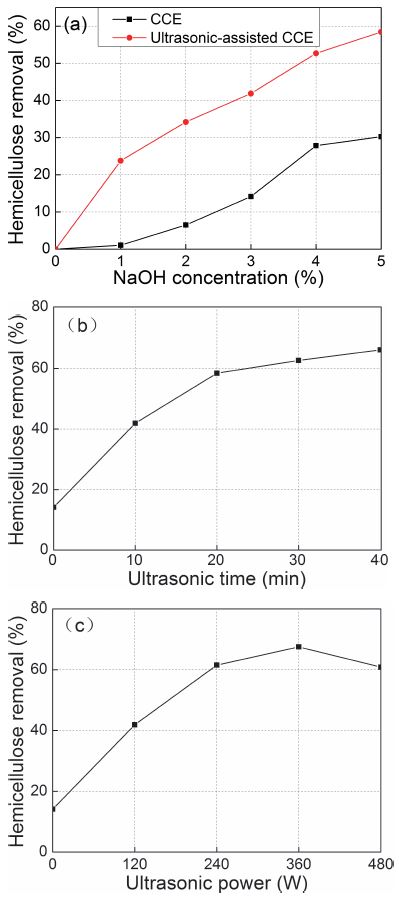
Fig. 2.
Effect of CCE and ultrasonic-assisted CCE on hemicellulose removal: (a) CCE treatment at 25°C for 30 min, ultrasonic- assisted CCE treatment at 25°C and 120 W for 10 min; (b) ultrasonic-assisted CCE treatment at 3 wt% NaOH concentration, 25°C and 120 W; and (c) ultrasonic-assisted CCE treatment at 3 wt% NaOH concentration, 25°C for 10 min. 0 = control CTMP.
It can be seen in Fig. 2(a) that hemicellulose removal increased with increasing in NaOH concentration both in CCE and ultrasonic-assisted CCE. The hemicellulose removals were 58.4% and 30.3%, respectively, at 5 wt% NaOH for 10 min in ultrasonic- assisted CCE and the traditional CCE process. In addition, hemicellulose removal was 34.2% at 2 wt% NaOH in ultrasonic-assisted CCE, which is higher than traditional CCE at 5 wt% NaOH. It seems that the ultrasonic treatment promotes the peeling reaction of hemicelluloses. The cavitation of ultrasonics on the fiber cell walls resulted in an increased accessibility to hemicellulose, where the mechanical function of ultrasonics promoted the peeling of hemicellulose.30) Thus, the ultrasonic treatment enhanced hemicellulose removal during CCE and decreased the concentration of NaOH. Fig. 2(b) shows that the hemicellulose removal increased by prolonging the ultrasonic time, and reached 66.2% at 40 min. Fig. 2(c) shows that the hemicellulose removal reached to maximum of 67.5% at 360 W of ultrasonic power, increased 53.4% compared with CCE at 3 wt% NaOH.
Fig. 3 shows the effect of ultrasonic-assisted CCE and CCE on pulp yield. The yield of treated pulp was decreased by increasing the NaOH concentration both in CCE and ultrasonic-assisted CCE, whereas after ultrasonic-assisted CCE, pulp yield was a little less than CCE. In addition, the yield for the ultrasonic-assisted CCE at 2 wt% NaOH was higher than CCE alone at 5 wt% NaOH, which can achieve a similar hemicellulose removal degree. Figs. 3(b) and (c) demonstrate that the yield of treated pulp decreased with increasing ultrasonic time or ultrasonic power. Ultrasonics enhanced hemicellulose removal in CCE leading to loss of pulp.
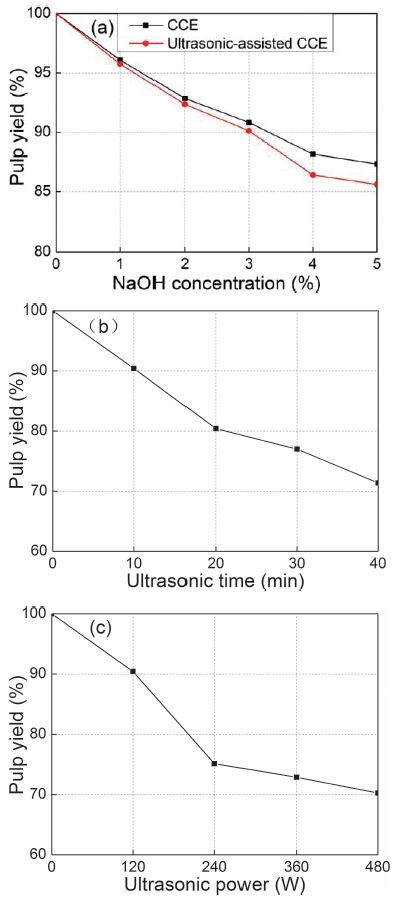
Fig. 3.
Effect of ultrasonic-assisted CCE and CCE on pulp yield: (a) CCE treatment at 25°C for 30 min, ultrasonic-assisted CCE treatment at 25°C and 120 W for 10 min; (b) ultrasonic-assisted CCE treatment at 3 wt% NaOH concentration, 25°C and 120 W; and (c) ultrasonic- assisted CCE treatment at 3 wt% NaOH concentration, 25°C for 10 min. 0 = the control CTMP.
3.2 Canadian standard freeness
In Fig. 4(a), CSF is shown to increase with increasing NaOH concentration from 1 wt% to 5 wt%, while the effect of ultrasonic-assisted CCE was better than CCE. Under optimal treatment conditions (5 wt% NaOH, 10 min.), CSF increased 23.3% compared to the control CTMP. This finding likely can be attributed to the fact that hemicellulose is easier to hydrate and swell than cellulose, and the finding was validated by increasing CSF when increasing NaOH concentration and applying ultrasonics. In addition, decreasing fines would result in an increase in drainability. CSF reached a maximum of 620 and 625 mL under 30 min, 120 W, 3 wt% NaOH, and 10 min, 360 W, 3 wt% NaOH, respectively. Under optimal treatment conditions (3 wt% NaOH, 10 min, 360 W), CSF increased 24.3% and 9.6% compared with the control CTMP and CTMP treated by CCE, respectively. CSF was attenuated when the time and power were more than 30 min and 360 W likely because longer sonication times and greater power led to more fines.
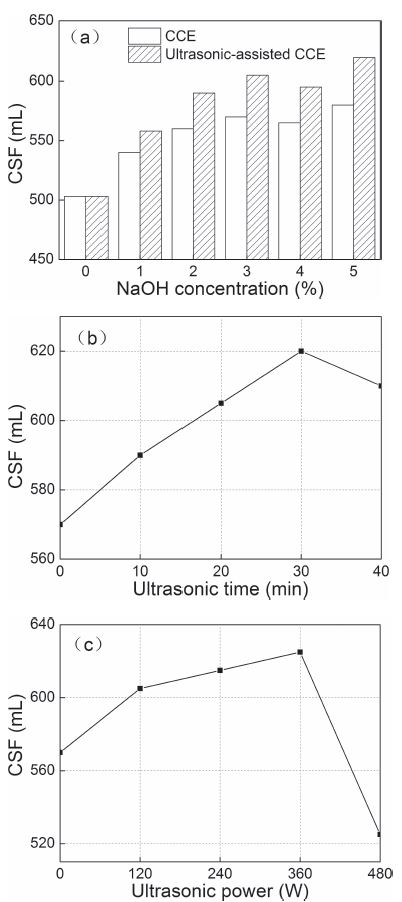
Fig. 4.
Effect of ultrasonic-assisted CCE and CCE on CSF: (a) CCE treatment at 25°C for 30 min, ultrasonic-assisted CCE treatment at 25°C and 120 W for 10 min; (b) ultrasonic-assisted CCE treatment at 3 wt% NaOH concentration, 25°C and 120 W; and (c) ultrasonic-assisted CCE treatment at 3 wt% NaOH concentration, 25°C for 10 min. 0 = control CTMP.
3.3 Strength properties
As shown in Fig. 5(a), the tensile indices increased with increasing NaOH concentration in CCE while it reached a maximum at 3 wt% NaOH for ultrasonic-assisted CCE. Figs. 5(b) and (c) show that the optimal conditions of ultrasonic treatment were 10 min and 120 W at 3 wt% NaOH concentration, where the tensile index reached a maximum of 23.68 N·m/g, 70.4% and 12.7% greater than the control CTMP and CTMP treated with CCE.
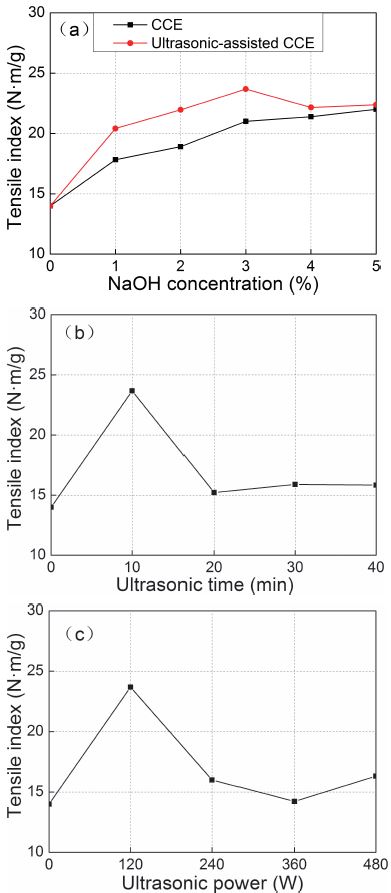
Fig. 5.
Effect of ultrasonic-assisted CCE and CCE on tensile index of CTMP: (a) CCE treatment at 25°C for 30 min, ultrasonic- assisted CCE treatment at 25°C and 120 W for 10 min; (b) ultrasonic-assisted CCE treatment at 3 wt% NaOH concentration, 25°C and 120 W; and (c) ultrasonic-assisted CCE treatment at 3 wt% NaOH concentration, 25°C for 10 min. 0 = control CTMP.
As shown in Fig. 6(a), bursting index followed different trends in CCE and ultrasonic-assisted CCE, attaining maxima of 0.83 kPa·m2/g at 4 wt% NaOH under CCE and 0.89 kPa·m2/g at 3 wt% NaOH under ultrasonic-assisted CCE. Figs. 6(b) and (c) show that optimal ultrasonic treatment conditions were 10 min and 120 W at 3 wt% NaOH concentration, which provide a bursting index increase of 86.0% and 11.34% compared to the control CTMP and CTMP treated by CCE, respectively. Because entanglement and bonding amongst fibers are important factors influencing tensile and bursting strength, external fibrillation caused by cavitation and the mechanical beating effect of ultrasonics contributes greatly to achieve strength. However, at 5% consistency of pulp, too long times and power are likely not favorable conditions. The polymerization degree of hemicellulose decreased under alkaline conditions contributing to decrease of interfiber bonding strength and simultaneously decrease of hemicellulose polymerization degree leading to the inescapable conclusion that an appropriate hemicellulose content is needed to ensure optimal strength properties.
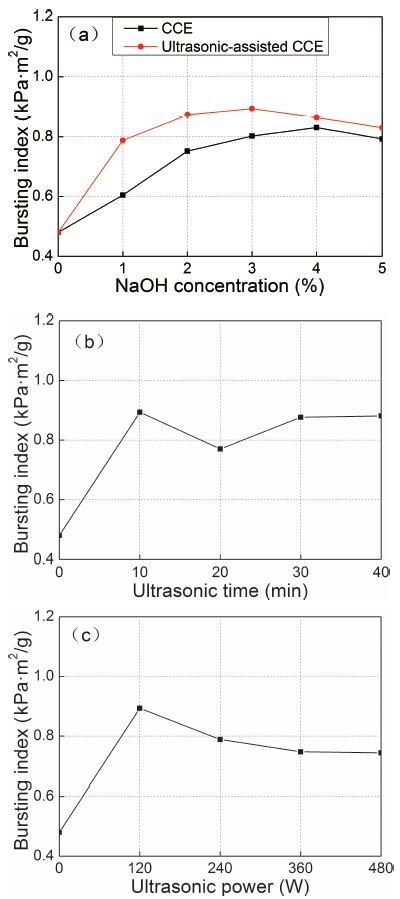
Fig. 6.
Effect of ultrasonic-assisted CCE and CCE on bursting index of CTMP: (a) CCE treatment at 25°C for 30 min, ultrasonic- assisted CCE treatment at 25° C and 120 W for 10 min; (b) ultrasonicassisted CCE treatment at 3 wt% NaOH concentration, 25°C and 120 W; (c) ultrasonic- assisted CCE treatment at 3 wt% NaOH concentration, 25°C for 10 min. 0 = control CTMP.
In Fig. 7(a), the tearing indices trends were similar to bursting indices. Tearing reached to maximum of 3.58 mN·m2/g at 3 wt% NaOH in CCE and 3.67 mN·m2/g at 3 wt% NaOH in ultrasonic-assisted CCE. Under the optimal conditions of ultrasonic- assisted CCE, the tearing index increased 42.3% and 3.0% compared to the control CTMP and CTMP treated by CCE. Figs. 7(b) and (c) demonstrate the optimal ultrasonic treating time and power were 30 min and 240 W at 3 wt% NaOH concentration. Fiber length is critical factor influencing tearing strength. Because fines have more specific surface area, they come into contact with the alkaline solution easier leading to a decrease in fines and thus increase fiber length. However, fiber length may decrease with excessive dissolving of hemicellulose.
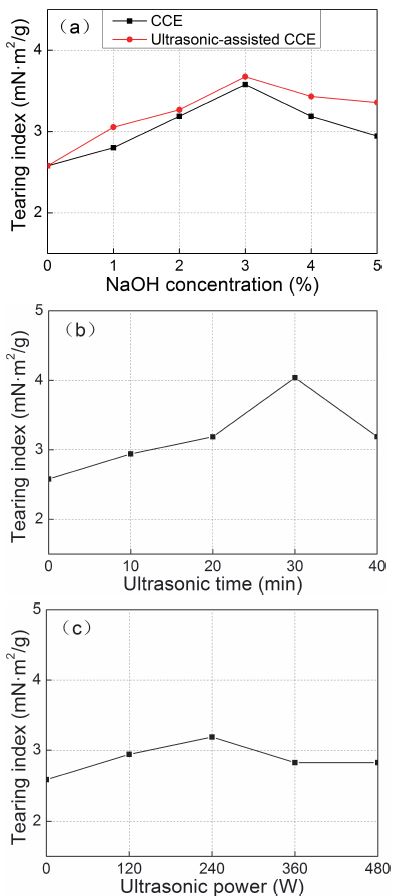
Fig. 7.
Effect of ultrasonic-assisted CCE and CCE on tearing index of CTMP: (a) CCE treatment at 25°C for 30 min, ultrasonic- assisted CCE treatment at 25°C and 120 W for 10 min; (b) ultrasonic-assisted CCE treatment at 3 wt% NaOH concentration, 25°C and 120 W; and (c) ultrasonic-assisted CCE treatment at 3 wt% NaOH concentration, 25°C for 10 min. 0 = control CTMP.
In summary, the strength properties of CTMP treated by ultrasonic-assisted CCE were better than CCE. Optimal conditions for ultrasonic-assisted CCE were 3 wt% NaOH and 120 W for 10 min, while a suitable hemicellulose content is 10%.
3.4 Surface morphology
Fig. 8 shows SEM images of the control CTMP and the treated CTMP after CCE and ultrasonic-assisted CCE. Compared with the smooth and compact surface of control CTMP (Fig. 8(a)), the pulp treated by CCE (Fig. 8(b)) presented more asperities on the fiber surface. However, Fig. 8(c) shows that the pulp treated with ultrasonic-assisted CCE at 3 wt% NaOH concentration, 25°C and 120 W for 10 min had a strong fibrillation. Figs. 8(d) and (e) show that the pulp treated with ultrasonic - assisted CCE at 3 wt% NaOH concentration with too long times and power had less fibrillation than the pulp treated with ultrasonic-assisted CCE at 3 wt% NaOH concentration, 25°C and 120 W for 10 min. This finding likely can be attributed to the fact that fines caused by fibrillation of ultrasonic treatment were degraded by caustic when prolonging the time and enhancing the power of ultrasonic.
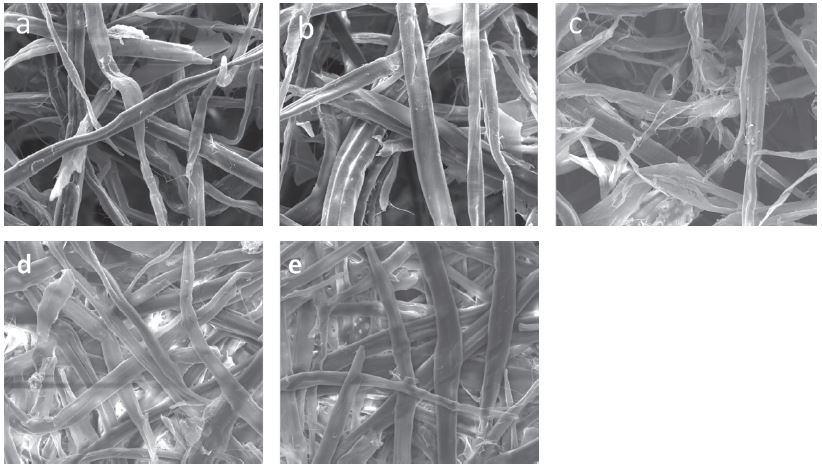
Fig. 8.
Effect of ultrasonic-assisted CCE and CCE on surface morphology: (a) control CTMP; (b) CCE treatment at 3 wt% NaOH concentration, 25°C for 30 min; (c) ultrasonic-assisted CCE treatment at 3 wt% NaOH concentration, 25°C and 120 W for 10 min; (d) ultrasonic-assisted CCE treatment at 3 wt% NaOH concentration, 25°C and 120 W for 20 min; and (e) ultrasonic- assisted CCE treatment at 3 wt% NaOH concentration, 25°C and 240 W for 10 min.
4. Conclusions
A combined treatment of ultrasonic and cold caustic extraction (CCE) for enhancing the hemicellulose removal from CTMP of poplar was investigated. Hemicellulose removal of the ultrasonic-assisted CCE was higher than that of the CCE. The ultrasonic-assisted CCE can reduce the alkali concentration (from 5 wt% to 2 wt%) and achieve a similar hemicellulose removal of traditional CCE, and the yield for the ultrasonic-assisted CCE at 2 wt% NaOH was higher than that CCE alone at 5 wt% NaOH. The drainability and strength properties of CTMP treated by ultrasonic-assisted CCE increased compared to the control CTMP. The effect of ultrasonic-assisted CCE was thus better than the traditional CCE. Ultrasonic-assisted CCE enhanced the fibrillation of fibers at optimal conditions, as determined by SEM.