1. 서 론
지속 가능성은 오늘날 가장 중요한 이슈 중 하나이다. 지속가능성이란 재생 가능한 에너지원을 기반으로 한 신소재 연구 및 개발을 통한 석유 제품 대체와 더불어 에너지 절감 및 고부가가치 원료를 개발하는 것에 그 목표가 있다.1)
나노셀룰로오스는 셀룰로오스를 이용하여 기계적, 화학적, 생물학적 처리를 통해 나노사이즈로 제조한 소재이다. 본 연구에서는 화학적 처리를 통한 나노셀룰로오스를 사용하였으며, 화학적 처리를 통한 나노셀룰로오스는 셀룰로오스를 강산을 통해 가수분해하여 그 크기를 나노사이즈로 만든 물질이다. 이러한 나노 입자는 높은 종횡비와 막대모양(rod-like) 또는 수염모양(whisker)의 형태로 나타난다. 이러한 형태학적 특성은 제조 전 셀룰로오스의 형태와 가수분해 조건에 따라 달라진다. 화학적 처리로 제조된 나노셀룰로오스는 일반적으로 수백 나노미터 정도이고 너비는 수 나노미터 수준이다. 이렇게 제조된 나노입자는 일반적으로 TAPPI(표준 용어 및 셀룰로오스 나노 물질 WI 3021에 대한 정의)에 따라 cellulose nano crystal(CNC)로 불린다.2)
이러한 나노셀룰로오스는 나노사이즈의 치수와, 높은 종횡비, 고유한 높은 기계적 특성으로 인하여 나노복합 체로서 잠재적 가능성을 보였다.3) 이러한 특성은 다른 고분자 폴리머와 대체할 수 있다는 가능성을 나타내었고, 일부 연구에서 라텍스 또는 Carboxyl Methyl Cellulose, 전분, PLA(poly latic acid) 등 석유계 폴리머와 천연 폴리머와의 혼합을 통한 사용으로 배리어 특성과 물리적 강도가 향상되었다고 보고된 바 있다.4-8)
그에 발맞추어 제지분야에도 응용하기 위한 연구가 진행되고 있다.9-12) 하지만 그 가능성은 여러 논문을 통해 밝혀졌지만,13,14) 제지산업 특히 초지 공정에서 사용되고 있다는 보고는 아직까지 없다. 그 이유는 CNC 자체의 치수가 매우 작아 와이어에서 지필형성 시 보류가 잘 안되어 손실되는 양이 많고, 다량의 하이드록실(-OH)기로 인해 탈수에 문제가 있기 때문이다.15,16)
따라서 본 연구에서는 CNC를 사용하여 종이에 표면코팅하고 그에 따른 표면강도와 배리어적 특성을 평가하고자 하였다. 또한 종래 사이즈프레스제로 많이 사용하는 전분에 CNC를 혼합하여 강도향상에 대한 실험을 진행하였다.
2. 재료 및 방법
2.1 공시재료
2.1.1 원지
본 연구에 사용된 원지는 국내 K 사의 평량 80 g/m2, 두께 110 μm의 원지를 사용하였으며 그 물성은 Table 1에 나타내었다.
Table 1.
Properties of base paper
| Base weight (g/m2) | 80 |
|---|
| Thickness (μm) | 110 |
|---|
| Opacity (%) | 99 |
|---|
| Brightness (%) | 89 |
|---|
| Air resistance (s.) | 16 |
|---|
2.1.2 Cellulose nano crystal(CNC)
본 연구에 사용된 CNC는 Canada의 CelluForce 社에서 Cellulose nanocrystal(NCCTM) 제품을 분말 형태로 분양받아 사용하였다. 물성은 Table 2에 나타내었고 형태학적 특성은 Fig. 1에 나타냈다.
Table 2.
Properties of Cellulose Nano Crystal
| Parameter | Specification |
|---|
| Form | Spray dried powder |
| Color | White |
| Bulk density | 0.7 g/cm3 |
| Molecular formula | [(C6O5H10)22-28 SO3 Na]4-6 |
| Particle diameter (crystallite) | 2.3-4.5 nm (by AFM) |
| Particle length (crystallite) | 44-108 nm (by AFM) |
| Zeta potential | -37 mV |
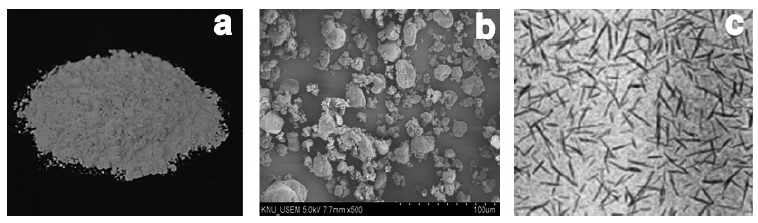
Fig. 1.
Morphological characteristics of CNC.
a) picture of the CNC powder, b) SEM image of CNC, c) TEM image of CNC.
2.1.3 Oxidized starch
본 연구에 사용된 전분은 Potato 기반의 산화전분을 이용하였으며, R 사에서 분양을 받아 사용하였다. 호화는 농도 30%, 온도 90℃, 30분간 교반하여 사용하였다.
2.2 실험방법
2.2.1 CNC solution 제조
CNC solution은 증류수를 사용하여 10% 농도로 2시간 교반하여 제조하였다.
2.2.2 CNC와 전분이 혼합된 solution 제조
CNC와 산화전분을 혼합하여 25% 농도로 20분간 교반하여 제조하였다. Formulation은 Table 3에 나타내었다.
Table 3.
Formulation according to mixing ratio of starch and CNC
(unit: part)
2.2.3 표면 코팅지 제작
CNC와 CNC & 전분이 혼합된 solution의 표면코팅은 실험실용 반자동 코터(K-control, RK Print Coat Instrument Co. Ltd., UK)를 사용하여 제조하였다. 도포한 원지는 열풍건조기(YJ-8600D, Yujin Electronics, S. Korea)에서 105℃, 60초의 조건으로 건조하였다. 샘플은 조건당 10개를 제조하였고 CNC 포면코팅의 평균 도포량은 Table 4에 나타내었고 CNC와 전분이 혼합된 용액의 도포량은 4 g/m2로 제조하였다.
Table 4.
The amount of CNC pick-up according to the number of application
| Control | No. 1 | No. 2 | No. 3 | No. 4 |
|---|
| CNC coating (times) | 0 | 1 | 2 | 3 | 4 |
| CNC Coating weight (g/m2) | 0 | 2.6 | 4.7 | 6.1 | 7.5 |
2.2.4 SEM Image
CNC 코팅된 샘플의 표면 특성을 관찰하기 위해 고분해능 주사전자현미경(ultra high resolution scanning electron microscope, Hitachi S-4800, Japan)을 이용하여 SEM 이미지를 촬영하였다.
2.2.5 물성측정
온도 23±1℃, 상대습도 50±2℃의 항온항습실에서 24시간 이상 조습처리 후 물성을 분석하였다. 물성은 각각 파열강도(T403 om, Lorentzen & Wettre, Sweden), 광택도(T480 om, Gloss meter)를 통해 측정하였다. 결과 값은 샘플당 10번 반복측정 후 평균값을 구하여 나타내었다.
2.2.6 배리어 특성 평가
배리어 특성은 Air resistance(T460 om. FRANKPTI GmbH), Oil- resistance(T559 cm), Water Vapor Transmittance Rate(ASTM standard E96/E96M)를 통해 측정하였다.
2.2.7 표면 뜯김 강도
RI 인쇄 시험기(RI-II, KRK, Japan)를 이용하여 Ink 0.5 cc 전이시키고, Dry-pick을 통해 표면 강도를 측정하였다. 측정된 샘플은 화상분석프로그램(Image-J)을 통해 화상을 분석하여 5점법으로 나타내었다.
3. 결과 및 고찰
3.1 코팅지의 물성
3.1.1 CNC와 전분과 혼합된 CNC의 표면코팅지의 파열강도
Fig. 2는 CNC 코팅지의 파열강도를 나타낸다. CNC 도포량이 증가할수록 파열강도는 증가하는 경향을 보였는데, 표면의 필름 층이 두꺼워지면서 그로 인해 강도가 향상되는 것으로 사료된다. Fig. 3은 전분과 CNC의 혼합비에 따른 코팅지의 파열강도를 나타내다. CNC 첨가량에 따른 파열강도는 큰 차이를 보이지 않았다. 즉 소량의 CNC 첨가는 파열강도에 크게 영향을 미치지 않는 것으로 나타난다.
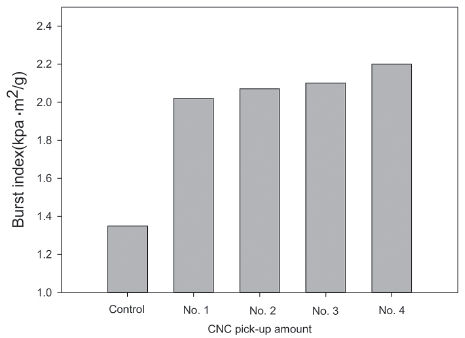
Fig. 2.
Burst index according to CNC pick-up amount.
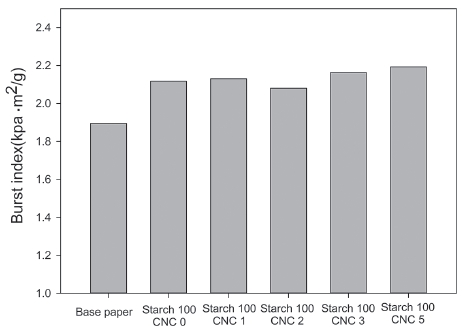
Fig. 3.
Burst index according to the ratio of CNC and starch.
하지만 강도 향상폭이 크지 않았고 오히려 떨어지는 결과를 나타내기도 하였다. 이는 농도가 상대적으로 낮기 때문에 실험실적으로 건조 응력을 제한하지 못하였고 원지방향으로 수분 이동에 의한 섬유의 fibril to fibril 수소결합을 약화시켜 발생한 결과라고 사료된다.17)
3.1.2 SEM image, Gloss
Fig. 4는 CNC 코팅지의 광택을 나타낸다. 광택은 CNC 도포량이 증가함에 따라 증가하는 경향을 나타내었다. 이는 CNC가 도포됨에 따른 필름형성에 의해 원지 표면의 요철과 공극을 매워 다음과 같은 결과가 나왔다고 사료되었다.
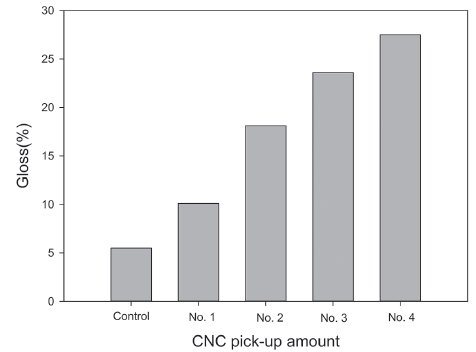
Fig. 4.
Gloss according to CNC pick-up amount.
이는 Fig. 5의 SEM 사진에서 확인할 수 있었다. 코팅량이 증가할수록 원지의 공극과 요철이 감소하며 필름이 형성되는 것을 관찰할 수 있다. 이러한 결과를 통해 CNC의 표면코팅을 통한 배리어 특성의 향상을 기대할 수 있었다.
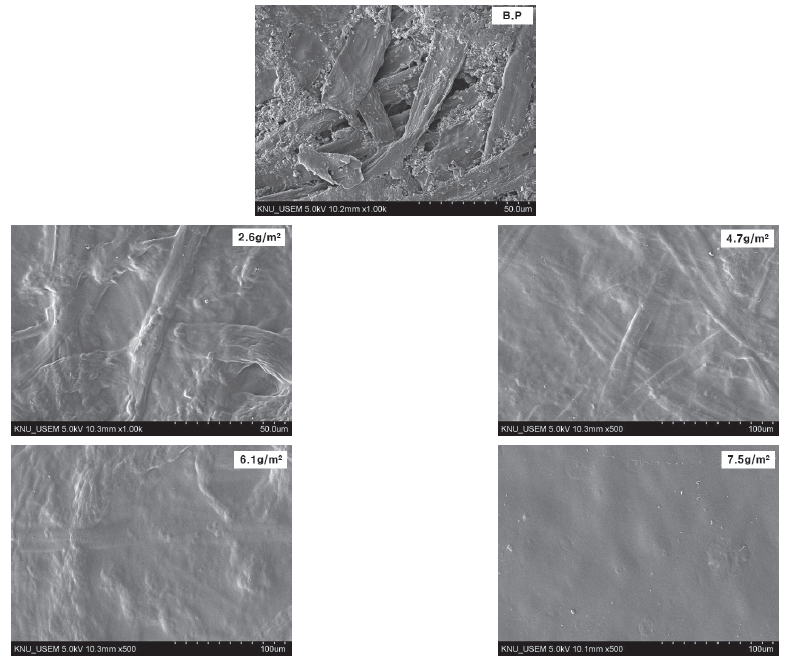
Fig. 5.
SEM image according to CNC pick-up amount.
3.1.3 Pick-strength
Fig. 6은 CNC 코팅지의 드라이픽을 나타낸다. 드라이 픽은 CNC 코팅량이 증가할수록 향상되는 경향을 보였다. 이는 CNC가 건조됨에 따라 조직화된 필름을 형성하고 그에 따른 강도발현으로서 뜯김 강도가 향상되었다고 사료된다.
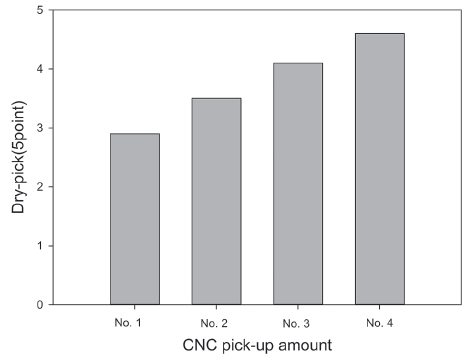
Fig. 6.
Dry pick by 5point evaluation method according to CNC pick-up amount.
Fig. 7은 starch와 CNC의 혼합비에 따른 코팅지의 Dry-pick을 나타낸다. CNC 첨가량이 증가할수록 드라이픽의 강도는 향상되는 결과를 나타내었다. 이는 CNC가 건조되면서 원지와의 수소결합과 더불어 나노사이즈의 CNC가 starch와 혼합되면서 조밀하고 조직화된 필름을 형성하여 자체적 강도발현을 통해 다음과 같은 결과가 나타냈다고 사료된다.
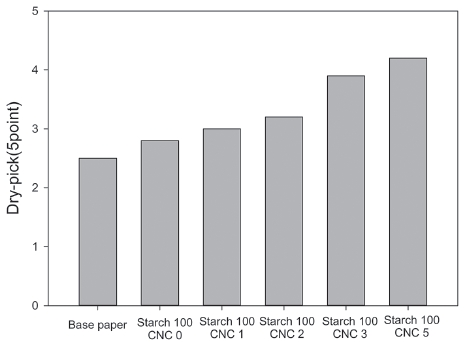
Fig. 7.
Dry pick by 5point evaluation method according to the ratio of CNC and starch.
3.2 CNC 코팅에 따른 배리어 특성 평가
Fig. 8은 CNC 코팅지의 공기 투과저항성을 나타낸다. 투기저항은 원지에 비해 코팅량 2.6 g/m2인 샘플이 큰폭으로 시간이 증가하였고, 그보다 더 많은 코팅량의 샘플에서는 시간 측정이 불가하였다. 즉 CNC를 코팅량이 증가함에 따라 표면 공극이 매워지고 그로 인해 공기투과저항성이 향상되는 결과를 보였다.
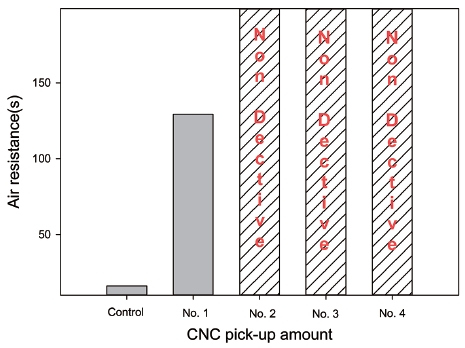
Fig. 8.
Results of the air resistance according to CNC pick-up amount.
Fig. 9는 Kit-test를 통한 내유성 결과를 나타낸다. Kit-test 그래프의 determination no.는 값이 클수록 더 강한 오일 배리어 특성을 나타낸다고 볼 수 있다. 보통 공기투과도가 적을수록 오일침투성이 감소되며 즉, CNC 코팅량이 증가함에 따라 오일 배리어 특성이 향상되었고, 이는 CNC 코팅층이 조밀하고 조직화된 코팅층을 형성하면서 공극을 매워 침투성을 저하시키고, 배리 어성을 부여한다고 사료된다.18)
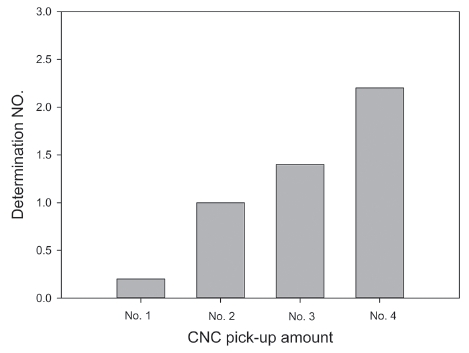
Fig. 9.
Results of the oil resistance by kit-test according to CNC pick-up amount.
Fig. 10은 CNC 코팅지의 수증기 투과도를 2시간, 24시간에 나누어 측정한 결과이다. 코팅량이 증가함에 따라 수증기 투과도는 감소하는 경향을 보였다. 즉 CNC를 코팅함에 따라 표면의 공극이 감소하여 수분의 침투성을 저하시키기 때문으로 사료된다.
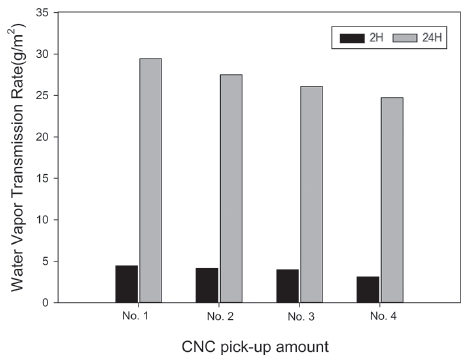
Fig. 10.
Results of the water vapor transmission rate according to CNC pick-up amount.
4. 결 론
본 연구에서는 나노셀룰로오스 중 화학적 가수분해를 통해 제조된 CNC(cellulose nano crystal)를 이용하여 CNC와 CNC/Starch 표면코팅이 원지의 표면 특성 및 배리어 특성에 미치는 영향에 대해서 알아보았다. CNC의 코팅량이 증가함에 따라 파열강도는 증가하였으며, starch와 혼합 시에도 파열강도가 소폭 증가하는 경향을 보였다. 특히 dry-pick을 통해 뜯김 강도를 평가하였을 때 CNC 첨가량이 증가할수록 강도향상의 결과를 확인할 수 있었다.
또한 CNC를 원지에 코팅함으로 원지의 공극과 요철이 감소하였으며 그로 인해 광택이 향상되는 결과를 확인하였다. 이러한 원지의 공극과 요철 감소의 결과는 공기투과저항성, 내유성, 수증기 투과성의 3가지 배리어 특성을 향상시키는 결과를 나타내었다.
결과적으로 친환경 소재로서 CNC를 단독 또는 폴리머와의 혼합을 통해 강도향상제로서의 역할을 확인할 수 있었으며, 배리어 코팅에도 적용가능하다는 결과를 얻을수 있었다. 이러한 결과는 추후 화학적 개질 또는 기능성 폴리머와의 결합을 통하여 강도 향상 또는 배리어성 등 기능성을 부여할 수 있는 소재로 활용의 기초가 될 것으로 기대된다.
Acknowledgements
본 연구는 2017년도 정부(교육부)의 재원으로 한국연구재단의 지원을 받아 수행된 기초연구사업임(No. NRF-2017R1D1A3B03034031).
Literature Cited
H. Rautkoski, H. Pajari, H. Koskela, A. Sneck and P. Moilanen, Nordic Pulp & Paper Research Journal,
Use of cellulose nanofibrils (CNF) in coating colors,
30(3); 511-518 (2015)
Rautkoski, H., Pajari, H., Koskela, H., Sneck, A., and Moilanen, P., Use of cellulose nanofibrils (CNF) in coating colors, Nordic Pulp & Paper Research Journal 30(3):511-518 (2015).
10.3183/npprj-2015-30-03-p511-518A. Dufresne, Current Opinion in Colloid & Interface Science,
Cellulose nanomaterial reinforced polymer nanocomposites,
29; 1-8 (2017)
Dufresne, A., Cellulose nanomaterial reinforced polymer nanocomposites, Current Opinion in Colloid & Interface Science 29:1-8 (2017).
10.1016/j.cocis.2017.01.004I. Siró and D. Plackett, Cellulose,
Microfibrillated cellulose and new nanocomposite materials: A review,
17(3); 459-494 (2010)
Siró, I., and Plackett, D., Microfibrillated cellulose and new nanocomposite materials: A review, Cellulose 17(3):459-494 (2010).
10.1007/s10570-010-9405-yM. R. Kamal and V. Khoshkava, Carbohydrate Polymers,
Effect of cellulose nanocrystals (CNC) on rheological and mechanical properties and crystallization behavior of PLA/CNC nanocomposites,
123; 105-114 (2015)
Kamal, M. R. and Khoshkava, V., Effect of cellulose nanocrystals (CNC) on rheological and mechanical properties and crystallization behavior of PLA/CNC nanocomposites, Carbohydrate Polymers 123:105-114 (2015).
10.1016/j.carbpol.2015.01.012K. Syverud and P. Stenius, Cellulose,
Strength and barrier properties of MFC films,
16(1); 75-85 (2009)
Syverud, K. and Stenius, P., Strength and barrier properties of MFC films, Cellulose 16(1):75-85 (2009).
10.1007/s10570-008-9244-2V. Kumar, E. Lazarus, P. Salminen, D. Bousfield and M. Toivakka, Nordic Pulp & Paper Research Journal,
Influence of nanolatex addition on cellulose nanofiber film properties,
31(2); 333-340 (2016)
Kumar, V., Lazarus, E., Salminen, P., Bousfield, D., and Toivakka, M., Influence of nanolatex addition on cellulose nanofiber film properties, Nordic Pulp & Paper Research Journal 31(2):333-340 (2016).
10.3183/npprj-2016-31-02-p333-340S. Y. Z. Zainuddin, I. Ahmad and H. Kargarzadeh, Composite Interfaces,
Cassava starch biocomposites reinforced with cellulose nanocrystals from kenaf fibers,
20(3); 189-199 (2013)
Zainuddin, S. Y. Z., Ahmad, I., and Kargarzadeh, H., Cassava starch biocomposites reinforced with cellulose nanocrystals from kenaf fibers, Composite Interfaces 20(3):189-199 (2013).
10.1080/15685543.2013.766122X. Xu, F. Liu, L. Jiang, J. Y. Zhu, D. Haagenson and D. P. Wiesenborn, ACS applied materials & interfaces,
Cellulose nanocrystals vs. cellulose nanofibrils: A comparative study on their microstructures and effects as polymer reinforcing agents,
5(8); 2999-3009 (2013)
Xu, X., Liu, F., Jiang, L., Zhu, J. Y., Haagenson, D., and Wiesenborn, D. P., Cellulose nanocrystals vs. cellulose nanofibrils: A comparative study on their microstructures and effects as polymer reinforcing agents, ACS applied materials & interfaces 5(8):2999-3009 (2013).
10.1021/am302624tJ. Lee, K. Sim, K. Sim and H. Yoon, Journal of Korea TAPPI,
Strengthening effect of surface treatment of cellulose nanofibrils on aged paper,
48(6); 123-130 (2016)
Lee, J., Sim, K., Sim, K., and Yoon, H., Strengthening effect of surface treatment of cellulose nanofibrils on aged paper, Journal of Korea TAPPI 48(6):123-130 (2016).
10.7584/JKTAPPI.2016.12.48.6.123I. Hwang, J. Kim, Y. Lee and J. Won, Journal of Korea TAPPI,
Effect of alkaline pre-treatment on the production characteristic of nanofibrillated cellulose from white ledger,
49(5); 86-96 (2017)
Hwang, I., Kim, J., Lee, Y., and Won, J., Effect of alkaline pre-treatment on the production characteristic of nanofibrillated cellulose from white ledger, Journal of Korea TAPPI 49(5):86-96 (2017).
10.7584/jktappi.2017.10.49.5.86N. Lavoine, I. Desloges, B. Khelifi and J. Bras, Journal of Materials Science,
Impact of different coating processes of microfibrillated cellulose on the mechanical and barrier properties of paper,
49(7); 2879-2893 (2014)
Lavoine, N., Desloges, I., Khelifi, B., and Bras, J., Impact of different coating processes of microfibrillated cellulose on the mechanical and barrier properties of paper, Journal of Materials Science 49(7):2879-2893 (2014).
10.1007/s10853-013-7995-0B. Sun, Q. Hou, Z. Liu and Y. Ni, Cellulose,
Sodium periodate oxidation of cellulose nanocrystal and its application as a paper wet strength additive,
22(2); 1135-1146 (2015)
Sun, B., Hou, Q., Liu, Z., and Ni, Y., Sodium periodate oxidation of cellulose nanocrystal and its application as a paper wet strength additive, Cellulose 22(2):1135-1146 (2015).
10.1007/s10570-015-0575-5F. W. Brodin, Ø. W. Gregersen and K. Syverud, Nordic Pulp & Paper Research Journal,
Cellulose nanofibrils: Challenges and possibilities as a paper additive or coating material–A review,
29(1); 156-166 (2014)
Brodin, F. W., Gregersen, Ø. W., and Syverud, K., Cellulose nanofibrils: Challenges and possibilities as a paper additive or coating material–A review, Nordic Pulp & Paper Research Journal 29(1):156-166 (2014).
10.3183/npprj-2014-29-01-p156-166R. Bardet and J. Bras, Bionanomaterials: separation processes, characterization and propertiesCellulose nanofibers and their use in paper industry,
1; 207-232, In Handbook of Green Materials (2014)
Bardet, R. and Bras, J., Cellulose nanofibers and their use in paper industry, In Handbook of Green Materials, Vol. 1. Bionanomaterials: separation processes, characterization and properties, pp. 207-232 (2014).
T. Taipale, M. Österberg, A. Nykänen, J. Ruokolainen and J. Laine, Cellulose,
Effect of microfibrillated cellulose and fines on the drainage of kraft pulp suspension and paper strength,
17(5); 1005-1020 (2010)
Taipale, T., Österberg, M., Nykänen, A., Ruokolainen, J., and Laine, J., Effect of microfibrillated cellulose and fines on the drainage of kraft pulp suspension and paper strength, Cellulose 17(5):1005-1020 (2010).
10.1007/s10570-010-9431-9C. Hii, Ø. W. Gregersen, G. Chinga-Carrasco and Ø. Eriksen, Nordic Pulp and Paper Research Journal,
The effect of MFC on the pressability and paper properties of TMP and GCC based sheets,
27(2); 388-396 (2012)
Hii, C., Gregersen, Ø. W., Chinga-Carrasco, G., and Eriksen, Ø., The effect of MFC on the pressability and paper properties of TMP and GCC based sheets, Nordic Pulp and Paper Research Journal 27(2):388-396 (2012).
10.3183/npprj-2012-27-02-p388-396H. C. Han and X. L. Gong,
Investigation of humidity ageing mechanism of hemp fiber reinforced polypropylene compositesEC-CM16-16TH European Conference on Composites Materials (2014)
Han, H. C. and Gong, X. L., Investigation of humidity ageing mechanism of hemp fiber reinforced polypropylene composites, EC-CM16-16TH European Conference on Composites Materials (2014).
C. Aulin, E. Johansson, L. Wagberg and T. Lindstrom, Biomacromolecules,
Self-organized films from cellulose nanofibrils using the layer-by-layer technique,
11(4); 872-882 (2010)
Aulin, C., Johansson, E., Wagberg, L., and Lindstrom, T., Self-organized films from cellulose nanofibrils using the layer-by-layer technique, Biomacromolecules 11(4):872-882 (2010).
10.1021/bm100075e