


1. Introduction
Biobased latex binders adopted in the paper industry in 2008 were the first use of biopolymer-based microgels and nanogels for large-scale industrial applications.1-7) Both biobased latex binders and biopolymer-based microgels can be broadly defined as a special class of latexes whose particles are made up of water-swollen crosslinked hydrophilic polymers. Since the biobased latex binders currently used in the paper industry are water-swollen crosslinked starch nanoparticles, their wet and dry properties depend mainly on their particle size and crosslink density. The current biobased latex binders are manufactured by a continuous reactive extrusion process comprising of solubilizing starch granules, i.e. converting the very high-solids starch paste into a thermoplastic melt phase, and then crosslinking and sizing the solubilized starch molecules into nanoparticles.8)
Starch-based nanoparticle latex provides an alternative binder system to petrochemical-based binders, such as carboxylated and acrylonitrile-containing styrene butadiene latexes (XSB), as well as styrene acrylate latexes (SA). When added to the coating color formulation, these binders typically replace 35% to 50% of XSB or SA latex used in paper coating processes today.1-7,9-13) The starch nanoparticle latex binders provide a performance that is different to conventional cooked coating starches and is comparable to all-synthetic latex systems. Although considerable practical working knowledge, as well as the rheological performance for these materials has been reported and a number of hypotheses put forward on the basic and fundamental design characteristics and properties of these materials1-7,9-13), this study examines the fundamental rheological performance of the crosslinked water-swollen starch nanoparticles relative to conventional cooked coating starches and XSB latex both in pure dispersions and in paper coatings.
2. Experimental
2.1 Materials
Samples used for this study include Dow 620NA (XSB latex 1) and Dow ProStar (XSB latex 2) as examples of XSB latex binders (formerly The Dow Chemical Company, now Styron), and different experimental grades of ECOSPHEREⓇ starch nanoparticles labeled Bio-A, Bio-B, and Bio-C (ECOSYNTHETIX Inc.), Penford Gum PG 290 starch (Penford Corporation), and Ethylex 2015 starch (Tate & Lyle). The other ingredients used in the coating formulations, listed in Table 1, were Hydragloss 91 clay (KaMin), Covercarb HP-FL CaCO3 (OMYA); Finnfix 10 carboxymethyl cellulose from Hercules, and Calsan 50V Ca-Stearate lubricant (BASF).
Table 1.
Coating formulations containing all-XSB latex with and without CMC and XSB latex with starch based latex and soluble starch as co-binders at 30% and 50% replacement levels
2.2 Methods
2.2.1 Rheological experiments
Lab studies were carried out to establish a number of similarities and differences between binders, such as starch latexes (Bio-A, Bio-B, and Bio-C), XSB latex, and soluble starch. The work performed included rheological measurements using a dilute capillary viscometer (Cannon-Fenske, Cannon Instrument Company), a stress rheometer (TA Instruments dynamic stress rheometer, model AR- 2000), a Hercules “high” shear rheometer (relatively low to moderate shear), and ultra-high shear capillary and slit viscometers (ACAV). Shear rates beyond 105 s-1 were obtained using an ACA Viscometer (ACAV) with either a slit or capillary configuration. The ACAV consists of a movable cylinder that can operate at pressures up to 400 bar. Samples contained in the cylinder are forced through a small capillary or slit, and depending on the flow rate and the slit or capillary gap, viscosities and shear rates can be achieved from 105 to 2 ×10⁶ s-1. These shear rates are commonly known to be relevant for industrial paper coating operations using rod or blade coaters. The capillary dimensions used were 0.5 mm in diameter by 50 mm in length, while the slit dimensions were 10 mm in height by 0.095 mm in width by 0.5 mm in length. Because of the much smaller gap for the slit, these samples reached higher shear rates, and it should also be noted that the different geometries will result in different rheological behavior, where the slit is a better model for blade coating.
2.2.2 Coating formulations
XSB was used as the 50% aqueous liquid and directly added to the coatings. Dry starch latex agglomerate powder (~92% solids) was dispersed under moderate shear conditions into the pigment slurry. Conventional coating starch was cooked at 95°C for 30 minutes at 35% solids and then added to the coatings (complete gelatinization was confirmed using cross-polarizing microscopy). All coating samples were targeted to 67% solids. The formulations prepared are shown in Table 1.
3. Results and Discussion
3.1 Characterization of starch latex samples in terms of volume swell ratios by dilute dispersion viscosity measurements
The relative viscosity (ηr=η/ηo) was obtained by measuring the flow times between two demarcations on a glass Cannon-Fenske viscometer for starch latex dispersions and for the dispersion medium, which was water. Using the modified Einstein equation, ηr=1+2.5fφ, where f is the effective volume factor and φ is the volume fraction, one can obtain the effective volume factor, f, that is equal to the volume swelling of latex nanoparticles at very low concentrations. If one plots the relative viscosity, ηr, versus volume fraction, φ, the effective volume factor, f, can be obtained from the slope at the zero volume fraction. The volume fraction of starch nanoparticles ranged from 0.0016 to 0.0157. The temperature was maintained at 24°C during the measurements.
By measuring the relative viscosity, ηr, at low volume fractions for latex, one can gather relevant information about the viscosity and swelling behavior of that colloid. The relative viscosity, ηr=η/ηo, is plotted in Fig. 1 against the volume fraction, φ, for the different experimental starch latex binders. The effective volume factor of the starch nanoparticle latex measured by the relative viscosity method (the initial slope (Table 2) of the plot at zero volume fraction in Fig. 1) may be expressed as Eq. 1:
Since the volume of the shell, VShell, of the starch nanoparticle has not been experimentally determined, VShell is included as a part of the volume swell ratio, SR(V)(Eq. 2).
SB latex colloid particles contain virtually no water in the core so that swelling occurs primarily as a result of electric double-layer in the shell.10,13) Therefore, the core swell ratio (Eq. 3) of SB latex is:
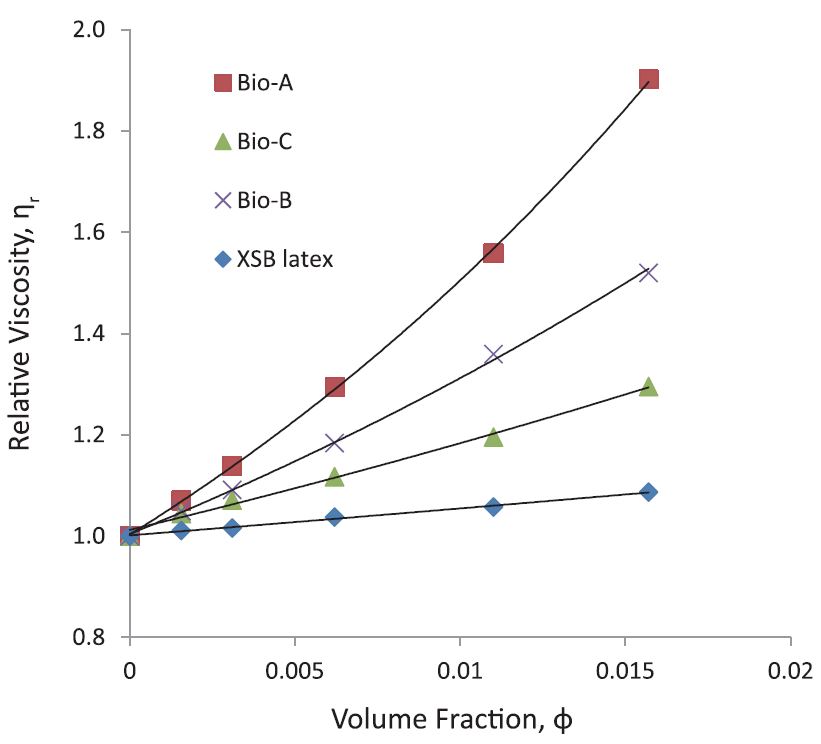
Table 2.
The regression equations and R-squared values of starch nanoparticle latexes
| Bio-A | Bio-B | Bio-C | XSB latex 1 | |
|---|---|---|---|---|
| Regression Equation | y=1.0025e40.622x | y=1.0039e26.757x | y=1.0121e15.635x | y=1.0013e5.1696x |
| R-squared value | R2=0.9998 | R2=0.9990 | R2=0.9936 | R2=0.9947 |
The values in Table 3 represent the maximum volume swell ratio, SR(V), of the water-swollen starch latex nanoparticles at very low concentrations. The results in Table 3 follow an expected trend of increased swelling with lower crosslink densities. These results confirm the unique performance of crosslinked starch nanoparticles reported elsewhere. 7,10) First, their swelling under conditions of extreme dilution with water achieves the maximum swelling value, which is a balance between their elastic constraint due to their crosslinked network and osmotic pressure. Secondly, starch latex nanoparticles de-swell with increasing solids so that their dispersions can be made at higher solids.7,10)
3.2 Composite rheograms
Composite rheograms are constructed by combining the viscosity data obtained using a low shear stress rheometer, a Hercules “high” shear rheometer (relatively low to moderate shear), and ultra-high shear capillary and slit viscometers (ACAV) in Figs. 2-5.
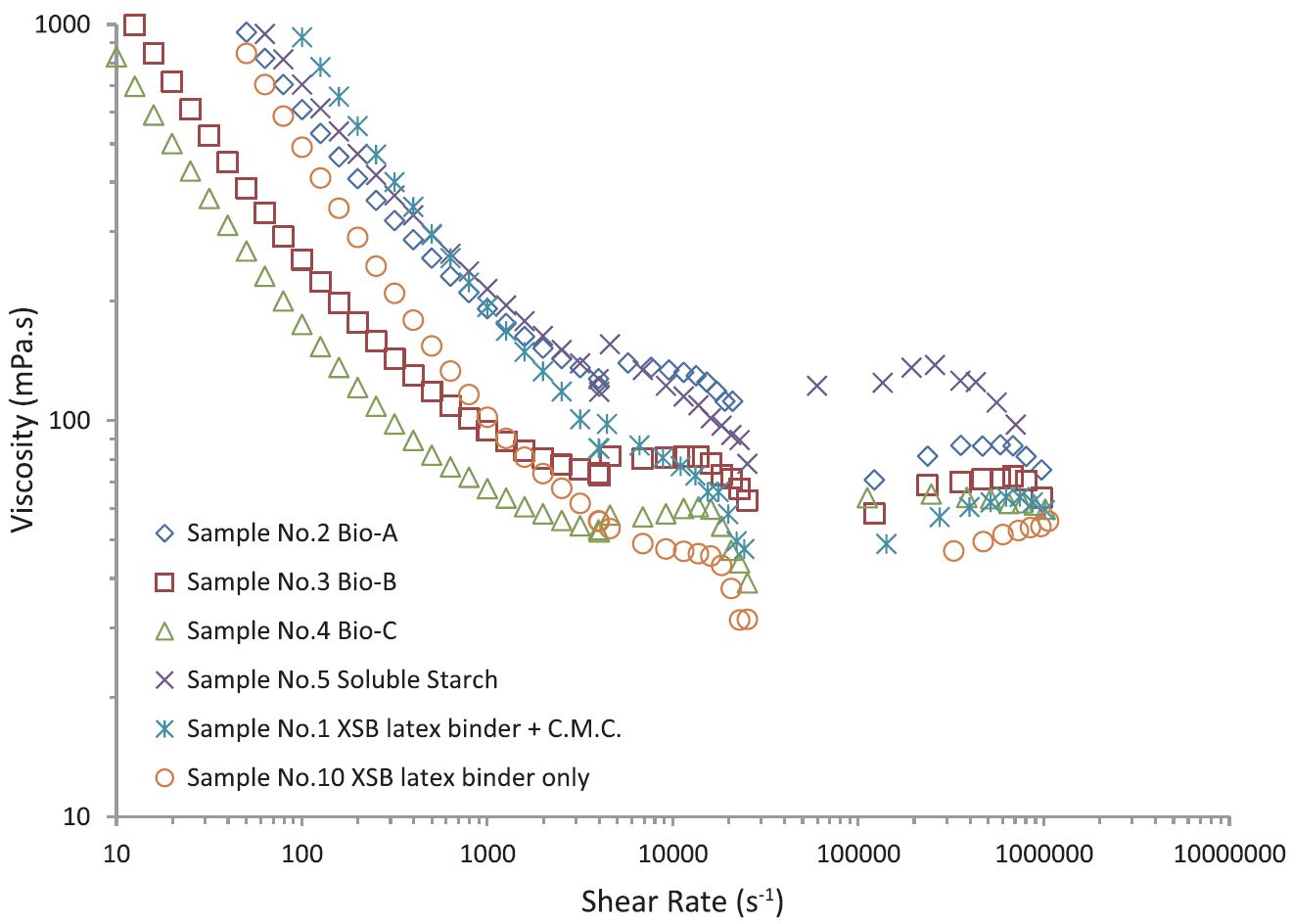
Fig. 2.
The composite rheograms of coating colors with 30% XSB replacement, along with all-XSB latex coating colors with and without CMC, using the capillary viscometer, (30% replacement, Capillary Viscometer).
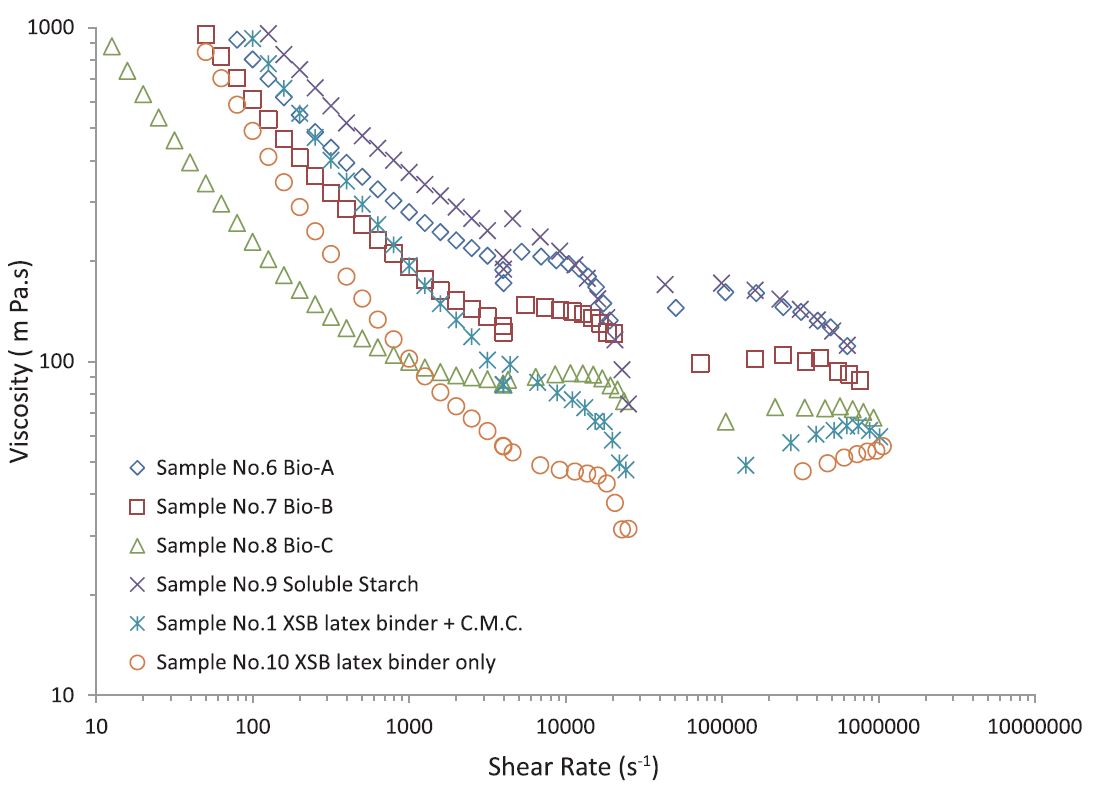
Fig. 3.
The composite rheograms of coating colors with 50% XSB replacement, along with all-XSB latex coating colors with and without CMC, using the capillary viscometer, (50% replacement, Capillary Viscometer).
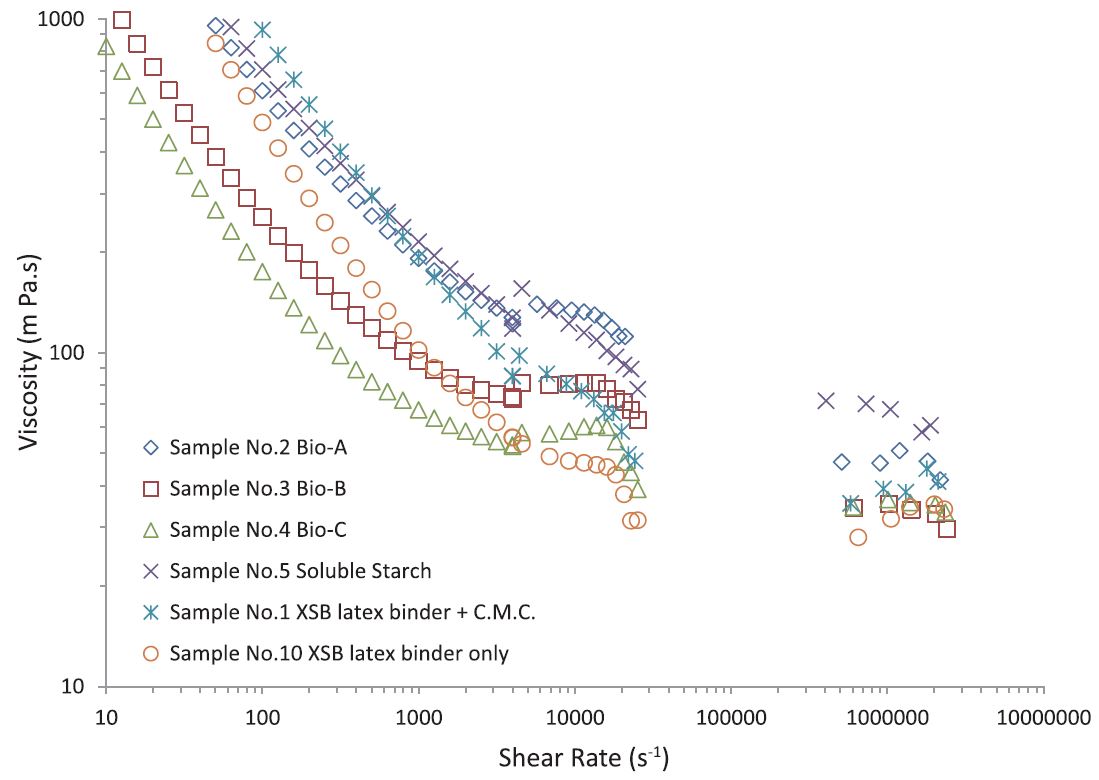
Fig. 4.
The composite rheograms of coating colors with 30% XSB replacement, along with all-XSB latex coating colors with and without CMC, using the slit viscometer, (30% replacement, Slit Viscometer).
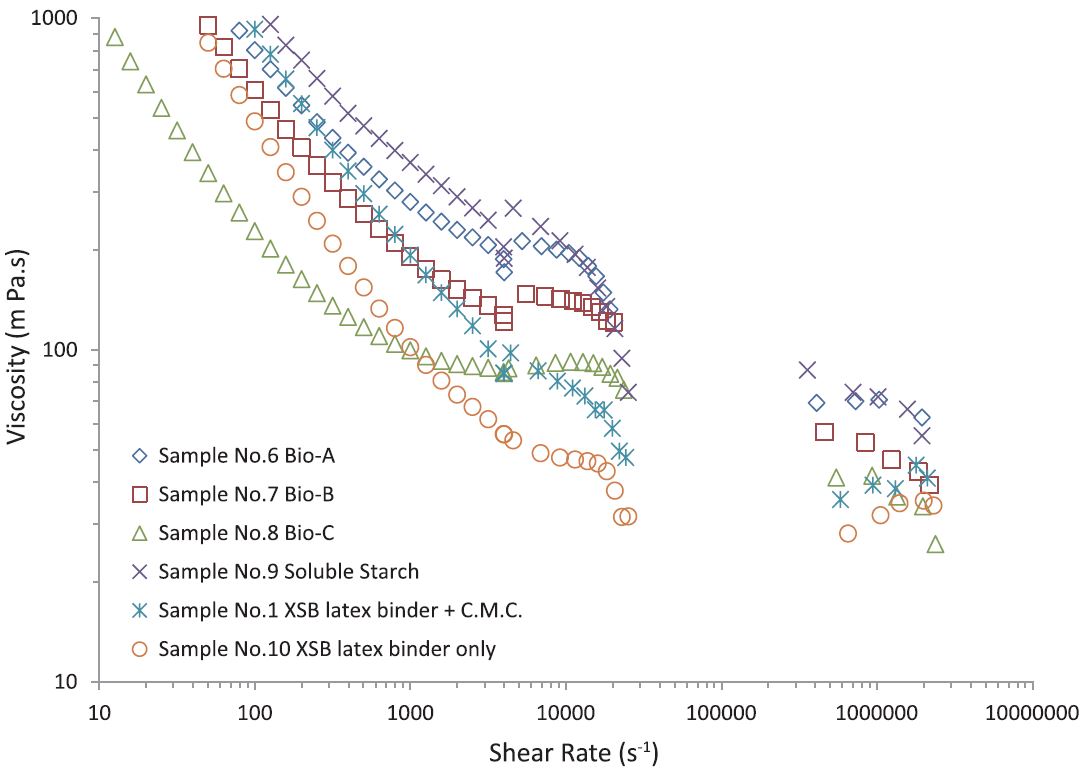
Fig. 5.
The composite rheograms of coating colors with 50% XSB replacement, along with all-XSB latex coating colors with and without CMC, using the slit viscometer, (50% replacement, Slit Viscometer).
It is interesting to note that all coating colors appear to be shear-thickening between ~30,000 and ~80,000 s-1, while their viscosities peaked between ~300,000 and ~600,000 s-1.
It appears that all coating colors at 50% replacement appear to be shear-thickening at lower shear rate ranges than those at 30% replacement, while their viscosities also peaked at the lower shear rate ranges. These changes can be explained by the higher viscosities of their medium phase excluding the hard particles such as XSB latex and pigment particles. It has been indeed found that the shear-thickening of dispersions increases with increasing medium viscosity due to the fact that aggregation of particles under shear increases with increasing medium viscosity.8) This will be discussed later in a generalized rheogram for high solids paper coatings over a wide range of shear rates.
The results from the ACAV are repeatable experimental values found from having repeated each experiment 3 times. The results reported are the average values. The shear thickening trend was observed in all of these measurements, regardless of whether the sample was run from low-high or high-low shear. As this is at a lower shear rate, turbulence effects are minimal with Reynold’s numbers well below the 2000 cut-off. Additionally, it should be noted that the ACAV is calibrated using water in between each run, and so the shear thickening (or dilatancy) is an observable trend relative to water.
From a theoretical standpoint, the key difference between hard particle latexes and soft bio-based latex is the deformability of the particles. At moderately high shear, hard latex particles, such as XSB, first align, which lowers the viscosity, explaining the shear thinning. As shear increases, the forces on the hard particles overcome the electrostatic repulsion of the double-layer, and agglomeration occurs. We correspondingly see a Newtonian plateau as the alignment of particles is in balance with aggregation-type effects. As shear rates increase, the interactions between particles continues to increase, and with aggregation the particles, the particles become more randomly arranged and dilatancy or shear-thickening occurs. Conversely, the bio-based “soft” latex particles are believed to exhibit shear-induced de-watering. Under high shear, the swollen particles deform by releasing water, thus lubricating the system and allowing better particle alignment and a smaller effective volume fraction. Consequently, these biobased latex particles show shear thinning properties over the entire measured range of shear rates.
3.3 Generalized rheogram for high solids paper coating colors over a wide range of shear rates
Based on composite rheograms shown in Figs. 2-5, as well as the fact that high solids dispersions of hard particles exhibit shear-thinning, and a Newtonian plateau, followed by shear-thickening over a wide range of shear rates, the following rheogram (Fig. 6) is proposed as a generalized rheogram for high solids paper coating colors.
The proposed generalized rheogram for high solids paper coating colors shows shear thinning, followed by an interim Newtonian plateau (between 1 and 2), subsequent shear-thickening (between 2 and 3), and shear thinning (from 3 and on), as shown in Fig. 6. The shear-thinning behavior of particle dispersions is due to either an ordered arrangement of particles and, a progressive disruption of aggregates by shear or the shear dependence of electro-viscous effects and electric double layer repulsion, while their shear-thickening behavior is attributed to either a disruption of ordered particle arrangement or a progressive increase in shear-induced aggregation of particles. The shear rate at the onset of shear-thickening behavior (e.g., at 2 in Fig. 6) coincides with the critical shear rate for shear-induced aggregation or coagulation of particles, when the hydrodynamic compressive force between the colliding particles surpasses their repulsive force (Eq. 4):
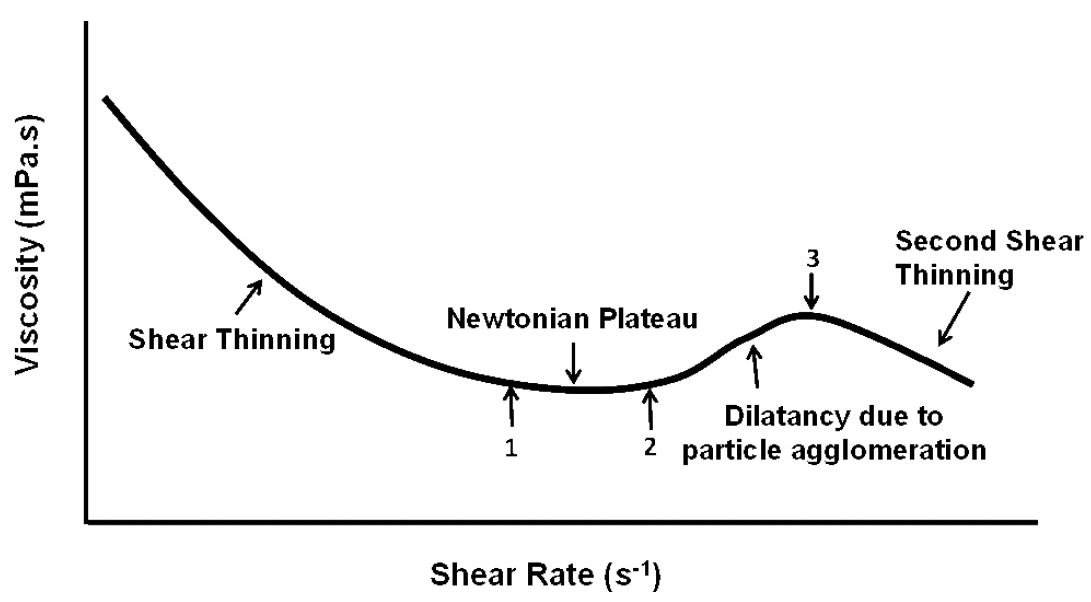
Fig. 6.
A generalized rheogram for high solids paper coating colors over a wide range of shear rates.
where FH is the average hydrodynamic compressive or shearing force between two particles of radius a, ηo the medium viscosity, Ho the distance between two colliding particles, and γ the shear rate.14)
For small separations (Ho << a), the hydrodynamic force equation becomes FH = 6 ηoa2γ. As shown in Figs. 2-5, the shear-thickening and maximum viscosity of coating colors occur at lower shear rates with corresponding higher medium viscosity due to the greater hydrodynamic compressive forces. The occurrence of geometric dilatancy, when the packing volume fraction of the aggregated dispersion under shear becomes lower than its volume fraction, increases with increasing extent of shear-thickening behavior and concentration. It is speculated that the point 3 in Fig. 6 is very close to the onset of geometric dilatancy, but since the volume expansion is somewhat prohibited in the confined geometry of the ACAV capillary, the onset of dilatancy turns into the onset of the second shear-thinning.
4. Conclusions
The unique characteristics and properties of starch latex binders for paper coating were presented. While low shear Brookfield and Hercules rheograms are commonly used in the industry to assess the runnability of coatings, these results demonstrate that such low shear techniques can be extremely misleading when it comes to the prediction of coating performance on high speed metered size press, rod and blade coaters. The use of more specialized “ultra-high” shear equipment such as the ACAV might be needed to better understand the rheological properties under true coating conditions. The unique characteristics of starch based latex binders were found to be attributed to the fact that they are made up of water- swollen internally crosslinked nanoparticles, which depending on their crosslink densities have varying degree of water swelling. The swell ratio determined for various experimental grades of internally crosslinked starch nanoparticle based latexes correlated systematically with the degree of crosslinking and rheological performance. Although the internally crosslinked starch nanoparticle latex samples are equal to or greater than their 50% XSB latex counterpart in their effective volumes, they are shear-thinning, unlike their XSB counterpart, which exhibits shear thickening behavior. These findings enable starch latexes to meet low and high shear rheological requirements for better paper coating runnability by controlling their crosslink densities. The results presented here demonstrate that these nanoparticles can in principle outperform conventional cooked coating starches as well as petro-latex binders in terms of fundamental rheological properties and practical high speed coating runnability performance.