


1. Introduction
2. Materials and Methods
2.1 Materials
2.2 Preparation of coating suspensions
2.3 Characterization of coating suspensions and films
2.4 Evaluation of fruit quality during storage
2.5 Statistical analysis
3. Results and Discussion
3.1 Characteristics of coating suspensions
3.2 Rheological properties of coating suspensions
3.3 Storage quality of bananas
4. Conclusions
1. Introduction
Fresh fruits and vegetables continue to respire and undergo metabolic processes after harvest, leading to quality deterioration during storage and distribution [1]. Bananas (Musa spp.) are climacteric fruits that exhibit increased respiration and metabolic activity during postharvest ripening, characterized by conversion of starch into soluble sugars and organic acid metabolism. These physiological changes are associated with peel color alterations and tissue softening, and extended storage leads to further quality decline, including browning and decay [2,3,4]. Consequently, postharvest strategies are essential for delaying ripening and preserving banana quality during storage. Various treatments have been employed to enhance banana storability, such as low-temperature storage, controlled-atmosphere (CA) storage, modified-atmosphere (MA) packaging, ripening regulators such as 1-methylcyclopropene (1-MCP), and surface coatings [2,5,6,7,8]. These approaches aim to retard ripening and quality deterioration by regulating storage temperature and atmospheric gas composition or by inhibiting ethylene action. However, low-temperature and atmosphere-control technologies require continuous maintenance of specific environmental conditions during storage and distribution, and the efficacy of ripening regulators can vary depending on treatment protocols and application methods.
Edible coating is a postharvest treatment that involves applying a thin film to the fruit surface to regulate mass transfer between the fruit and the external environment. This film functions as a physical barrier, mitigating moisture loss and the exchange of oxygen and carbon dioxide, thereby helping to preserve quality during respiration and ripening [1,5]. To ensure the formation of a uniform and reproducible edible coating, careful selection of coating materials, as well as optimization of the coating suspension properties and application techniques, are essential. Common application methods include dipping, brushing, and spraying. Dipping presents a risk of cross-contamination due to reuse of the treatment solution, whereas brushing may be limited by processing efficiency and coating uniformity [1,9]. In contrast to dipping and brushing, spray coating offers the advantages of reducing contamination of the coating solution and facilitating control over the amount of coating solution used [9]. However, inadequate dispersion stability of the coating suspension in the supply reservoir can lead to sedimentation of solids during spraying, resulting in variations in solids concentration over time and non-uniform layer deposition [10]. The suspension must exhibit sufficient flowability for atomization while maintaining low-shear viscosity and viscoelasticity post-deposition to minimize drainage from the fruit surface [11,12]. Thus, effective spray coating relies on stable dispersion and rheological properties optimized for both spraying and coating retention.
To meet these requirements for spray applications, formulations based on natural polymers, including cellulose, starch, pectin, and carrageenan, have been widely used as edible coating materials owing to their ability to form films or coatings that preserve fruit quality during storage [1]. Among these, cellulose nanofiber (CNF) is a fibrous biomaterial featuring numerous hydroxyl (-OH) groups on its surface. Through inter-fiber hydrogen bonding, physical contact, and entanglement, CNF contributes to favorable gas-barrier properties and influences the viscosity and viscoelastic behavior of suspensions [13]. Carrageenan, a water-soluble polysaccharide containing sulfate ester groups (-OSO3−), becomes sufficiently hydrated and dispersed upon heating to form a homogeneous solution. Cooling induces the formation of a continuous polymer matrix, with κ-carrageenan capable of developing a network via conformational transitions and chain associations [14]. Upon blending, the fibrous CNF structure disperses within the carrageenan matrix and serves as a reinforcement phase, with hydrogen bonding and physical interactions, primarily between the hydroxyl groups of the two polysaccharides, contributing to the formation of a composite network [14,15]. The stability of this network is highly dependent on the specific formulation of the suspension [10,13].
However, suspensions composed solely of CNF and carrageenan may exhibit insufficient network stability, allowing fiber migration and aggregation under quiescent conditions, which can lead to sedimentation. Consequently, additional reinforcement is necessary to enhance the stability of the CNF/carrageenan matrix. Chitin, a fibrous natural polysaccharide containing hydroxyl and acetamide (-NHCOCH3) groups, can influence network structure and rheology when blended with CNF through noncovalent interactions, including hydrogen bonding and physical entanglement [16]. Chitin fibers can also form intermolecular hydrogen bonds with the carrageenan matrix, thereby introducing supplementary interactions that reinforce the CNF/carrageenan network [17]. Incorporation of chitin into CNF/carrageenan-based coatings can restrict polymer migration and aggregation within the suspension, suppress sedimentation under quiescent conditions, and promote more uniform deposition during spray application [16,17]. The structural modifications induced by chitin are expected to affect dispersion stability and viscoelastic properties by limiting molecular and fiber mobility within the suspension [16].
Previous investigations have elucidated the structural and rheological properties of carrageenan/chitin or CNF/chitin combinations, as well as the potential applications of cellulose- and biomass-derived fibrous materials as fruit-preservation coatings [12,16,17,18]. Nonetheless, research directly linking chitin-induced modifications in the dispersion stability and rheological behavior of CNF/carrageenan-based coating suspensions to spray-application performance, coating-layer formation on banana surfaces, and subsequent storage quality remains scarce. To address this gap, CNF, which provides a fibrous network, and carrageenan, which forms a continuous polymer matrix, were employed as the base materials, with chitin incorporated as a reinforcing agent to enhance the stability and structural integrity of the CNF/carrageenan matrix. The aims of this study were to investigate the influence of chitin content on the sedimentation behavior and rheological properties of the coating suspensions and to evaluate their feasibility as sprayable edible coatings by analyzing coating-layer formation on banana surfaces and assessing changes in appearance, color, firmness, and internal quality during storage.
2. Materials and Methods
2.1 Materials
The CNF and phosphorylated chitin fibers used in this study were obtained from a commercial supplier. The CNF isolation process followed Han et al. [19]. Briefly, E. cottonii was extracted in water at 120°C for 3 h with sulfuric acid (0.5% of dry algae weight). Residual solids were separated using a 200-mesh copper screen (75 µm pores) and thoroughly washed with tap water. The residues were then bleached in two stages: first with chlorine dioxide (5% active chlorine dioxide by dry residue weight, pH 3.5, 80°C, 60 min), followed by hydrogen peroxide (5% active hydrogen peroxide by dry residue weight, initial pH 12, 80°C, 60 min). Finally, the bleached solids were thoroughly washed with water using the 200-mesh screen. The resulting CNF dispersion contained approximately 8–9% solids, with fiber lengths of 100–200 µm and a width of approximately 200 nm. Food-grade κ-carrageenan was provided by AMJ, Indonesia, and had a molecular weight of 400–600 kDa and a sulfate content of 20–25%. Chitin fibers were produced from red snow crab shells through demineralization, deproteinization, sodium hypochlorite bleaching, drying, phosphorylation at 140°C, and fibrillation using a high-speed mixer and homogenizer. The chitin fiber dispersion contained approximately 1–2% solids, and the fibers had a width of approximately 30 nm and lengths of 500–600 nm.
2.2 Preparation of coating suspensions
CNF was dispersed in distilled water to attain a concentration of 0.5 wt%, followed by stirring at 500 rpm for 30 minutes using a magnetic stirrer. Separately, carrageenan was dissolved in distilled water to achieve a concentration of 0.5 wt%, then heated and stirred at 85°C and 500 rpm for 30 minutes to ensure complete dispersion. The carrageenan solution was subsequently combined with the CNF suspension and stirred at 500 rpm for 1 hour to form the CNF/carrageenan-based coating suspension. For the coating suspensions designated 0.5CT and 1.0CT, chitin was added to the CNF/carrageenan mixture to reach final concentrations of 0.5 and 1.0 wt%, respectively, based on the final coating suspension, to compare the effects of increasing chitin content on the dispersion stability and rheological properties of the coating suspensions. The suspensions were then stirred for an additional 1 h at 85°C and 500 rpm. The resulting coating suspensions were sealed in sterile specimen bottles and stored at 7 ± 1°C until further characterization and application. The suspension without chitin was designated as 0CT, whereas those containing 0.5 and 1.0 wt% chitin were designated as 0.5CT and 1.0CT, respectively. The chitin concentrations of 0.5 and 1.0 wt% were selected with reference to a previous study reporting concentration-dependent rheological behavior in chitin nanofiber dispersions [20]. These concentrations were used to compare changes in dispersion stability and rheological properties rather than to identify an optimal formulation.
2.3 Characterization of coating suspensions and films
2.3.1 Chemical characterization
Fourier transform infrared (FT-IR) spectroscopy (IRTracer-100, Shimadzu, Japan) was employed to characterize the chemical properties of the prepared coating suspensions and to investigate the functional groups and assess spectral changes associated with interactions among the constituents. The coating suspensions were dried to prepare film specimens, and spectra were acquired in attenuated total reflectance (ATR) mode within the 4,000–500 cm-1 range.
2.3.2 Sedimentation stability
To investigate the sedimentation behavior of CNF/carrageenan-based suspensions as a function of chitin concentration, 10 mL aliquots were transferred into vials and stored at 25 ± 1°C for 3 days. The sedimentation index (SI) was determined by measuring the height of the settled solids at 10-minute intervals and calculating it using Eq. (1).
where is the total height of the suspension, and is the height of the sedimented suspension layer after settlement. In cases where no sedimentation occurs, is set equal to for the calculation of the SI.
2.3.3 Rheological characterization
The rheological properties of the coating suspensions were characterized at 25°C using a hybrid rheometer (Discovery HR-10, TA Instruments, USA). Measurements were conducted with a 20 mm parallel-plate geometry at a 200 µm gap. Strain sweeps at 10 rad/s over a strain range of 0.1–100% were performed to identify the linear viscoelastic region (LVER). Viscosity was assessed in flow-sweep mode over a shear rate range of 0.1–1,000 s-1. Frequency sweeps within the LVER were carried out at 0.5% strain across an angular frequency range of 0.1–120 rad/s to determine the storage modulus (G′), loss modulus (G″), and tan δ.
2.3.4 Morphological characterization
Films were prepared by solution casting for morphological characterization. Eight grams of each coating suspension were dispensed into a 90-mm-diameter Petri dish and dried at 50°C for 2 hours and 30 minutes. Following drying, the films were peeled from the dishes, and their surface and cross-sectional morphologies were examined using field-emission scanning electron microscopy (FE-SEM; JSM-7900F, JEOL, Japan). For SEM observation of the banana peel, peel samples were cut into approximately 1 × 1 cm pieces and freeze-dried. For cross-sectional observation, the dried peel samples were sectioned using a sharp cutter blade. The samples were mounted on SEM stubs using carbon double-sided adhesive tape, sputter-coated with Pt, and subsequently observed by FE-SEM.
2.4 Evaluation of fruit quality during storage
2.4.1 Application of coating suspensions
Prior to coating application, the bananas were surface-sanitized with a 300 mg L-1 sodium chlorite (NaClO2) solution for 1 min at room temperature [21]. Then the bananas were rinsed with tap water. Excess surface water was gently removed, followed by air-drying for approximately 2 h at 25°C and 50% relative humidity (RH). The uncoated control bananas underwent the same sanitization, rinsing, and drying procedures as the coated samples. The coating suspensions were applied using a multi-spray coater (HANTECH, Daejeon, Rep. Korea) with a 0.5 mm spray nozzle. The spray speed, distance, and pressure were set to 25 mm/s, 150 mm, and 30 kPa, respectively. Under these conditions, the apparent shear rate at the nozzle was estimated to be approximately 49,099 s-1. Although this value exceeded the measurement limit of the rheometer, the pronounced shear-thinning behavior of all coating suspensions suggests a substantial reduction in viscosity at this high shear rate. This reduction in flow resistance facilitated smooth extrusion and effective atomization through the spray nozzle. Meanwhile, the higher low-shear viscosity and elastic response may help reduce drainage after deposition. A total volume of 40 mL of coating suspension was used per treatment group, applying one spray pass to each side of nine bananas to ensure complete coverage of the peel surface. Post-application, the coated bananas were dried at 25°C for 6 hours prior to subsequent storage quality assessments.
2.4.2 Storage conditions and experimental design
Uncoated bananas were analyzed on day 0 prior to coating application to establish the initial quality parameters. Coatings were prepared with 0.5 wt% CNF, 0.5 wt% carrageenan, and chitin at concentrations of 0, 0.5, or 1.0 wt%, designated as 0CT, 0.5CT, and 1.0CT, respectively. The uncoated control group received no coating suspension, whereas 0CT represented the CNF/carrageenan coating without chitin. Three individual bananas were used for each treatment at each storage period (n = 3), with each banana considered an independent experimental replicate. Non-destructive measurements, including color evaluation, were performed first, followed by destructive measurements. Firmness was measured before soluble solids content (SSC) and acidity were determined using juice extracted from the banana pulp. Repeated measurements on the same banana were averaged to obtain a representative value for each sample. Both uncoated and coated bananas were stored at 25°C and 50% RH. Storage quality was evaluated at 4-day intervals over a 12-day storage period, corresponding to days 0, 4, 8, and 12.
2.4.3 Appearance and color changes
Changes in peel color during storage were evaluated using a colorimeter (Color Reader CR-20, Konica Minolta, Japan) by measuring the L*, a*, and b* values of the coated banana peel surface. L* represents lightness, a* represents red-green chromaticity, and b* represents yellow-blue chromaticity, whereas ΔE represents the overall magnitude of color change. ΔE was calculated relative to the day-0 values using the following Eq. (2).
2.4.4 Firmness evaluation
Changes in banana firmness during storage were assessed using a CTX Texture Analyzer (AMETEK Brookfield, USA) equipped with a 2-mm cylindrical probe (TA39). Firmness measurements were conducted three times at identical locations on each sample, and the mean value was derived from nine replicate measurements per condition.
2.4.5 Soluble solids content and acidity
The variations in SSC and acidity during storage were assessed using juice extracted from the samples. Following peel removal, the banana pulp was placed in a filter bag and compressed to extract the juice. SSC and acidity were measured using a portable Brix/Acidity meter (PAL-BX/ACID, ATAGO, Japan). Mean values were calculated for each treatment group, along with the changes relative to the initial measurement (day 0).
2.5 Statistical analysis
All experiments were conducted in at least three replicates. The effects of coating treatment, storage time, and their interaction were analyzed using two-way analysis of variance (ANOVA), followed by Fisher’s Least Significant Difference (LSD) test. Statistical significance was set at p < 0.05. Different lowercase letters denote significant differences among treatments within the same storage duration, while different uppercase letters denote significant differences among storage durations within the same treatment.
3. Results and Discussion
3.1 Characteristics of coating suspensions
FT-IR spectroscopy was employed to characterize spectral changes associated with the incorporation of chitin into the CNF/carrageenan-based coatings subsequent to chitin incorporation and to identify the predominant functional groups in each constituent. Fig. 1a displays the FT-IR spectra of CNF/carrageenan coatings with varying chitin content. All samples demonstrated common absorption bands at approximately 3,260, 2,895, and 1,231 cm-1. The broad band near 3,260 cm-1 is attributed to O-H stretching vibrations in polysaccharides such as CNF and carrageenan, indicating hydroxyl groups capable of hydrogen bonding within the matrix. The peak near 2,895 cm-1 corresponds to aliphatic C-H stretching vibrations characteristic of polysaccharides [22]. The band at 1,231 cm-1 is associated with S=O stretching vibrations of sulfate ester groups in carrageenan [23]. The presence of this band in all coatings (0CT, 0.5CT, and 1.0CT) was consistent with the presence of carrageenan. In the films containing chitin (0.5CT and 1.0CT), absorption features indicative of chitin’s amide groups were detected near 1,621 cm-1. This region corresponds to the amide I vibration of chitin; however, it may partially overlap with O-H bending vibrations of adsorbed water and other polysaccharide components. In CNF films, hydroxyl (-OH) groups are involved in water adsorption, and the H-O-H bending band near 1,640 cm-1 increases with ambient humidity. Since water adsorption influences the broader 1,740–1,618 cm-1 range, the band at 1,621 cm-1 was assigned to an overlap of the amide I vibration of chitin and the bending vibration of adsorbed water. Relative intensity changes in this region for 0.5CT and 1.0CT compared to 0CT indicate enhanced contributions from chitin-derived amide groups, supporting the incorporation into the CNF/carrageenan matrix [17,24]. Hydroxyl groups in CNF and carrageenan and acetamide groups in chitin are capable of participating in hydrogen-bonding interactions, and hydrogen bonding and physical fiber entanglement between CNF and nanochitin have been reported [15,16]. Therefore, the FT-IR results support the incorporation of chitin into the CNF/carrageenan matrix and the presence of functional groups capable of such interactions, rather than directly demonstrating an increase in hydrogen bonding.
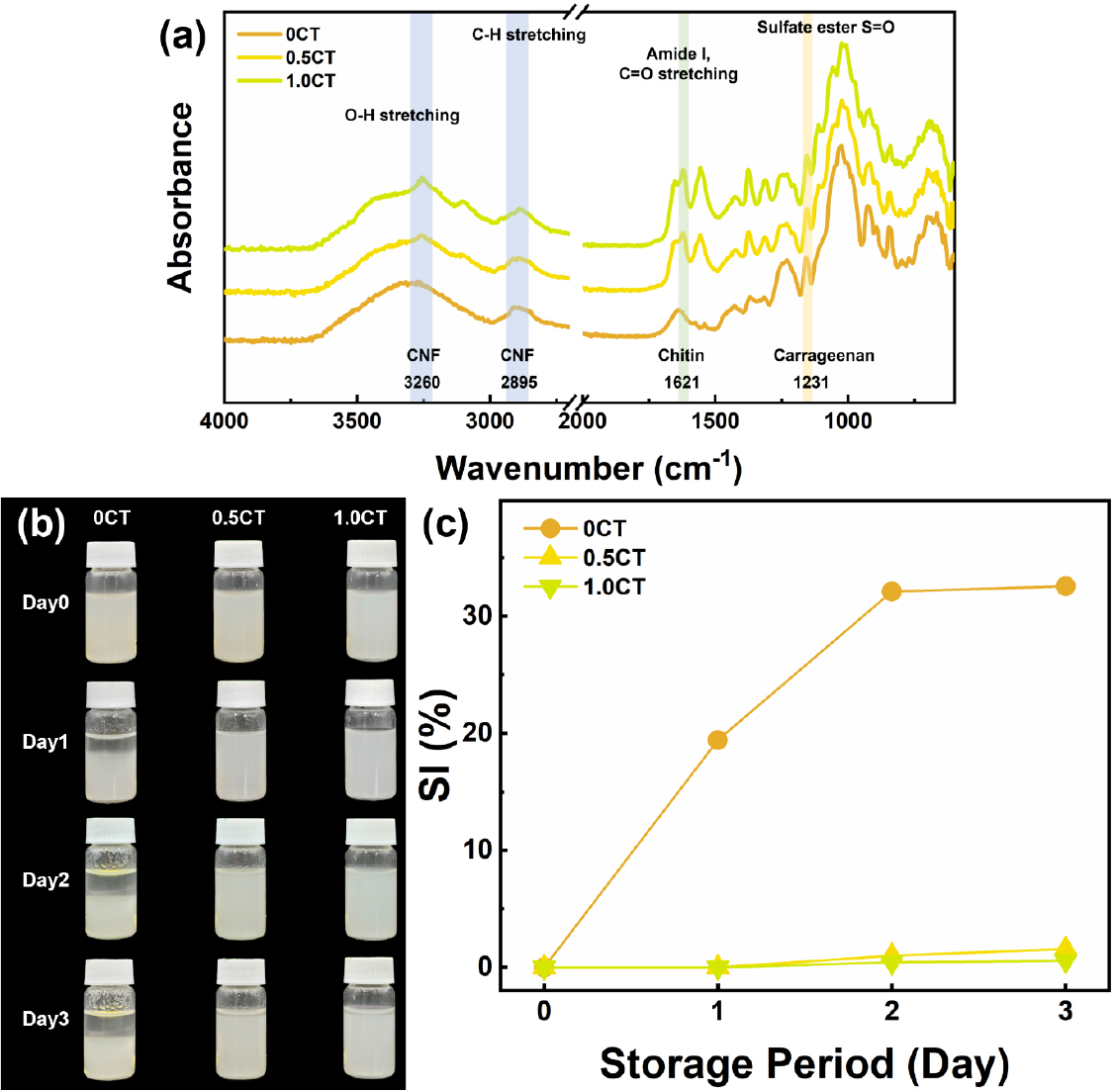
Sedimentation behavior was subsequently examined to assess the influence of component combination on the physical stability of the coating suspensions. Fig. 1b and c illustrate the visual sedimentation behavior and the variation in SI over time, respectively. The SI of 0CT increased progressively, reaching 30.78% after three days, whereas supernatant formation was minimal in 0.5CT and 1.0CT, with SI values of only 1.16% and 0.77%, respectively. Sedimentation in suspensions depends on factors including particle or aggregate size and interparticle network strength. In 0CT, relatively weak physicochemical interactions between CNF and carrageenan may have been inadequate to restrict aggregate movement, leading to increased sedimentation under gravity. Conversely, in 0.5CT and 1.0CT, chitin fibers can form additional interactions with CNF and carrageenan, enhancing hydrogen bonding and fiber entanglement. These chitin-mediated interactions are understood to restrict polymer and fiber mobility, strengthen network stability, and minimize sedimentation [16,17]. However, the increase in total solids accompanying chitin addition may also have contributed to the observed changes in suspension stability; therefore, the reduced sedimentation cannot be attributed solely to chitin-mediated reinforcement. Improved dispersion stability benefits spray application by minimizing time-dependent changes in suspension composition and enabling more uniform coating deposition. Since chitin-induced modifications in network structure can also influence rheological behavior and post-application structural integrity, their rheological properties were further characterized.
3.2 Rheological properties of coating suspensions
The rheological characteristics of CNF/carrageenan-based coating suspensions are important because they provide information on flow behavior associated with spray application to fruit surfaces. Effective spray application requires adequate flowability for atomization while ensuring the suspension resists drainage and maintains structural integrity post-deposition. Accordingly, the flow behavior and viscoelastic structural changes of the suspensions were systematically evaluated [13]. Fig. 2a depicts the variations in storage modulus (G′) and loss modulus (G″) as a function of strain. An amplitude sweep was conducted to identify the LVER, within which the viscoelastic properties can be reliably assessed without disrupting the sample’s internal structure. Across all suspensions, G′ and G″ remained relatively invariant up to a strain of 0.2–1.0%, indicating preservation of the internal network within this strain range [13]. Subsequent frequency sweep tests were performed at 0.5% strain within the LVER. At strains exceeding the LVER, both G′ and G″ decreased, suggesting a progressive weakening of the network structure. The measured shear-rate range should not be interpreted as a direct reproduction of the shear conditions inside the spray nozzle, because the actual nozzle shear rate depends on factors such as nozzle geometry, flow rate, pressure, and fluid viscosity. Accordingly, the shear-thinning behavior provides indirect evidence of flowability during spraying, while the higher low-shear viscosity may help reduce drainage after deposition; excessive viscosity, however, could affect atomization.
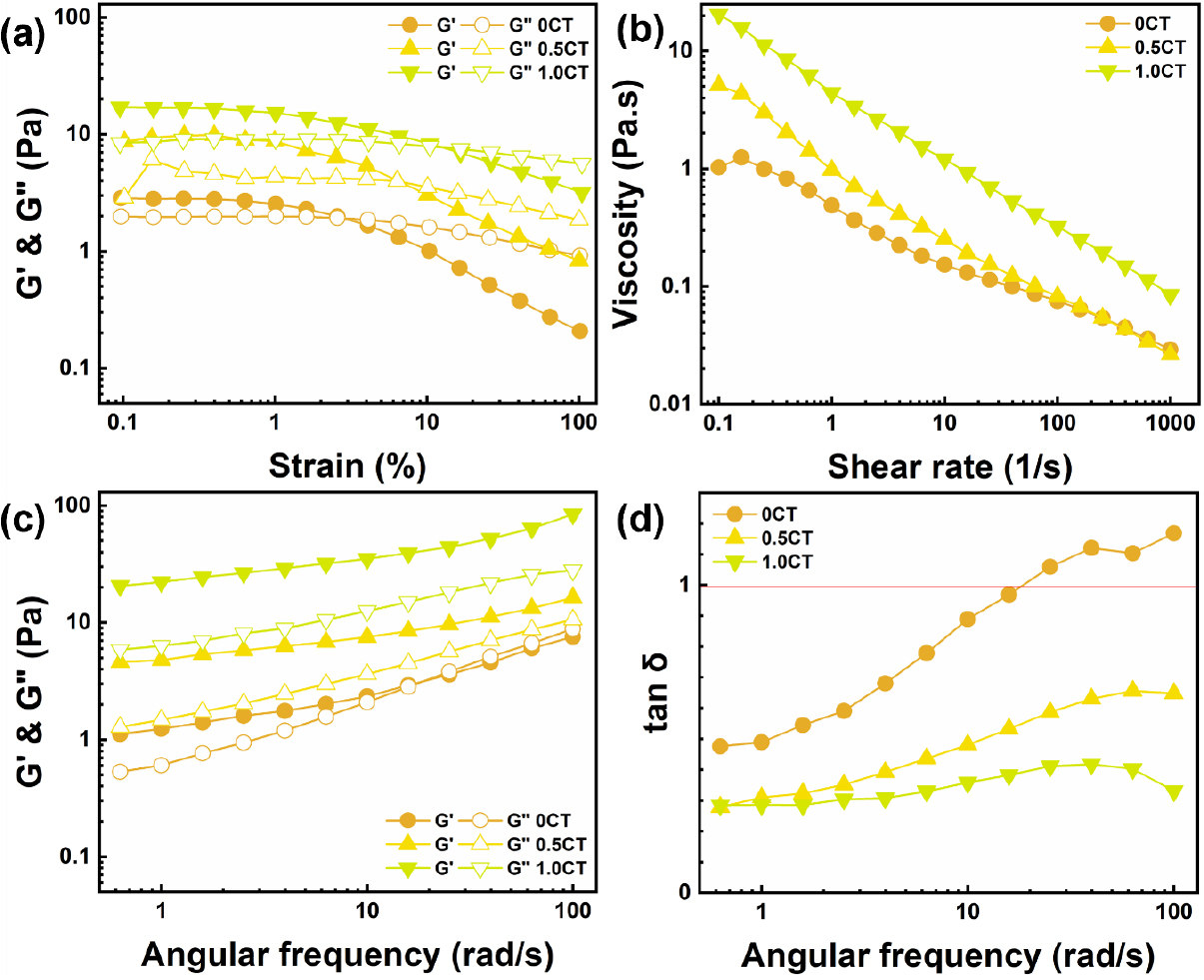
Fig. 2b depicts the viscosity of the coating suspensions as a function of shear rate. All coatings demonstrated shear-thinning behavior, characterized by a decrease in viscosity with increasing shear rate. This phenomenon is primarily attributed to partial disruption of the polymer-chain/fiber network formed under quiescent or low-shear conditions and to the alignment of CNF, chitin fibers, and carrageenan chains in the flow direction, which reduces flow resistance. The 1.0CT exhibited the highest viscosity across the entire shear-rate range. Notably, within the low-shear region (0.1–10 s-1), viscosity decreased in the order: 1.0CT > 0.5CT > 0CT. The elevated low-shear viscosity of chitin-containing coatings is linked to stronger internal network formation resulting from enhanced interactions among coating components and greater physical entanglement of fibers. As shear rate increased, the difference in viscosity between 0.5CT and 0CT diminished due to partial disruption of interfiber hydrogen bonds and physical entanglements under high shear, as well as flow-induced component alignment, which mitigated the structural differences imparted by chitin addition in 0.5CT. Conversely, 1.0CT maintained a relatively high viscosity even under high shear conditions, indicating the persistence of the more robust internal network formed at higher chitin concentrations. This shear-thinning behavior across all coatings is advantageous for ensuring flowability during passage through spray nozzles, while the higher low-shear viscosity of chitin-containing coatings may help prevent excessive flow on fruit surfaces post-spraying. No nozzle clogging was observed during the spray application of any coating suspension under the tested conditions. However, droplet size, spray pattern, and atomization efficiency were not quantitatively evaluated; therefore, the observed rheological behavior and successful spray application do not establish improved sprayability.
Fig. 2c illustrates the variations in G′ and G″ as a function of angular frequency. During a frequency sweep, the high-frequency region indicates rapid deformation over short time scales, while the low-frequency region reflects structural response over longer time scales. For the 0CT sample, G′ exceeded G″ at angular frequencies below 10 rad/s, indicating a weak elastic network; however, the magnitude of G′ is lower compared to coatings with chitin. As the angular frequency increases, a crossover occurs where G″ exceeds G′, indicating that the network formed solely by CNF and carrageenan has a limited ability to maintain its structure over an extended frequency range [11]. Conversely, both 0.5CT and 1.0CT maintain G′ surpassing G″ across the entire measured frequency spectrum, indicating that the chitin-containing suspensions maintained predominantly elastic behavior across the measured frequency range. Notably, 1.0CT exhibits the highest G′ throughout the measurement range, which is attributed to chitin fibers serving as additional junction points between CNF and carrageenan, thereby enhancing hydrogen bonding and physical entanglements between fibers. This restricts polymer chain mobility and fiber movement [16,17]. Since the minimum angular frequency tested was 0.1 rad/s, interpretations regarding long-term dispersion stability under quiescent conditions should incorporate SI results rather than relying solely on the frequency sweep data.
The tan δ results presented in Fig. 2d provide complementary information on the relative relationship between G′ and G″. tan δ, defined as G″/G′, indicates that values below 1 correspond to predominantly elastic behavior, whereas values above 1 indicate viscous dominance. Consequently, the viscoelastic structure should be evaluated considering both the magnitude of G′ and the ratio of G′ to G″. For 0CT, tan δ increased with angular frequency and surpassed 1 at frequencies above approximately 30 rad/s, indicating a shift toward viscous behavior under rapid dynamic deformation. In contrast, for 0.5CT and 1.0CT, tan δ remained below 1 throughout the measured frequency range, reflecting a stable elastic-dominated structure in the chitin-containing coatings under external stress. This elastic-dominant behavior is attributed to the enhanced structural integrity conferred by hydrogen bonding and physical entanglement among chitin, CNF, and carrageenan [13,17]. All coatings demonstrated shear-thinning behavior, which is advantageous for maintaining flowability through spray nozzles under high shear conditions. Compared to 0CT, the chitin-containing coatings showed higher low-shear viscosity and a more elastic-dominant behavior across the measured frequency spectrum. These characteristics help prevent excessive flow on banana peels and maintain structural integrity after spraying. Notably, the 1.0CT exhibited the highest low-shear viscosity and G′ values. When considered together with the sedimentation stability data, these results indicate that 1.0CT exhibited rheological and dispersion characteristics that may be favorable for spray application among the formulations evaluated in this study.
3.3 Storage quality of bananas
3.3.1 Coating layer on banana peel
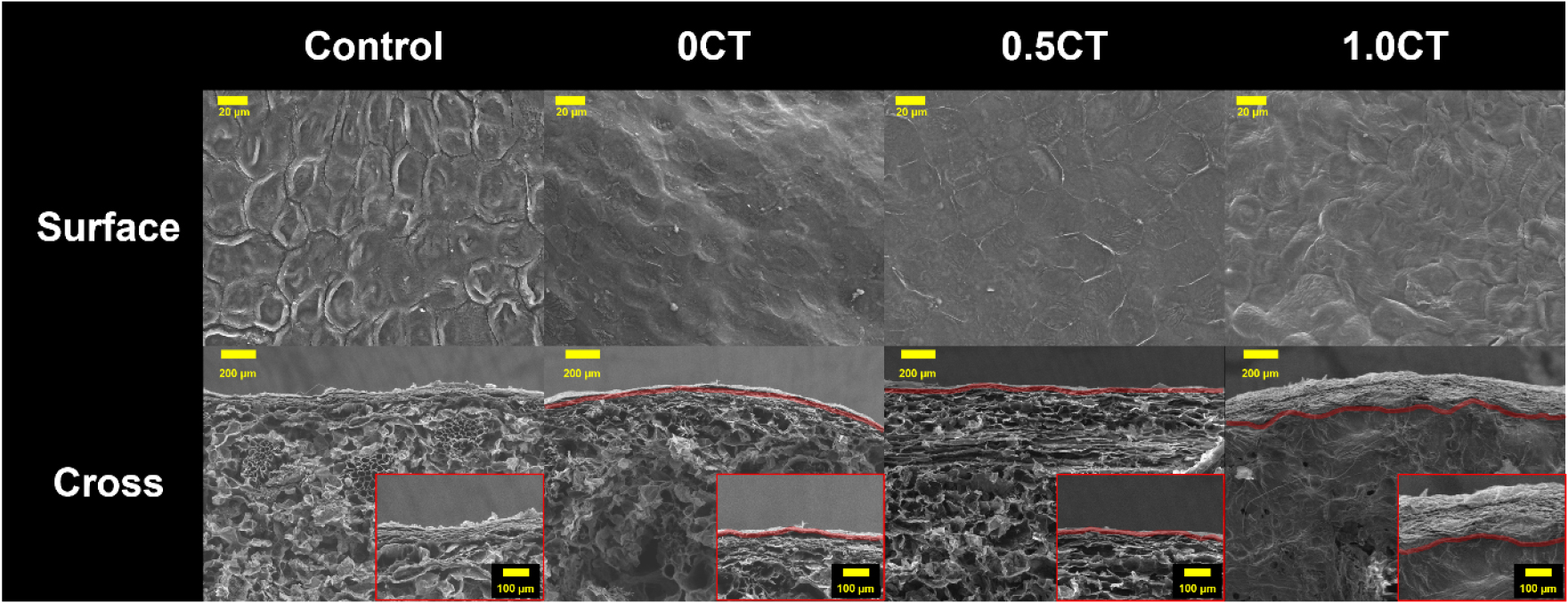
Surface and cross-sectional morphologies were examined by SEM to determine whether the dispersion stability and rheological properties of the coating suspensions influenced the formation of coating layers on banana peel surfaces. The results are depicted in Fig. 3. Surface images revealed that the uncoated bananas exhibited the characteristic irregular microstructure and surface undulations typical of banana peel. Conversely, treatments with 0CT, 0.5CT, and 1.0CT exhibited comparatively smoother surfaces, indicating that the coating material covered the peel’s irregularities. Among the coated samples, the 1.0CT surface appeared relatively rougher than the 0.5CT surface. This difference may be associated with the increased chitin and total solids contents, which could have promoted local aggregation or surface heterogeneity during drying. The surface smoothness of coated bananas resulted from the adhesion of the coating suspension to the peel via the fibrous structures of CNF and chitin, as well as the film-forming properties of carrageenan, which upon drying formed a continuous polymer matrix [5,25]. Cross-sectional SEM images clearly showed coating-layer boundaries and thicknesses that were distinct from those of the uncoated peel, with layers along the peel contours. Quantitative measurements indicated coating-layer thicknesses of 2.15 ± 1.57 µm, 3.66 ± 1.58 µm, and 4.92 ± 1.57 µm for the 0CT, 0.5CT, and 1.0CT treatments, respectively (n = 100). Although the mean coating-layer thickness increased numerically with increasing chitin content, no statistically significant differences were detected among the three coating treatments (p > 0.05). Because chitin was added at increasing concentrations without maintaining a constant total solids content, the effects of chitin addition cannot be fully separated from those associated with the increase in total solids content. Accordingly, the observed differences in rheological properties, sedimentation behavior, and coating-layer formation should be interpreted as combined formulation effects rather than effects attributable solely to chitin. This experimental design represents a limitation of the present study, as the specific effects of chitin could not be distinguished from those of increasing total solids content. Further studies using formulations with constant total solids content are needed to clarify the contribution of chitin to the observed properties. Differences in suspension rheology may nevertheless influence coating retention and layer formation during application and drying [9,16]. The favorable dispersion stability and viscoelastic properties of the coating suspensions contributed to the smooth surface and continuous coating layers in the SEM images. The formation of a continuous coating layer may contribute to a physical barrier on the banana peel, which could potentially limit moisture and gas transfer during storage [5,25].
3.3.2 Color of banana peel during storage
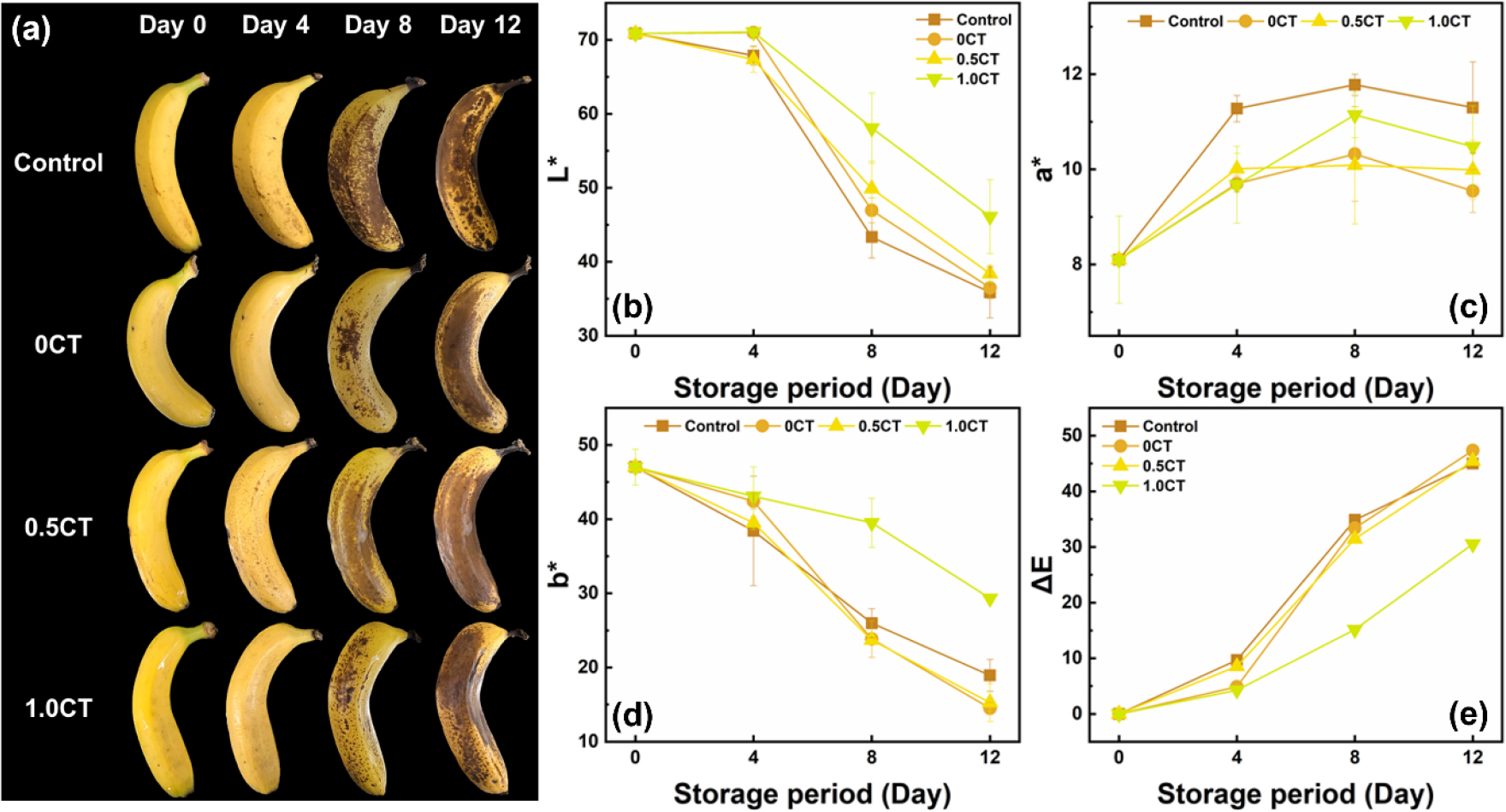
Banana peel browning progresses as ripening advances during storage, significantly impacting visual quality and marketability [26]. To assess the influence of coating treatments on color retention, visual assessments were conducted alongside analyses of L*, a*, b*, and ΔE values. Fig. 4a illustrates the gradual change in peel color across all samples over the storage period. Notably, browning increased markedly in the uncoated bananas, whereas coated bananas exhibited slower browning. In particular, the 1.0CT treatment demonstrated a more gradual change in peel coloration during the later storage stages compared to other treatments [27]. Fig. 4b–d depict the temporal variations in banana-peel L*, a*, and b* values. L* values generally decreased with storage duration, reaching 35.88, 36.50, 38.40, and 46.12 on day 12 for the uncoated bananas, 0CT, 0.5CT, and 1.0CT, respectively. Conversely, a* values tended to increase over time, reaching 11.30, 9.54, 9.99, and 10.48 at day 12. Since the peel was initially yellow, b* values served as indicators of yellowness retention; these decreased from an initial value of 47.03 in all treatments over the storage period. The 1.0CT treatment maintained the highest b* values of 43.07, 39.52, and 29.33 on days 4, 8, and 12, respectively. On day 12, the b* values recorded for the uncoated bananas, 0CT, and 0.5CT were 18.94, 14.51, and 15.28, respectively, indicating superior yellowness retention in 1.0CT. The total color difference (ΔE) on day 12 was approximately 45.00 for the uncoated bananas and 30.53 for 1.0CT, with ΔE in 1.0CT being approximately 32.2% lower. This decline in L*, increase in a*, and reduction in b* during storage reflect changes in pigment composition and peel condition associated with ripening and oxidative browning during later storage stages [26]. The attenuated color changes in coated bananas resulted from the coating layer on the banana surface, which restricts mass transfer and limits direct exposure to oxygen, thereby delaying ripening and oxidative browning reactions [18,28]. Therefore, the colorimetric analysis indicates that the coating treatments influenced peel color changes during storage. Among the measured color parameters, 1.0CT maintained relatively higher L* and b* values and exhibited the lowest ΔE at day 12, whereas a* did not show a consistent chitin concentration-dependent trend. Accordingly, the observed color changes should be interpreted on the basis of individual color parameters rather than as a uniform concentration-dependent effect of chitin.
3.3.3 Firmness of bananas during storage
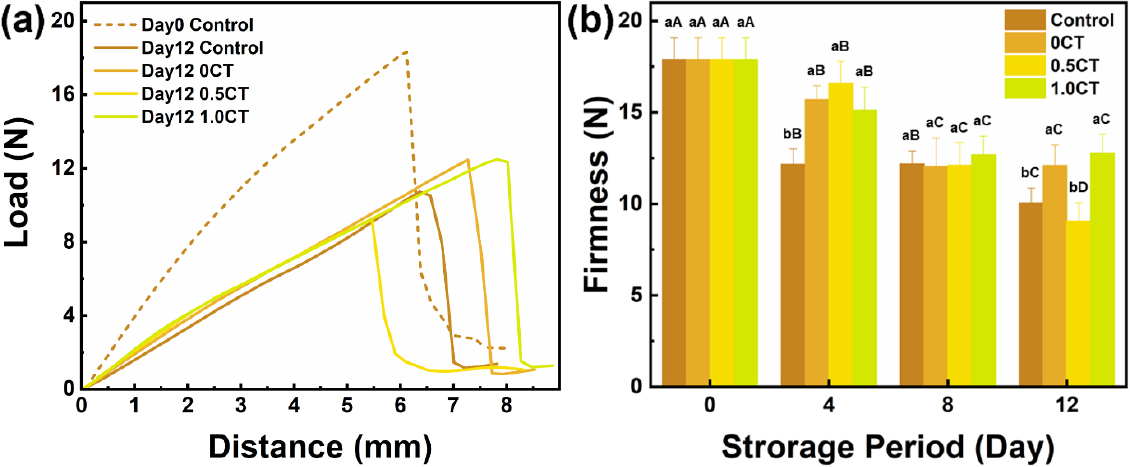
Ripening of bananas during storage involves cell-wall degradation and tissue softening, leading to a decline in pulp firmness [6]. Consequently, firmness was evaluated to assess whether coating treatment could delay tissue softening. As depicted in Fig. 5b, firmness generally declined with increasing storage duration across all treatments, with the uncoated bananas showing a more pronounced reduction. This decrease in firmness arises from the degradation of cell wall constituents and structural weakening during ripening, which diminishes the mechanical strength of the pulp [6]. Coated bananas tended to maintain higher firmness levels than the uncoated ones, particularly at later stages of storage. Notably, on day 12, the firmness of the 1.0CT coated bananas reached 12.77 N, approximately 26.9% higher than that of the uncoated ones. The load–displacement curves presented in Fig. 5a further corroborate that coating treatments maintained higher maximum loads at day 12. Since the maximum load reflects the pulp tissue’s mechanical resistance to probe penetration, elevated values indicate an effective delay in softening due to the coating application [28]. This retention of firmness can be ascribed to the physical barrier formed by the coating layer, as evidenced by SEM analysis. The coating layer can partially restrict water loss and the diffusion of gases such as O2 and CO2, thereby modulating respiration and ripening processes. This firmness retention may primarily be associated with the physical barrier effect of the coating. A previous study has also reported suppression of cell-wall-degrading enzymes by edible coatings during banana ripening [29]. Thus, the data indicate that chitin-containing CNF/carrageenan-based coatings effectively mitigate softening of banana tissue during storage, with the most significant firmness retention noted in the 1.0CT treatment.
3.3.4 Soluble solids content and acidity of bananas during storage
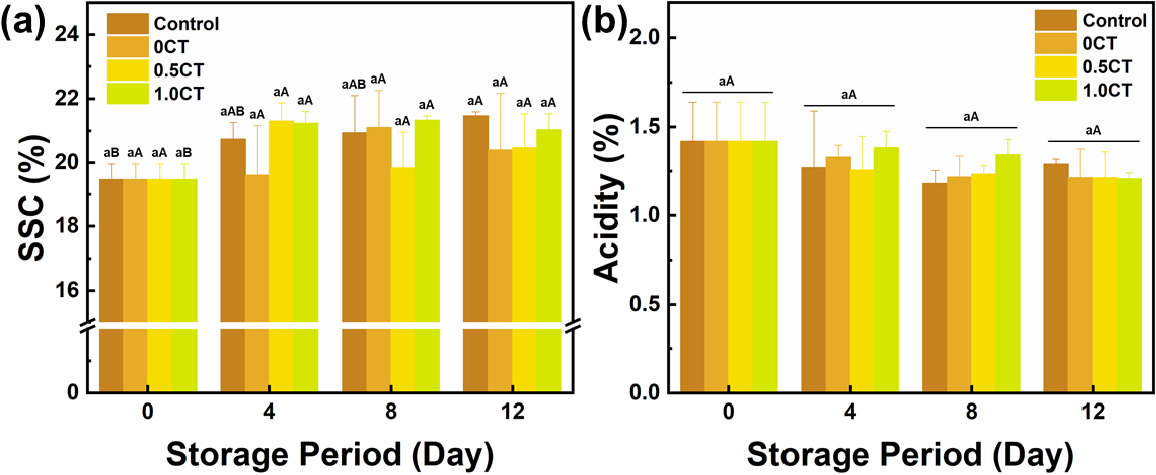
Fig. 6 illustrates changes in SSC and acidity during storage to assess the impact of the coating treatment on internal compositional variations in bananas. As shown in Fig. 6a, SSC generally increased with storage duration. The initial values were 19.47 SSC (%) across all treatments, rising to 21.47, 20.40, 20.47, and 21.03 SSC on day 12 for the uncoated bananas, 0CT, 0.5CT, and 1.0CT, respectively. Although the day-12 values were numerically lower in coated bananas compared to the uncoated ones, the differences were not statistically significant. As illustrated in Fig. 6b, acidity decreased from an initial value of 1.30% to 1.29, 1.21, 1.21, and 1.20% on day 12 for the uncoated bananas, 0CT, 0.5CT, and 1.0CT, respectively. Although minor fluctuations occurred during storage, no significant differences were evident among the coating treatments. The limited change in acidity is attributed to the maturity stage of the bananas, which had predominantly yellow peels at the onset of storage, thereby limiting fluctuations in organic acids [4,30]. Regarding internal compositional changes, the general increase in SSC stems from the conversion of starch into soluble sugars during ripening [3]. Although coated bananas showed numerically smaller increases in SSC, the lack of statistical significance indicates that the coatings did not induce detectable changes in SSC under the tested conditions. Generally, no definitive coating treatment-dependent differences in SSC and acidity were detected, indicating that these parameters alone provide limited insights into the effects of coating treatments on storage quality. Consequently, they should be considered supplementary to assessments of visual appearance, color, and firmness.
4. Conclusions
This study investigated the impact of incorporating 0, 0.5, and 1.0 wt% chitin into CNF/carrageenan-based edible coating suspensions, assessing their dispersion characteristics, rheological behavior, and effects on the storage quality of bananas. FT-IR spectroscopy supported the integration of chitin into the coating matrix. Coatings with chitin demonstrated lower sedimentation indices compared to the control (0CT), increased low-shear viscosity and G′, and sustained predominantly elastic behavior across the tested frequency spectrum, with G′ exceeding G″. The reduced sedimentation and elastic-dominant behavior may be associated with interactions such as hydrogen bonding and physical interfiber entanglement among chitin, CNF, and carrageenan, together with the accompanying increase in total solids content. However, because chitin addition was accompanied by an increase in total solids content, the observed improvements cannot be attributed solely to chitin. Further studies controlling total solids content are needed to distinguish the specific effects of chitin from those of the overall formulation. All suspensions exhibited shear-thinning behavior conducive to spray application, while the mean coating-layer thickness increased numerically with increasing chitin content without statistically significant differences among treatments. Although no significant differences in SSC and acidity were observed among the treatments, coated bananas exhibited significantly less peel discoloration and firmness loss compared to the uncoated ones. Notably, on day 12, the 1.0CT treatment showed a 32.2% lower ΔE and a 26.9% higher firmness relative to the control, demonstrating improved retention of peel color and firmness. The observed retention of color and firmness may be partly associated with the potential barrier effect of the coating layer on moisture and gas transfer between the peel and the surrounding environment. No significant treatment-dependent differences were detected in SSC or acidity. Therefore, the beneficial effects of the coatings observed in this study were primarily reflected in peel color and firmness retention rather than in changes in SSC or acidity. In conclusion, incorporating chitin into CNF/carrageenan coatings may contribute to maintaining selected quality attributes of bananas during postharvest storage.