


1. Introduction
Paper drying is a very important process during paper and paperboard manufacture aimed at removing water continuously and cost-effectively while also achieving the desired physical properties of paper products. An investigation has revealed that the paper drying process removed the least amount of water compared to the forming and press section, however, it consumed more than 80% of mill-wide energy consumption in the papermaking process.[1] Meanwhile, it has the largest potential for energy conservation.[2] As a result, the drying process plays a crucial role in saving thermal energy use for the paper industry to transition towards a low-carbon economy.
The paper drying process is a coupled process in which mass and heat transport are involved concurrently.[3] To reduce thermal energy use, the analysis of the effects of operating conditions to be taken at a site is one of the many application fields of model-based simulation tools. Both experimental or empirical and theoretical models for the paper drying process from various perspectives can be found in the literature.[4-11] Nilsson,[4] Karlsson and Stenström,[5] and Heo et al.[6] constructed different models to describe heat and mass transfer in the paper drying process. Ghodbanan et al. [7,8] simulated a corrugating paper machine to optimize energy consumption in the drying process with a steady-state model based on the mass and energy balance relationships. Anjomshoaa and Salmanzadeh[9] introduced a novel thermodynamic and heat and mass transfer model for simulating the paper drying process based on empirical relationships in the literature and validated it via experimental data from Ghodbanan et al.[7] Janošovský et al.[10] conducted cost optimization on a graphical paper machine with a semi-empirical mathematical model and identified 2.2% decrease in heat use in the drying process. Further drying models can be found in the recent review on paper drying by Stenström.[11] In order to capture a clear picture of the effects of operating conditions on thermal energy consumption in the paper drying process, in this work, we simulated a newsprint paper drying machine based on the proposed sequential model. For further information about the model, please refer to our previous study.[12]
High energy use is forcing paper mills to pay more attention to improving thermal energy efficiency, especially reducing the steam consumption for drying paper as it represents the most energy-intensive step in the papermaking process. In this work, the simulation results of a paper drying process based on the proposed sequential drying model were presented and the influence of operating parameters on thermal energy use was also modeled and discussed.
2. Methods
2.1 Simulation methods
As presented in the previous literature,[12] the theoretical model of paper drying process was composed of eight basic modules based on their different functions, i.e., cylinder group module (CylGro), steam separation module (SteSep), surface condensation module (SurCond), fan module (Fan), conventional heat recovery module (CHR), air heating module (AirHeat), paper sheet module (PapDry) and hood module (Hood). The model of each basic module was presented and discussed in detail. With these basic modules, the drying model of a specific paper machine could be constructed according to the specific drying techniques for the simulated drying section. Afterward, we could simulate the paper drying process with the data surveyed on-filed from the case machine.
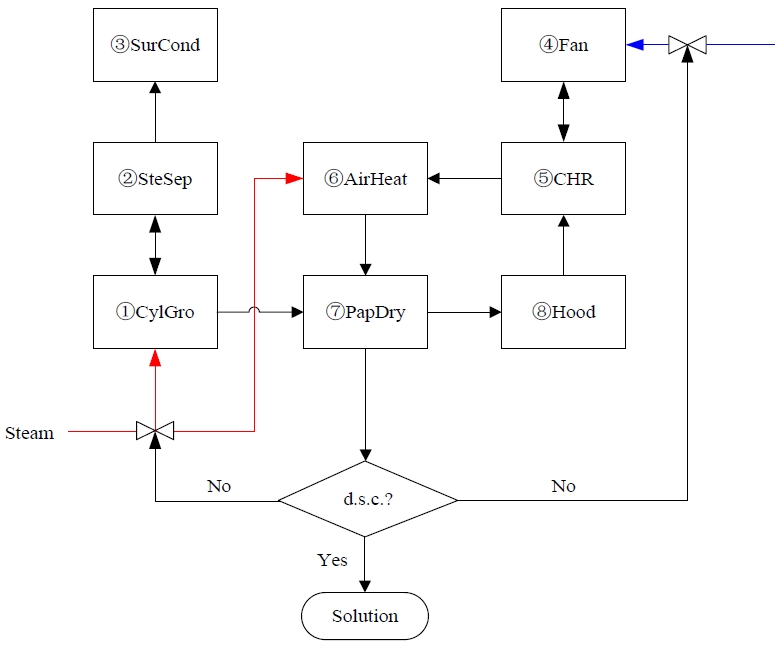
The simulation procedure of the paper drying process was shown in Fig. 1. According to the actual paper drying operation, the steam and condensate system was started firstly followed by the ventilation system. For a paper drying section, the steam and condensate system consisted of CylGro, SteSep, and SurCond modules. The Fan, CHR, Air-Heat, and Hood module made up the ventilation system. After both subsystems start-up, the wet paper sheet was sent to the cylinder group to be dried. Based on the above drying technique, the CylGro, SteSep, and SurCond modules could be calculated sequentially, based on the results, the Fan, CHR, AirHeat, and Hood module was determined consequently. Finally, the paper sheet modules (PapDry) were simulated to check the predicted dried solid content (d.s.c.). If the d.s.c. disagrees with the measured values, a new simulation will restart by adjusting the steam and air-flow requirements. The steam was mainly used in the CylGro and AirHeat modules. The supply air and exhaust air were controlled by related air fans. The new simulation continues to be executed until the output predicted d.s.c. of each paper sheet module agreed with the measured values. With the outputs of each module, we can further validate the model with the thermal energy use from the field survey on the case machine. Furthermore, the total thermal energy use and drying efficiency could also be determined according to the method presented in the literature.[12]
2.2 Data collection and assumptions
A newsprint drying process was chosen as the case study in this work. The production capacity was 540 tons per day for the case paper drying machine. It was running at the maximum speed of 1500 m/min with 4.8 m of paper width. The drying section y was built with 33 cylinders which were divided into four groups. Table 1 displays the cylinder group configuration of the newsprint machine. The four-cylinder groups consisted of 9, 12, 7, and 5 cylinders, respectively, and operated at various steam pressures based on cascading principle.
Table 1.
Cylinder group configuration of the newsprint machine
| CylGro | Cylinder | Cylinder numbers | Steam pressure (kPa) | Steam temperature (℃) |
|---|---|---|---|---|
| I | #25-33 | 9 | 75 | 115 |
| II | #13-24 | 12 | 140 | 125 |
| III | #6-12 | 7 | 22 | 105 |
| IV | #1-5 | 5 | -5 | 100 |
Other operating parameters, such as basis weight, machine speed, temperature and humidity of supply/exhaust air, and steam use of each cylinder group, were collected from the energy optimization platform of the investigated newsprint machine. The paper temperatures could be measured with the infrared thermometer/thermography. As measured from the field survey, the d.s.c. and web temperature of the input wet web were 48% and 45℃. The target d.s.c. of the output paper was around 92%. The assumed parameters were collected from design data and the operator’s experience of the case machine. In the simulation, the following values of parameters were also used. The heat loss coefficient of cylinder groups was 5%, the ratio of blow-through steam was 10%, the ratio of flash steam and condensate was 3%, the heat efficiency of conventional heat recovery was 60%, and the heat loss of air heater was 20%, the heat loss from paper drying module was 3%, and the hood balance was 70%.
3. Results and Discussion
3.1 Framework of the newsprint drying model
From the process flow of the steam and condensate system for the newsprint drying section, the 33 drying cylinders were divided into four groups with different steam pressure levels. The pressure and temperature of the steam for each cylinder group were presented in Table 1.
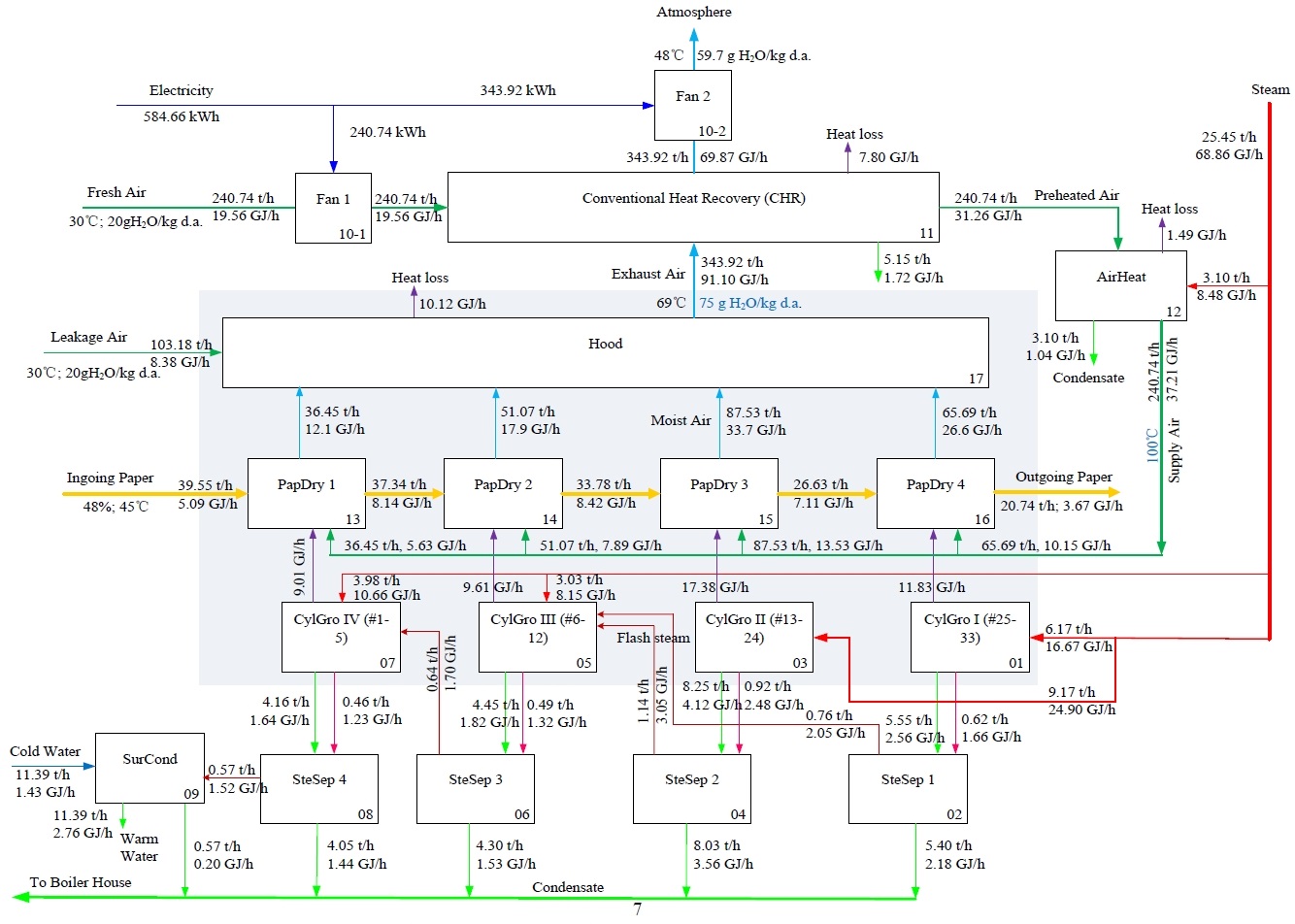
According to the newsprint drying process flow, an additional cylinder group module and a related paper sheet module have to be added to construct the framework of the newsprint drying model. For each module, the model was developed based on the basic laws of mass balance and conservation of heat flow. The equations of the model were the same as those presented in the previous work.[12] However, compared with the earlier model, there were 17 modules for the case newsprint drying process totally in the current work. Besides the surface condensation module (1), fan module (2), heat recovery module (3), air heating module (4), and hood module (5), the framework of the current model also includes four cylinder-group modules (6-9), four steam-separation modules (10-13), and four paper-sheet modules (14-17). The overview of the framework for the newsprint drying model was illustrated in Fig. 2. The identification (ID) in the right corner of each module indicated the simulation procedure for the studied newsprint drying process.
3.2 Simulation results
Fig. 2 presented the simulation results of the studied newsprint drying process. We can see the mass and heat flow of each module from the results clearly. The relative error of the total output and input heat flow was 2.3% as shown in Table 2. The total input heat flow was 28700 kW (or 103.32 GJ/h) compared with that of 29350 kW (or 105.66 GJ/h) for total output heat flow.
Table 2.
Results of energy balance validation for the newsprint drying process
The steam and thermal energy use of each cylinder group module were presented in Table 3. As can be seen from the results, 25.45 tons of steam were used to produce 20.74 tons of newsprint per hour. Thus, the specific steam use was 1.23 t/t paper, which was almost equivalent to the statistical specific steam use for the case machine.
Table 3.
Steam and thermal energy use in each cylinder group
Regarding overall thermal energy use, it consumed 68.86 GJ/h of thermal energy (sum of steam in CylGro and AirHeat) to evaporate 18.81 tons of water per hour. Thus, the specific thermal energy use was 3.66 GJ/t of water evaporated. For the case machine, its drying efficiency was 79.5% and the simulated d.s.c. of the paper web was also agreed well with the measured value. In addition, it can also be found that 69% of water was evaporated in the first two-cylinder groups (CylGro I and II) with 21 cylinders. And the rest 12 dryers only removed 31% of the water from the wet paper web.
The case newsprint drying machine consumed 8.48 GJ/h or 2356 kW of thermal energy for heating supply air in the AirHeat module, accounting for 12.3% of total thermal energy consumption in the drying process. However, only 89% of thermal energy, namely 2090 kW, was used for heating the supply air for a benchmark newsprint drying process as reported in reference.[13] Thus, the thermal energy use could be reduced for the simulated newsprint drying process, in particular for the ventilation system. However, it is hard to determine the thermal energy savings attributed to parameter adjustment without the paper drying model.
3.3 Effects of operating parameters on thermal energy use
To reduce thermal energy use for drying paper, the effects of supply air temperature and exhaust air humidity were simulated. In the paper drying operation, these parameters were usually ignored by operators because they were not sure about their effects on the whole drying process. However, this work can be done conveniently and quickly with the proposed sequential paper drying model.
Fig. 3 shows the thermal energy use of each consuming module. Case 0 was the basic situation without any changes. Case 1 was the result when the supply air temperature decreased to 90℃ from 100℃. Case 2 was the result of enhancing exhaust air humidity to 85 from 75 g water/kg dry air. From the simulation results, we can also see that both cases could accomplish the drying requirements after adjusting the ventilation parameters.
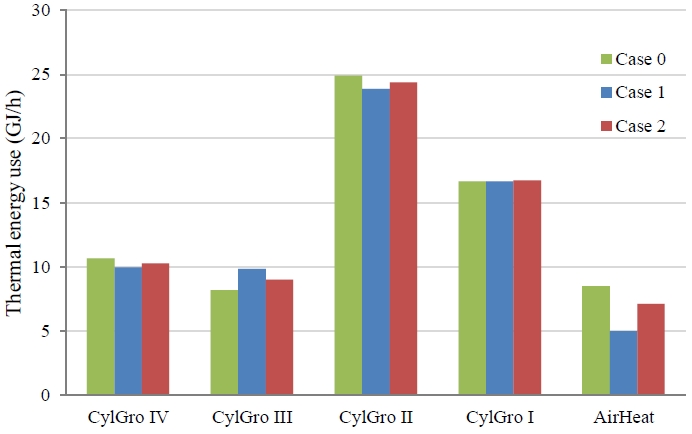
The total thermal energy use of Case 1 and Case 2 were 65.32 and 67.48 GJ/h, as a result of reducing thermal energy use in CylGro II, CylGro IV, and AirHeat. Additionally, Case 1 used less energy than Case 2. In comparison with Case 0, the total thermal energy was reduced by 5.1% when the supply air temperature decreased by 10℃ for Case 1. While it was only reduced by 2.0% when the exhaust air humidity was enhanced by 10 g water/kg dry air for Case 2. However, it has a greater impact on the thermal energy use in the air heating module. As presented in Fig. 3, the thermal energy used by heating supply air was reduced by 42% for Case 1 and 16% for Case 2. It also demonstrates that decreasing supply air temperature could save more thermal energy for heating the supply air.
Table 4 presents the effects of the operating parameters of the ventilation system on drying energy performance. For Case 1, the specific thermal energy use was reduced to 3.47 from 3.66 GJ/t water evaporated with 5.1% of thermal energy savings. Consequently, the drying efficiency improved by 4.6%, increasing from 79.5% to the current 84.1%. While for Case 2, in addition to 15.3% of electricity savings by fans due to humidity enhancement, it also decreased thermal energy use by 2.0% since less supply air was heated. Its specific thermal energy use was reduced to 3.59 GJ/t water evaporated and the drying efficiency was enhanced to 81.3%, with a 1.8% of efficiency improvement. For other operating parameters and ranges outside of this work, it could also be used for assessing their effects on thermal energy use with the sequential paper drying model.
4. Conclusions
In this work, a newsprint drying process was simulated based on the theoretical model for the paper drying process using the sequential modeling method. The overall framework of the newsprint drying model was constructed according to the specific drying techniques. The mass and heat flow of each module could be determined with the proposed model. The simulated paper dry solid content and steam use from each paper sheet module and cylinder group module were validated with the measured values. The simulation results showed the specific steam use was 1.23 t/t paper and the specific thermal energy use was 3.66 GJ/t water evaporated for the case paper drying process with a drying efficiency of 79.5%. It was also found that 12.3% of total thermal energy consumption was used for heating the supply air. As a comparison, only 89% of energy was used to heat the supply air for a similar newsprint drying process. To determine the potential of thermal energy savings, the effects of supply air temperature and exhaust air humidity were also simulated. When the supply air temperature decreased from 100℃to 90℃, the specific steam use was reduced by 5.1%, and the drying efficiency was improved by 4.6%. The thermal energy use was reduced by 2.0% in addition to 15.3% of electricity savings by fans when the exhaust air humidity was enhanced from 75 to 85 g water/kg dry air, and the drying efficiency was improved by 1.8%. Therefore, it could be used to assess thermal energy use reductions for the paper drying process by the sequential drying model. Additionally, it will also be useful for training purposes to determine the impacts of operating parameters on paper drying thermal energy consumption.