


1. Introduction
The Korea government is pouring out measures to expand the use of new and renewable energy while regulations on fossil fuel-based power generation industries are becoming more and more severe due to climate change and fine dust pollution. The Renewable Energy Certificate, called REC, is a certificate that proves that energy was supplied using renewable energy. According to the Ministry of Industry Notice No. 2018-130, the REC credits are assigned according to the energy source such as wind, solar or biomass, and the REC credit of unused forest biomass has increased from 1.5 to 2.0.1) It is well-known that biomass is used as energy in a direct or stored form through various methods such as combustion, fermentation, or chemical decomposition, depending on the type of resource. It can generate electricity or generate heat, or store and utilize it in the form of solid fuels or gas.
In order to meet the Renewable Portfolio Standards (RPS) in domestic thermal power plants, the demand for imported pellets increased sharply because the coal and wood pellets were co-fired. The excessive consumption of imported pellets eventually becomes a factor that hinders the effective use of forest biomass generated in Korea. Eventually, on July 1, 2020, the Korean government implemented a guideline to drastically lower the REC for co-fired coal and pellet power generation to 0.5.1) However, when unused forest biomass is co-fired, the same REC credit of 1.5 as before is applied.
The use of unused forest biomass as a renewable energy source is considered to be one of the pioneering fields to be studied to meet the demand for woody biomass and to expand the supply of renewable energy.
When looking at the proportion of bio and waste energy sources generated in Korea, there are 43% (8,746 GWh) of forest products, 7% (1,444 GWh) of organic biomass, and 49% (9,965 GWh) of combustible biomass and waste. Among the forest products that occupy the highest proportion, the amount of unused woody forest biomass currently stands at 3.6 million m3 in 2017.2)
Currently, power generation of renewable energy generation using woody biomass is 2,671.4 MW/36 sites in 2020 and is mainly used in the form of wood pellets and wood chips. The demand for woody biomass is expected to increase from about 5.2 million tons in 2019 to about 8.9 million tons in 2030, but the Korea Forest Service will increase the domestic supply ratio of forest biomass by 11.3% (about 1 million tons) by 2022.3) For reference, it was found that the amount of woody biomass used was 5.1593, 50 tons in 2019 and the power generation amounted to 6.11,1291 MWh.4) Eventually, the remaining deficit must depend on imported woody biomass. In 2030, about 4 million m3/year of unused forest biomass is expected to occur, and, in order to increase the consumption of domestic pellets, if their quality does not deteriorate, it is very necessary to manufacture pellets using them.
In particular, pellets are one of the representative methods of utilizing woody biomass. Pellets can be loaded, transported and stored three times more than original raw materials by compressing raw materials at high density. The global wood pellet market has been growing rapidly since 2011 and is growing explosively to record an average growth rate of 14% per year. According to Walker’s report in RISI, demand for wood pellet is expected to reach about 59 million tons by 2030.5) In 2017, the total timber harvesting in Korea was 6.75 million m3, of which 4.85 million m3 (71.9%) was used for lumber, pulp, and board, and so on. However, if remnants such as twigs generated in the process of use are included, unused forest biomass resources amount to 3.43 million m3. The actual amount of forest available from the forest field is around 14 million tons/year. If the unused forest biomass is used to make pellets, it is expected to reduce the use of 450,000 tons of crude oil and about 1.37 million tons of CO2 emission annually.5)
Ahn et al. suggested that it would be more economical to use the forest biomass generated from the national forest management operation project led by the Korea Forest Service as raw materials for pulp or other wood-based products instead of wood pellets.6) Their analysis was closely related to the accessibility and transportation convenience required for the collection of unused forest biomass. Sung et al., Cho et al. and Lee et al. introduced a technology to produce biopellets and torrefied pellets using empty fruit bunches (EFB) and palm kernel shells (PKS), which are byproducts of palm oil that are widely produced in Southeast Asia.7-10) This might be applied because of its economic feasibility in palm oil production regions, but it is difficult to use easily in Korea due to profitability problems.
With the recent anti-aging fever and increasing preference for natural substances, the demand for the natural substances with various functions such as camellia oil, peppercorn oil, and mulberry is also increasing.11) These species are cultivated in the Gyeongnam and Jeonnam regions, and their natural oils and extracts are. About 80% of the seeds obtained from camellia growing in the south coast are collected at the Korea Camellia Research Institute in Tongyeong city, Gyeongnam. The institute produces 12-15 tons of camellia oil annually. After extracting the oil from camellia seeds, about 25% of the seeds remains in the form of oil cakes. These residues are used as organic fertilizers, but it is necessary to find out if they can be used as fuels to diversify the application field.
Toothache tree is evenly distributed in forests in Korea, and its stem, leaves and seeds are used as medicinal herbs. It has been reported that some farms produced about 270 liters of oil from 680 kg of peppercorns of the toothache trees and the rest remained as a byproduct. The toothache trees over 10 years in age are known to lose economic feasibility and die without bearing fruits. As interest in the anti-aging industry grows, the cultivation regions for the toothache tree have been expanding and the number of older trees that have reached the renewal period is also increasing. Therefore, it is needed to utilize these old trees in a more valuable way than to leave them in the forest after cutting them down.
In this study, biopellets were manufactured using easily available byproducts of forest resources unlike general unused forest biomass, and it was evaluated whether these pellets can be used as a renewable energy source to compensate for the supply shortfall of wood pellets in Korea.
2. Materials and Methods
2.1 Woody biomass used for making biopellets
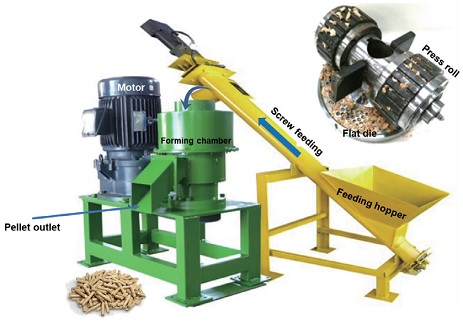
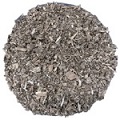
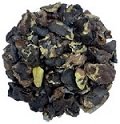
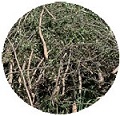
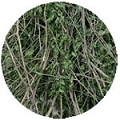
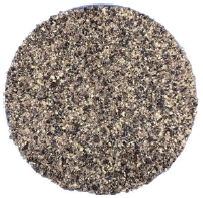
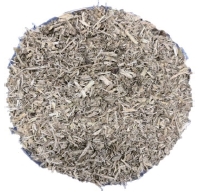
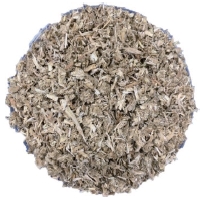
Hardwood chip debris supplied from Moorim P&P Co., Ltd. in Korea were used, and the debris are tiny fragments that were rejected during the wood chip screening process and consist of domestic oaks and Vietnamese acacia (refer to Fig. 1). Camellia (Camellia japonica) oil cakes was provided by Korea Camellia Research Institute Co., Ltd. Toothache trees (Zanthoxylum schinifolium) were used by logging trees of 5-10 years in age in the research forest of Gyeongsang National University. Mulberry trees (Morus alba) were collected through pruning at the mulberry plantation area in Hadong-gun, Gyeongnam province (refer to Table 1).
2.2 Analysis of chemical composition
The chemical composition of lignocellulosic raw materials was determined according to the TAPPI method T 203 and T 204, ISO/DIS 21436, ISO 18122. The components to be analyzed were holocellulose, lignin, extractives, and ash.
2.3 Pretreatment
After drying the wood biomass until its moisture content was lower than 5%, it was ground and pulverized to a small particle size appropriate for the pelletizing process. The wood biomass except for the wood chip rejects was reduced in size using a wood shredding machine, and then ground to a size of 1-1.5 mm suitable for pelletization using a laboratory blender (see Table 2). Since the wood chip rejects were collected in a size suitable for making pellets, they did not undergo a separate grinding process.
2.4 Pelletization
The collected woody biomass is densified in the form of pellets in order to improve its physical and mechanical properties during handling and storage. For the production of biopellets, the moisture content of the lignocellulosic biomass was adjusted to a level of 12-15%, and the pellets were prepared through a laboratory-scale custom-made pelletizer (Duko, Daejeon, Korea) equipped with a flat die with a hole diameter of 8 mm. As shown in Fig. 1, the pelletizer machine can produce up to 100 kg per hour. When the biopellets were prepared, the pelletizing temperature was about 85℃. Once the pelleting process had reached a stable state, a sample of 12 kg of each pellet mixture was used for pelletization. Fuel pellets with a diameter of 8 mm and an average length of 29 mm were produced. All eleven samples of pellets were stored at 20℃ and 55% relative humidity in a laboratory for 10 days after their production to reach a stable state before testing.
2.5 Proximate analysis
Proximate analysis of the samples was accomplished according to the methods set out by the ASTM.7,8) The moisture content was determined using ASTM E871-82 (2019) test methods for the direct moisture content analysis of wood and wood-based materials. A 10 g sample was heated in an oven at 103±5℃ for 24 h. Ash content was determined according to ASTM D1102-84 (2013) for analysis of ash content, 2 g of the pulverized sample was burned in a ceramic crucible for 3 h at 550℃ using a muffle furnace. The percentage of volatile matter was determined according to ISO 652 (2010). Fixed carbon is the solid combustible residue that remains after a sample is heated at 900±5℃ for 7 minutes and the volatile matter is expelled. The fixed-carbon content of the sample is then calculated according to the following formulae.
2.6 Ultimate analysis
The ultimate analysis of raw materials and prepared fuel pellet samples was performed according to ASTM D5373-16 (2016), which is the standard method for the analysis of coal and inhomogeneous materials, using a Macro Elemental Analyzer made in Langenselbold, Germany (Vario MACRO cube, Elementar Analysensysteme GmbH) working under CHNS mode. To determine the chlorine content, samples were prepared using a modified version of the bomb washing method in the United States Environmental Protection Agency (EPA) SWP-846 Method 5050 (1994), and it was then determined through ion chromatography (930 Compact IC Flex; Swiss, Metrohm, Herisau, Switzerland).12,14)
2.7 High Heating Value (HHV) and Low Heating Value (LHV)
The HHV of the raw materials and fuel pellets produced was measured following the ASTM E2618-13 (2019) standard test method for gross calorific value of coal using a 1138 oxygen combustion bomb calorimeter (Parr-6400; Parr Instrument Company, Moline, IL, USA). The LHV of fuel pellets was obtained using Dulong’s formula.10,11) The composition of lignocellulosic sawdust substrate lignin, cellulose, and hemicellulose was determined according to the TAPPI T203 cm-99 (1999) method.17)
2.8 Bulk density
The bulk density is mainly dependent on the density of particles and the pore volume. The higher the bulk density, the higher the energy density, and the lower the transport and storage costs. The bulk density of fuel pellets was determined according to ISO 17828. The densities of the raw material and the pellets were measured separately using different methods. Specifically, for the raw material (powder type), bulk density was measured using a 500-mL density cup. For the pellets, bulk density is a parameter that is easy to determine and is the ratio of the mass and total volume of the fuel pellets. The average index of bulk density for each sample was calculated from three measurements.
2.9 Durability
The mechanical durability of the fuel pellets was determined according to ISO 17831-1. In a laboratory-scale tumbler taster, 500 g of fuel pellets were tested after 500 revolutions. The treated sample was sieved using round screen holes of 3.15 mm according to ISO 3310-2. The percentage of unbroken pellets remaining was weighed and recorded for the mechanical durability index. Three replicates were analyzed for each sample.
2.10 Fines contents
Fine particles of fuel pellets (sample) are particles (impurities) smaller than 3.15 mm, as well as dust in the sample. According to the standard method, the required apparatus for determination of fine particles comprises a sieve with a dimension of 3.15 mm, an analytical scale, and a measuring pot. Fines content of fuel pellets was determined according to ISO 3310-2. For every determination of fine particles, it is necessary to take at least three measurements.
2.11 Ignition and combustion
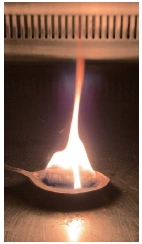
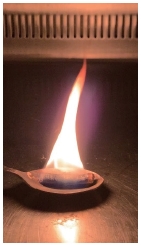
This experiment was conducted following a study of the literature to determine the ignition and combustion time of the fuel pellets. The ignition and combustion experiment were performed according to laboratory-scale available facilities. For single fuel pellet burning, a Prince micro torch lighter (GT-3000 ; Prince, Matsudo, Japan) was used, and each sample was burned in an aluminum foil petri dish. A digital camera (EOS 800D; Canon, Tokyo, Japan) was used for the direct quantitative and qualitative analyses of ignition and combustion time. During the ignition and combustion of the pellets, a high-speed camera was not essential, because single pellets only burn for a short period. To maintain an identical background, all the ignition and combustion experiments were performed in a dark room.
2.12 TGA (Thermogravimetric analysis)
Thermogravimetric analysis was performed based on ISO11358-1 to investigate the pyrolysis properties of the pellets produced. Thermalgravimetric analyzer (SDT, Q600, USA) has a reactor internal diameter of 20 mm. The scale accuracy was 1 μg and was performed at a nitrogen flow rate of 50 mL/min under all conditions.18) The experiment was conducted at a temperature rise of 10℃/min, and the decrease in sample weight according to the temperature could be measured.
3. Results and Discussion
3.1 Chemical composition of woody biomass
Lignin is a natural polymer that acts as glue between the cellulose fibers of woody biomass. If the lignocellulosic biomass does not contain an appropriate level of lignin, extra additives such as starch or kraft lignin is required to supplement the durability or density of the pellet.15) Except for hardwood chip rejects and camellia oil cakes, which contain about 21% lignin, toothache tree and mulberry tree contain about 12% lignin (refer to Table 3), so it was assumed that pelletization would not be easy. Lehtikangas (2001) and Whittaker and Shield (2017) also confirmed that there was a strong positive relationship between pellet durability and lignin content.19,20) Therefore, the higher lignin contents in the lignocellulosic biomass would have a positive effect on pelletization and quality.
3.2 Proximate analysis and ultimate analysis of biopellets
The most commonly used method for analyzing woody biomass is proximate analysis in which moisture content, volatile matter, ash, and fixed carbon are determined. The quality and classification of the pellets are generally based on the proximate analysis. Elemental analysis also called ultimate analysis is used to design the pellet combustion equipment and auxiliaries. Ultimate analysis analyzes various elements such as carbon, hydrogen, sulfur, oxygen, and nitrogen present in the pellet sample. Table 4 shows the results of proximate analysis and ultimate analysis of biopellets prepared from four lignocellulosic samples.
Table 4.
Basic properties of biopellets
When the moisture content of the pellet is high, heat is used to evaporate moisture, so the calorific value is lowered and further combustion is hindered. Although the mulberry pellets showed slightly higher moisture content than the other pellets, there was no remarkable difference.
The carbon content in ultimate analysis for biopellets is equal to the energy content of the fuel.13,14) The content of the fixed carbon in proximate of biopellets is not the same as that of the ultimate carbon.18,19) The camellia oil cake pellet had the highest carbon content of about 49%, and the mulberry pellet had the lowest carbon content of about 39%. The ultimate carbon disappears along with hydrocarbons due to its volatility. On the other hand, the amount of fixed carbon remaining while the volatiles were released during the combustion of the pellets was the least detected in the toothache tree, about 7.8%. The other pellets had fixed carbon contents of 15-21%. The camellia oil cake pellets had the highest fixed carbon of about 21% (see Fig. 2).
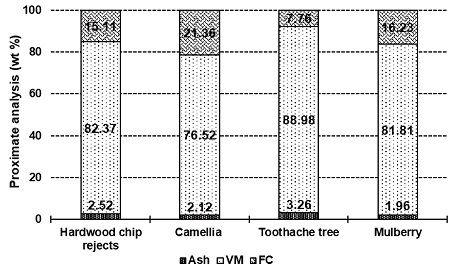
The volatile matters are substances that are detected in fuels, such as methane, hydrocarbons, hydrogen, carbon monoxide, nitrogen, and unburned gases. Pellets with higher contents of volatile matters lose heat in the gaseous phase during combustion, reducing the duration of combustion of the fuels.16) The highest levels of volatile matters were found on the pellets prepared from toothache trees, while the lower levels were detected in the pellets from the camellia oil cake and the mulberry tree. The pellets made of toothache tree appear to have contributed to the increase of volatile content due to the mixing of foliage parts unlike the other raw materials.
Ash is a residue after combustion of the pellet. A high content of ash in the fuel has a negative effect on the calorific value. The ash content of more than 3% was found in the toothache pellet, and the other pellets showed an ash content of 2-2.5%. The ash content of hardwood reject chips were considered to be higher than that of general wood because they were screened and collected as rejects including pin chips, bark and fine sand particles during the chip selection process.
3.3 Physical properties of biopellets
Bulk density, durability and fines are parts of the most important quality standards for using pellets as fuel. Bulk density measures the degree of compression of the pellet particles, and, when lignocellulosic biomass is extruded through a pellet die, its bulk density increases by 4-5 times.20,21) This makes fuel handling and transportation convenient. Regardless of the types of raw materials, the apparent density of all biopellets was over 600 kg/m3, and, in particular, the apparent density of camellia oil cake pellet was about 700 kg/m3, showing the best bulk density (see Fig. 3). The biopellets with a density of 600 kg/m3 or more are well suited for industrial use.
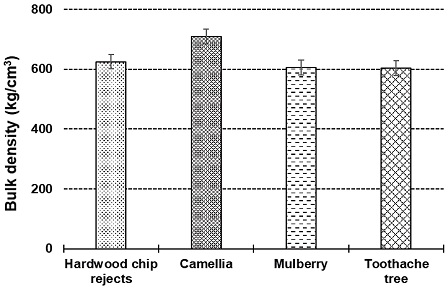
In general, bulk density has a higher specific surface area and a higher density when the particles become smaller during the pellet manufacturing process, which decreases in inverse proportion to the size of the particles.21) In general, in order to produce high-quality pellets with a high bulk density, it is better to pre-treat the particles through pulverization and crushing.22)
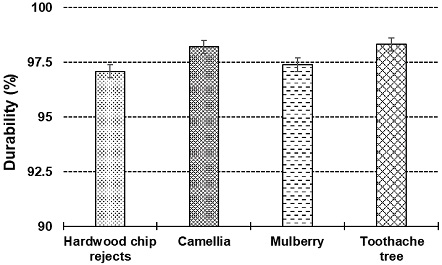
Durability and fines contents indicate the bond strength between the pellet particles.23,24) The durability of wood pellets should not be less than 97.5% according to European and domestic quality standards. The strength and durability of the pellet depends on the physical force that binds the particles together.19) If the durability of biopellets is too low, they can be easily crushed during storage, handling, and transportation, resulting in poor quality and health or environmental problems.17,20,21) As shown in Fig. 4, camellia oil cake pellets and sancho pellets showed durability of more than 97.5%, but the pellets from hardwood chip rejects and mulberry tree had a durability of about 96%, which are not insufficient for domestic or industrial use.
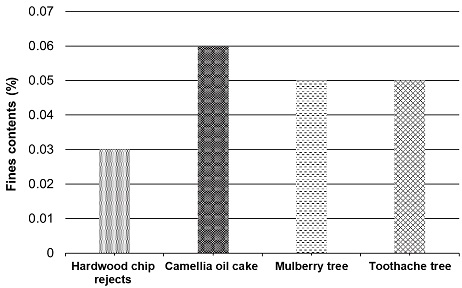
In general, fine particles smaller than 3.15 mm in size are defined as pellet fines. Fines of biopellets come from the pellets that do not meet the strict quality specification. Small particles or fines are generated if the pellets are handled inappropriately during transportation or storage. Particularly, fines detached from pellets can have health and safety implications, and even a risk of dust explosions. The fines content of biopellets is closely related to their mechanical durability.24,25) As shown in Fig. 5, the fines of all biopellets were less than 1%. This means that the biopellets made of hardwood chip reject, camellia oil cake, mulberry tree, and toothache tree are excellent in durability.
3.4 Heating values of biopellets
Fig. 6 is a graph comparing high and low calorific values of the biopellets prepared from hardwood chip rejects, camellia oil cake, mulberry, and toothache tree. Camellia oil cake exhibited the best calorific value because it had the highest carbon content, and the other pellets also showed the calorific values that met the pellet quality standard. It was confirmed that unused lignocellulosic biomass and wood chip rejects generated in pulp mills are important renewable energy sources that can replace fossil fuels. If unused forest biomass is used for power generation companies that rely heavily on imported wood pellets or bio-SRF, REC will be 1.5 if co-fired with coal, and 2.0 if burned without coal, resulting in very high economic incentives. On the other hand, according to the announcement from the Ministry of Industry revised in 2018, REC credit is not granted when wood pellets are used for co-firing power generation.
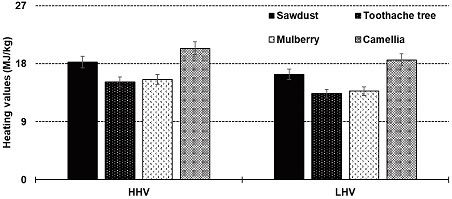
Fig. 6.
Comparison of high heating value (HHV) and low heating value (LHV) values of biopellets and wood pellets.
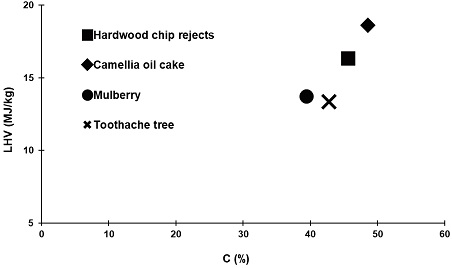
Fig. 7 is a graph comparing the correlation between carbon and LHV of biopellets made by hardwood chip rejects camellia oil cake, mulberry and toothache tree. It could be observed that, the higher C percentage was, the higher LV was found, regardless of the raw materials. This is based on the fact that C and H are responsible for the energy content in biofuels, due to exothermal reactions that take place under O2 atmosphere during combustion of the pellets, generating CO2 and H2O, respectively.26,27) The camellia oil cake pellet with the highest carbon content showed the highest LHV, and the mulberry and toothache pellets with the lowest carbon contents showed the lowest LHV. The pellets from mulberry and toothache trees contain stem, leaves, immature branches, and bark, which might cause them to have low carbon contents.29) In particular, the toothache tree with a lot of volatiles has a little more carbon content than the mulberry tree, but it has the lowest calorific value due to the very high volatile content.
3.5 Ignition and Combustion time of biopellets
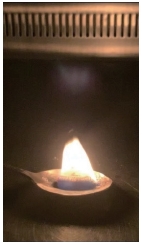
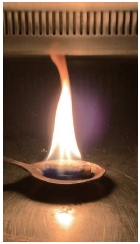
When solid fuels at ambient temperature is exposed to an external heat source, the temperature of the exposed surface begins to increase. This moment can be described as the onset of the ignition process. Biomass fuels usually have higher volatile matter content than coals. The pyrolysis and combustion of volatile matter in biopellets played an important role for the biomass, taking up to 50% of the burnout time.28,29)
Table 5 compares the initial ignition time and combustion duration of pellets prepared from various lignocellulosic biomass. The hardwood chip reject pellets ignited in the shortest time, about 5 seconds, and the mulberry pellets started to ignite in about 23 seconds. The difference in combustion duration between hardwood chip reject pellets and other pellets is a result showing that unused woody biomass can be used as a better fuel than wood pellets. Combustion duration is closely related to the carbon contents of biopellets. This was why camellia oil cake pellet with the highest carbon content was burned for the longest time. Thermal conductivity and heat transfer inside the pellet particles increase with increasing shrinkage which decreases the time of devolatilization.31) In other words, it was estimated that the pellets made from hardwood chip rejects had a very fast heat transfer rate to the inside and thus ignited quickly. The toothache tree pellet prepared by mixing woody parts and leaves was considered to have shorter combustion duration due to poor heat transfer rate and difficulty in uniform combustion.
3.6 Thermogravimetric analysis
Thermogravimetric analysis is a quantitative analysis of changes in sample weight that occurs as a sample is heated at a constant rate. When heat is applied to a solid combustible material, it is known that a weight loss process occurs in a total of three stages.30) First, the evaporation weight of the water contained in the solid combustible material is reduced. After that, the volatile matter will be removed. Finally, the combustion is completed and only the ash remains. Fig. 8 shows the combustion characteristics according to the heating temperature of the biopellets prepared from hardwood chip rejects, camellia oil cake, mulberry tree, and toothache tree.
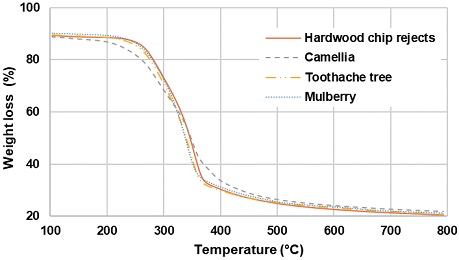
Dehydration (moisture drying process) and endothermic reaction begin to occur while all pellets absorb heat at around 250℃. It was observed that the weight loss rapidly occurred from around 350℃, and the devolatile reaction and the oxidation reaction of fixed carbon occurred. After about 400℃, the weight loss of the biopellets occurred very slowly toward the end point of combustion. Initially, the weight loss of camellia oil cake pellets occurred fastest, but it occurred relatively slower than the other pellets toward the combustion end point. Fixed carbon is the solid carbon in the woody biomass that remains in the char in the pyrolysis process after devolatilization. It was understood that the camellia oilseed pellets burned slowly in the char form because of the highest fixed carbon content.
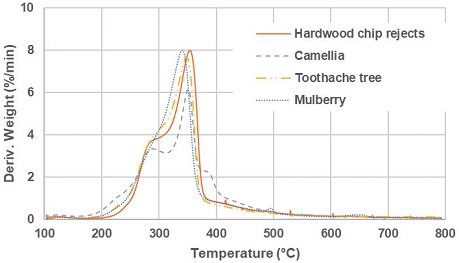
Fig. 9 also shows the rate of weight change with increasing heating temperature against the different biopellets. Except the camellia oil cake pellet, it could be seen that the weight loss of the other biopellets occurred rapidly as the heating temperature exceeded 200℃.
4. Conclusions
For different biopellets were prepared using hardwood, wood chip reject, camellia oil cake, toothache tree, and mulberry tree among woody biomass generated in Korea, and their quality characteristics were compared. The low calorific values of the pellets made from hardwood chip reject and camellia oil cake were 17 MJ/kg and 18 MJ/kg, which was better than those of toothache tree and mulberry tree. The initial ignition time of the pellet was the fastest in the hardwood chip reject pellets, but the burning duration was about twice as long in the camellia oil cake pellets compared to the other pellets. However, since the sulfur contents of the pellets were 0.7-1%, which exceeded the Bio-SRF quality standard, 0.6%, it was necessary to mix auxiliary raw materials such as sawdust to meet the standard. In conclusion, it was confirmed that unused woody biomass should be a renewable energy source that fills the shortage of wood pellets, and it was also expected that this could make a positive contribution to reducing the amount of imported pellets.