


1. Introduction
2. Materials and Methods
2.1 Materials
2.2 Methods
3. Results and Discussion
3.1 Effect of lipase treatment
3.2 Effect of cutinase treatment
3.3 Enzymatic hydrolysis pathway of rosin sizing agents in wallpaper broke
4. Conclusions
1. Introduction
The wallpaper application process consists of applying an water based adhesive to the wallpaper, followed by attaching the adhesive-coated wallpaper to the wall surface. Wallpaper must maintain sufficient strength and dimensional stability under wet conditions during manufacturing and subsequent converting processes. Accordingly, wet-strength agents and internal sizing agents are commonly employed. In particular, wet-strength agents are used to improve the wet strength of specialty paper products such as wallpaper, and the use of wet-strength agents and sizing agents to improve the wet strength and dimensional stability of wallpaper has been reported [1].
Dry broke generated during the production of base paper of wallpaper must be dispersed and repulped in water for internal recycling. However, paper treated with wet-strength agents is known to be difficult to repulp because the fiber–fiber bonds are maintained even under aqueous conditions. In particular, when dry broke containing permanent wet-strength agents such as polyamide-epichlorohydrin (PAE), urea-formaldehyde (UF), and melamine-formaldehyde (MF) is repulped, an increased amount of incompletely defibered fibers and flakes may remain, necessitating additional chemical or mechanical treatment [2]. In general, dry broke can be dispersed during the repulping process, followed by further defibration of incompletely dispersed flakes or fiber bundles using a deflaker [3]. In particular, rosin–alum sizing has traditionally been employed in wallpaper production because of its effective sizing performance and rapid development of water resistance.
However, rosin–alum sizing reduces the wettability of fibers and imparts hydrophobicity, while alum facilitates the fixation of rosin onto the fibers [4]. Therefore, in strongly rosin–alum-sized dry broke, rosin components bound to the fibers may remain even after repulping and deflaking, potentially affecting the surface characteristics of the recycled fibers and inter-fiber bonding.
The residual sizing agents may reduce the wettability of the fiber surface and thereby affect fiber–fiber contact and bonding. This may adversely affect wet-web strength, which develops through capillary forces, friction, and fiber entanglement during the dewatering process [5]. In particular, insufficient wet-web strength may lead to runnability problems, such as sheet delamination and picking, during the press section [6]. Therefore, when dry broke generated during wallpaper base paper production is recycled and reused in products requiring high strength, such as wallpaper base paper, not only may paper strength deteriorate, but the increased occurrence of press picking during mechanical dewatering may also reduce production efficiency and increase the risk of sheet breaks.
Residual rosin-based sizing agents on the fiber surface may undergo saponification and dissolution under alkaline conditions, potentially increasing fiber-surface wettability and reducing hydrophobicity. Such treatment is expected to improve inter-fiber bonding under wet conditions and consequently mitigate process runnability problems such as press picking. However, rosin–alum sizing is generally applied under acidic papermaking conditions, and the hydrolysis behavior of alum and the fixation characteristics of rosin are highly dependent on pH [7]. Therefore, direct addition of alkali to such a system may affect the pH and chemical balance of the papermaking process, limiting its practical applicability.
Enzymatic treatment using lipase has been reported as a method for controlling rosin-based pitch generated during the production of thermomechanical pulp (TMP), a high-yield pulp produced from softwood raw materials. Lipase treatment has been shown to hydrolyze triglycerides, which are major components of pitch [8]. Considering that the principal components of rosin–alum sizing are also derived from rosin, lipase treatment is expected to be effective in degrading residual rosin-based sizing agents on the fiber surface.
Therefore, this study proposes a novel modification technology for wallpaper dry broke using lipase and cutinase as a biocatalyst capable of selectively degrading rosin-based components. The feasibility of applying an environmentally friendly enzymatic treatment as an alternative to alkaline treatment was evaluated with respect to improving the repulpability and recyclability of dry broke and reducing press-picking problems during its recycling.
2. Materials and Methods
2.1 Materials
Dry broke samples were collected from the wallpaper production line at Ssangyong Paper Co., Ltd. To improve hydrophilicity of fibers through the modification of hydrophobic surfaces, one lipase and one cutinase were applied in this study. These enzymes belong to the esterase family and are capable of hydrolyzing ester bonds present in hydrophobic surface components. Two commercial enzymes were evaluated for their ability to hydrolyze and hydrophilize rosin sizing agents accumulated in recycled fibers, thereby reducing their potential to contribute to hydrophobic deposits and stickies during papermaking: a lipase (Resinase A2X®, Novozymes, Denmark) and a cutinase (Optimyze®, Buckman Laboratories, USA).
The activities of both enzymes were determined by measuring the hydrolysis rate of p-nitrophenyl myristate. The activities of lipase and cutinase were 35,056 and 187 U/mL, respectively.
2.2 Methods
The overall experimental procedure for the enzymatic hydrophilization of wallpaper dry broke containing rosin sizing agents is illustrated in Fig. 1. Dry broke was collected from a wallpaper manufacturing site where rosin soap sizing was applied. The collected dry broke was disintegrated at a consistency of 2% for 5 min using a standard disintegrator.
Lipase was then added to the disintegrated pulp at dosages of 0.1% and 0.2% based on the oven-dry weight of the pulp. Because cutinase exhibited substantially lower activity than lipase, higher dosages of 0.2% and 0.4% based on the oven-dry weight of the pulp were applied. The pulp was subsequently agitated in a laboratory-scale Valley beater without applying a load for 10 min to induce the enzymatic reaction. A laboratory-scale Valley beater was used for pulp agitation to simulate mixing conditions comparable to those in the broke chest of an actual papermaking process, where the pulp is typically handled at a relatively high consistency. Accordingly, the pulp was agitated at a consistency of 2%. Pulp samples were collected after 5 and 10 min of agitation, respectively, and handsheets with a basis weight of 100 g/m2 were prepared.
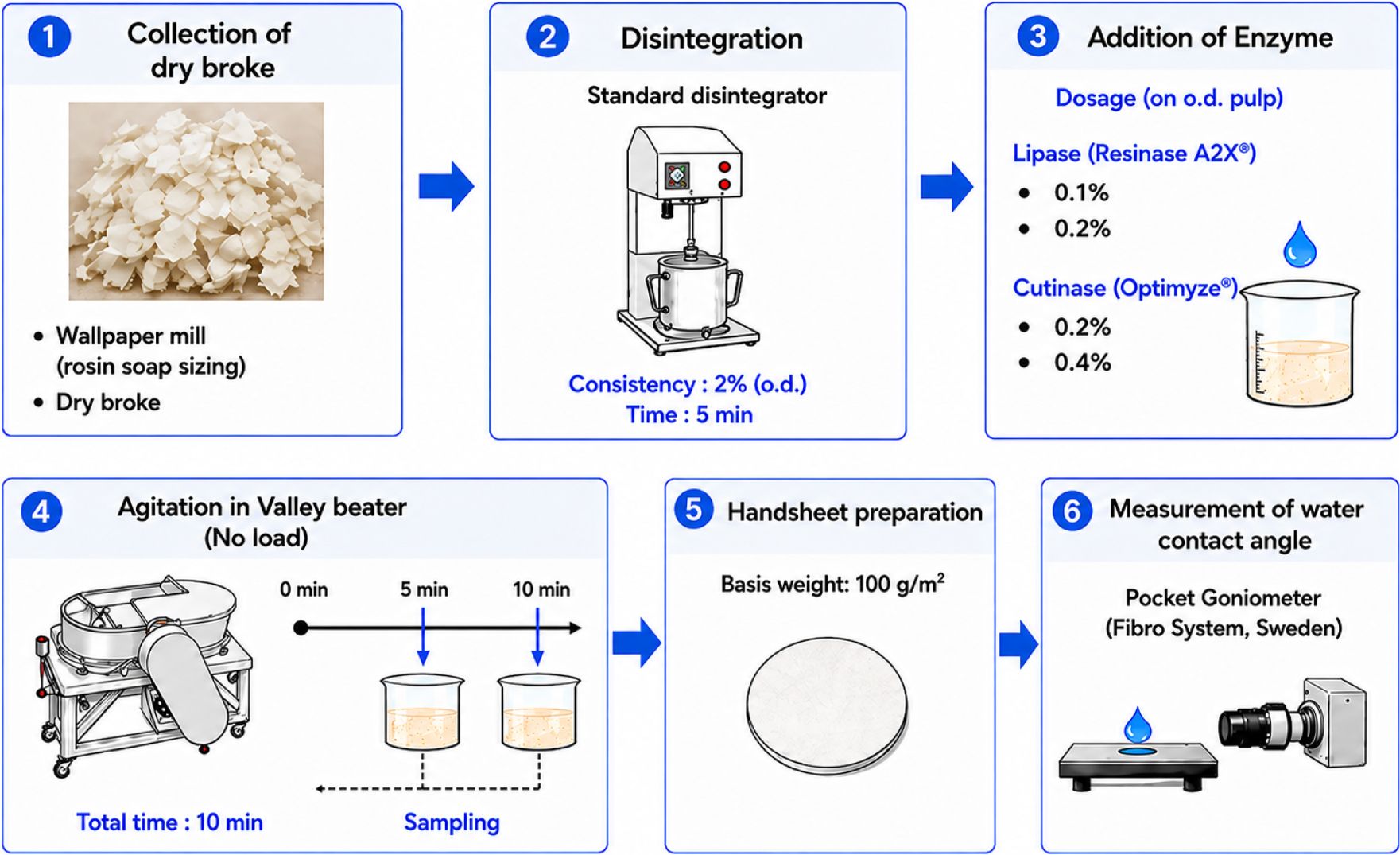
Because rosin sizing agents impart hydrophobicity to fiber surfaces, their enzymatic hydrolysis was expected to reduce surface hydrophobicity and thereby increase fiber hydrophilicity. Therefore, the extent of enzymatic hydrolysis was indirectly evaluated by comparing the water contact angles of handsheets prepared from the enzyme-treated pulps. The water contact angle was measured using a Pocket Goniometer (Fibro System, Sweden).
3. Results and Discussion
3.1 Effect of lipase treatment
Fig. 2 shows the changes in the dynamic water contact angle of recycled handsheets prepared from rosin-sized wallpaper broke at different dosages and treatment times to evaluate the enzymatic hydrolysis of hydrophobic substances by lipase (Resinase A2X®). Hydrolysis of hydrophobic substances, including rosin sizing agents, is expected to increase the hydrophilicity of the recycled handsheets, resulting in a decrease in water contact angle.
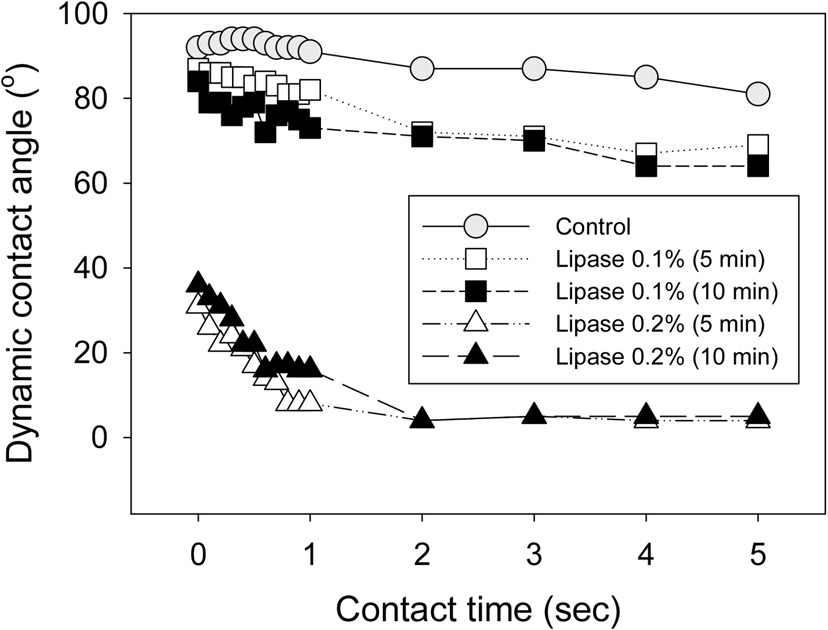
The handsheets prepared without enzyme treatment exhibited an initial water contact angle of approximately 92°, indicating that the recycled handsheets retained considerable hydrophobicity due to the rosin sizing agents present in the wallpaper broke. In addition, little change in water contact angle was observed as the agitation time increased from 5 to 10 min, indicating that prolonged agitation alone had little effect on the hydrophobicity of the untreated handsheets.
In contrast, lipase treatment decreased the water contact angle of the recycled handsheets. In particular, the reduction in water contact angle was substantially greater at a lipase dosage of 0.2% than at 0.1%. The observed decrease in contact angle suggests that lipase treatment increased the hydrophilicity and wettability of the fiber surface by altering or removing hydrophobic rosin-derived components. Therefore, surface hydrophilization of rosin-sized fibers using lipase may provide a potential approach for mitigating press-picking problems associated with the introduction of hydrophobic wallpaper dry broke into the papermaking process.
Increasing the treatment time, however, resulted in only a slight additional decrease in water contact angle at both lipase dosages (0.1% and 0.2%). This suggests that most of the enzymatic modification of the hydrophobic rosin-derived components occurred during the initial stage of treatment. Consequently, treatment time had a limited effect compared with lipase dosage under the present experimental conditions.
3.2 Effect of cutinase treatment
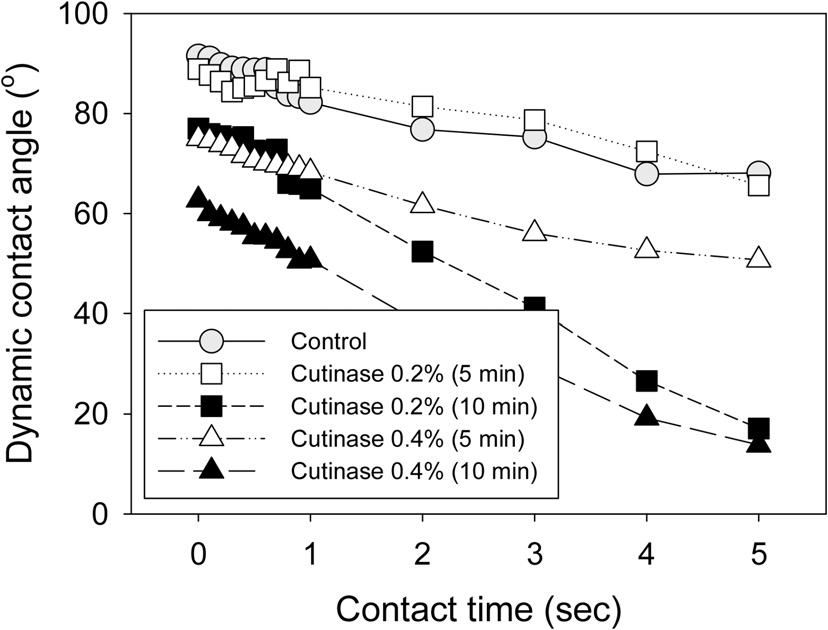
Fig. 3 shows the changes in the dynamic water contact angle of recycled handsheets prepared from rosin-sized wallpaper broke at different dosages and treatment times to evaluate the enzymatic hydrolysis of hydrophobic substances by cutinase (Optimyze®). As shown in Fig. 3, cutinase treatment decreased the water contact angle of the recycled handsheets under all treatment conditions except at a dosage of 0.2% for 5 min, indicating that cutinase, similar to lipase, was capable of hydrolyzing hydrophobic substances present in the wallpaper broke stock. In particular, the water contact angle decreased with increasing cutinase dosage and treatment time, indicating that both dosage and treatment time influenced the enzymatic hydrolysis efficiency of cutinase.
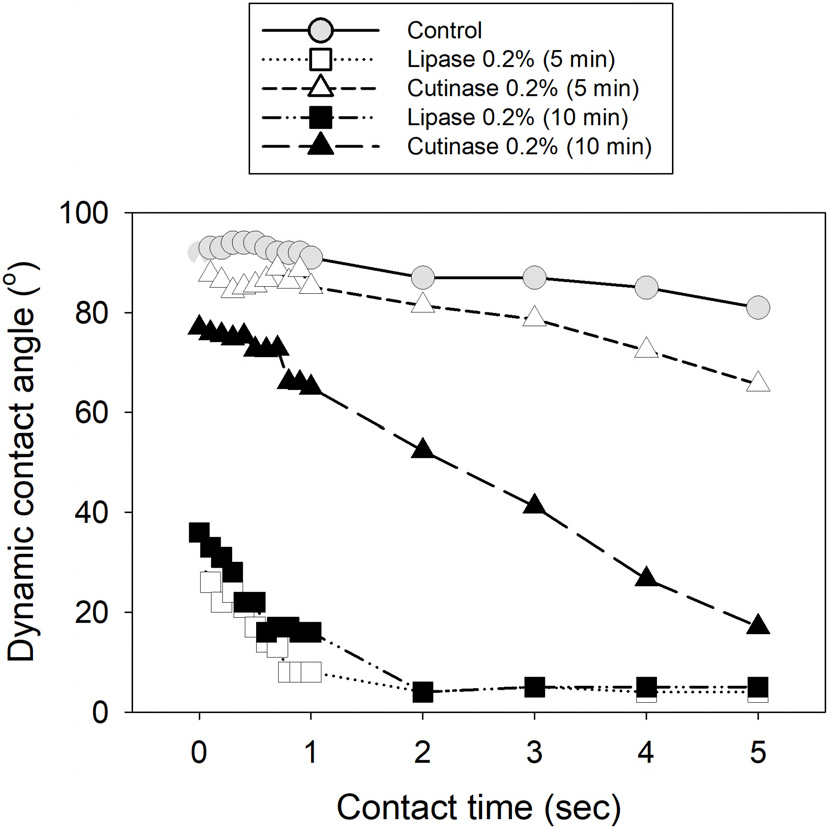
To compare the hydrolysis efficiencies of the two enzymes at the same dosage, the changes in the dynamic water contact angle of recycled handsheets treated with 0.2% lipase or cutinase are shown in Fig. 4. As shown in the figure, the reduction in water contact angle was more pronounced with lipase treatment than with cutinase treatment, indicating that lipase exhibited a higher hydrolysis efficiency toward the hydrophobic substances in the wallpaper broke stock. As described in Section 3.1, the effect of treatment time was limited for lipase, whereas the hydrolysis efficiency of cutinase increased with both increasing dosage and treatment time. These results indicate that lipase and cutinase exhibited different treatment-time dependencies in the enzymatic hydrolysis of hydrophobic substances in rosin-sized wallpaper broke.
3.3 Enzymatic hydrolysis pathway of rosin sizing agents in wallpaper broke (Fig. 5)
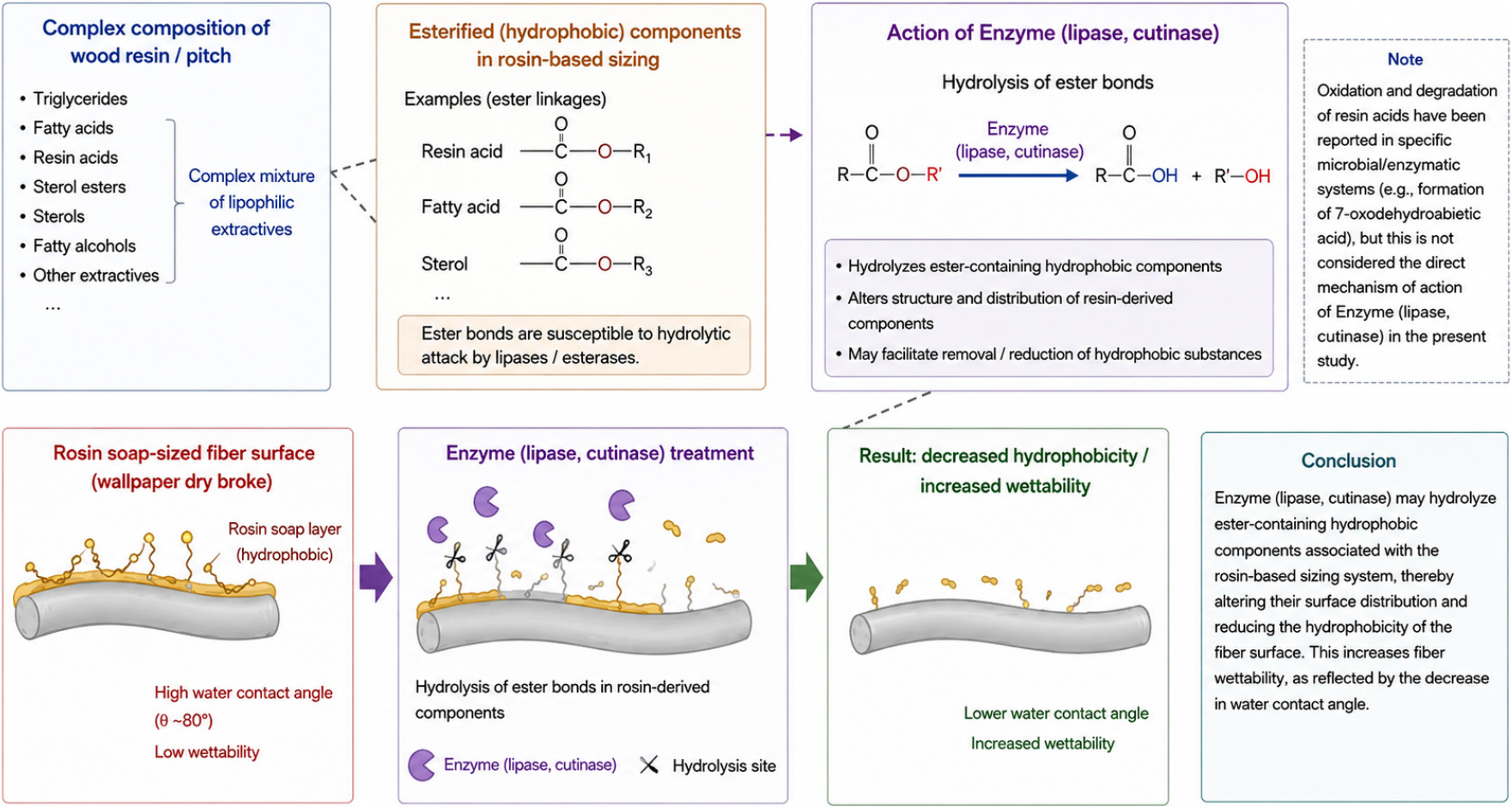
Rosin is obtained from coniferous trees such as pine, and its major constituents are resin acids, including abietic acid, dehydroabietic acid, palustric acid, and pimaric acid. Rosin soap size is prepared by saponifying these resin acids with an alkali such as NaOH, as shown below (Resin acid–COOH + NaOH → Resin acid–COO−Na+ + H2O), and its major components are sodium salts of resin acids, analogous to conventional fatty acid soaps. Resin acids, the major constituents of rosin, are hydrophobic molecules structurally belonging to the terpenoid/diterpenoid family; in particular, abietic acid is a diterpene resin acid containing a three-ring structure [9]. In certain microbial or enzymatic systems, these resin acids can undergo oxidation or other biochemical transformations and may ultimately be degraded. Indeed, previous studies on the microbial degradation of spruce bark have reported substantial decreases in resin acids such as abietic acid and dehydroabietic acid, accompanied by the formation of oxidized intermediates such as 7-oxodehydroabietic acid [10]. However, such oxidation and degradation pathways of resin acids have been reported for specific microbial or enzymatic systems and therefore cannot be considered to represent the direct mechanism of action of enzyme used in the present study. Accordingly, rather than assuming that enzyme directly oxidizes or degrades the terpene structure of resin acids, it is more reasonable to consider that the enzyme may act on ester-containing hydrophobic components present in the rosin-based sizing system, promoting the hydrolysis of ester bonds and thereby altering the structure and distribution of resin-derived hydrophobic components or facilitating their removal. In rosin soap-sized wallpaper dry broke, the presence of rosin soap on the fiber surface renders the surface relatively hydrophobic. When enzyme acts on rosin-derived components, the resulting structural alteration or removal of hydrophobic resin-derived components may reduce fiber-surface hydrophobicity and increase fiber wettability, thereby decreasing the water contact angle. Therefore, the decrease in water contact angle can be interpreted as an indirect indication that enzyme treatment removed rosin-derived hydrophobic substances or altered their surface characteristics.
Wood resin/pitch is not a single substance but a complex mixture of lipophilic extractives, including triglycerides, fatty acids, resin acids, sterol esters, sterols, fatty alcohols, and other extractives. Commercial rosin sizing formulations do not necessarily contain only pure resin acids; depending on the manufacturing process and papermaking formulation, they may also contain various neutral resin components, esterified resin derivatives, fatty acids, and other hydrophobic components [11]. In particular, the ester bonds present in esterified resin derivatives may be susceptible to hydrolytic attack by lipases or esterases. Therefore, when ester-containing hydrophobic components are present in a rosin-based sizing system, their hydrolysis by enzyme may affect the hydrophobicity of the sizing layer and the interactions between the sizing components and cellulose fibers.
The enzymatic treatment may have hydrolyzed ester-containing hydrophobic components associated with the rosin-based sizing system, thereby altering their surface distribution and reducing the hydrophobicity of the fiber surface. This could have increased fiber wettability, as reflected by the decrease in water contact angle.
4. Conclusions
This study confirmed that treatment with lipase and cutinase reduced the hydrophobicity of rosin-sized wallpaper fibers through the hydrolysis of ester-containing components in the sizing layer, with lipase exhibiting substantially greater effectiveness than cutinase. The decrease in water contact angle indicates improved fiber wettability, which may enhance inter-fiber bonding and reduce runnability issues such as press picking during recycling. In particular, lipase markedly reduced the hydrophobicity within a short treatment time of 5 min, suggesting rapid hydrolysis of rosin-derived hydrophobic substances. Unlike alkaline treatment, which may disrupt papermaking chemistry, lipase treatment offers a selective and environmentally friendly approach to improving the repulpability of wallpaper dry broke by mitigating problems caused by sizing-agent-derived stickies during repulping. These results support the feasibility of enzymatic hydrophilization as a practical strategy for enhancing the recycling efficiency and sustainability of wallpaper production.